Freshly Printed - allow 7 days lead
Couldn't load pickup availability
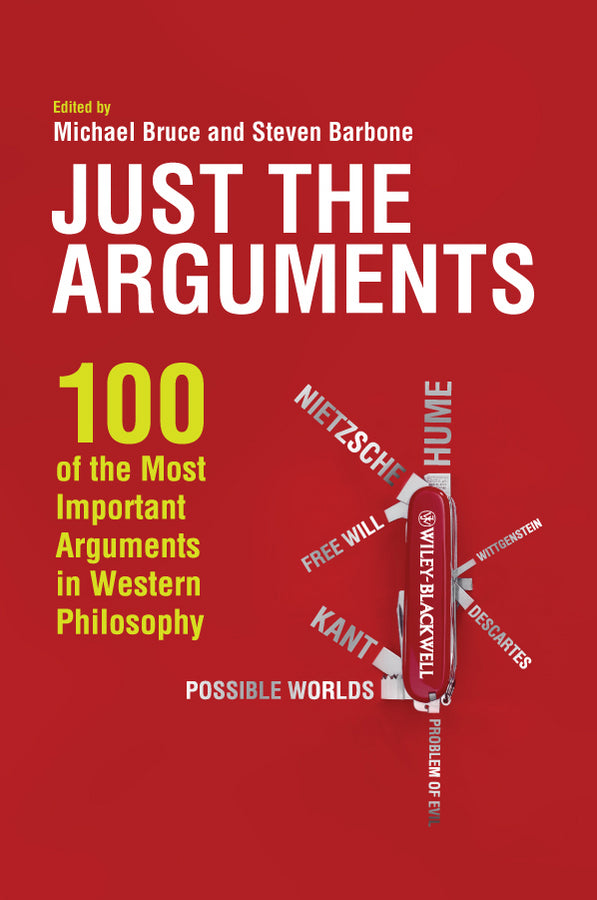
Just the Arguments
100 of the Most Important Arguments in Western Philosophy
Michael Bruce (Edited by), Steven Barbone (Edited by)
9781444336375, Wiley
Hardback, published 30 September 2011
432 pages
23.9 x 16.5 x 2.8 cm, 0.735 kg
“A useful resource for an undergraduate library, this book also would be suitable for undergraduate courses, particularly introduction to philosophy, logic, and critical thinking. Summing Up: Highly recommended. Lower-level undergraduates and general readers.” (Choice, 1 September 2012)
Does the existence of evil call into doubt the existence of God? Show me the argument. Philosophy starts with questions, but attempts at answers are just as important, and these answers require reasoned argument. Cutting through dense philosophical prose, 100 famous and influential arguments are presented in their essence, with premises, conclusions and logical form plainly identified. Key quotations provide a sense of style and approach. Just the Arguments is an invaluable one-stop argument shop.
Acknowledgments xiv Introduction: Show Me the Arguments 1 Part I Philosophy of Religion 7 1 Aquinas’ Five Ways 9 2 The Contingency Cosmological Argument 18 3 The Kalam Argument for the Existence of God 22 4 The Ontological Argument 25 5 Pascal’s Wager 28 6 James’ Will to Believe Argument 32 7 The Problem of Evil 35 8 The Free Will Defense to the Problem of Evil 37 9 St. Anselm on Free Choice and the Power to Sin 40 10 Hume’s Argument against Miracles 44 11 The Euthyphro Dilemma 49 12 Nietzsche’s Death of God 52 13 Ockham’s Razor 57 Part II Metaphysics 59 14 Parmenides’ Refutation of Change 61 15 McTaggart’s Argument against the Reality of Time 64 16 Berkeley’s Master Argument for Idealism 68 17 Kant’s Refutation of Idealism 70 18 The Master Argument of Diodorus Cronus 73 19 Lewis’ Argument for Possible Worlds 76 20 A Reductionist Account of Personal Identity 79 21 Split-Case Arguments about Personal Identity 86 22 The Ship of Theseus 88 23 The Problem of Temporary Intrinsics 90 24 A Modern Modal Argument for the Soul 93 25 Two Arguments for the Harmlessness of Death 99 Epicurus’ Death is Nothing to Us Argument 99 Lucretius’ Symmetry Argument 100 26 The Existence of Forms: Plato’s Argument from the Possibility of Knowledge 102 27 Plato, Aristotle, and the Third Man Argument 106 28 Logical Monism 111 29 The Maximality Paradox 115 30 An Argument for Free Will 119 31 Frankfurt’s Refutation of the Principle of Alternative Possibilities 121 32 Van Inwagen’s Consequence Argument against Compatibilism 123 33 Fatalism 125 34 Sartre’s Argument for Freedom 128 Part III Epistemology 131 35 The Cogito Arguments of Descartes and Augustine 133 Descartes’ Cogito 133 Augustine’s “Si fallor, sum” Argument (If I Am Mistaken, I Exist) 135 36 The Cartesian Dreaming Argument for External-World Skepticism 137 37 The Transparency of Experience Argument 142 38 The Regress Argument for Skepticism 146 39 Moore’s Anti-Skeptical Arguments 152 40 The Bias Paradox 154 41 Gettier’s Argument against the Traditional Account of Knowledge 156 42 Putnam’s Argument against Cultural Imperialism 159 43 Davidson on the Very Idea of a Conceptual Scheme 162 44 Quine’s Two Dogmas of Empiricism 169 45 Hume and the Problem of Induction 174 Hume’s Problem of Induction 174 Hume’s Negative Argument concerning Induction 176 46 Argument by Analogy in Thales and Anaximenes 180 47 Quine’s Epistemology Naturalized 183 48 Sellars and the Myth of the Given 188 49 Sellars’ “Rylean Myth” 193 50 Aristotle and the Argument to End All Arguments 198 Part IV Ethics 201 51 Justice Brings Happiness in Plato’s Republic 203 52 Aristotle’s Function Argument 208 53 Aristotle’s Argument that Goods are Irreducible 211 54 Aristotle’s Argument for Perfectionism 214 55 Categorical Imperative as the Source for Morality 217 56 Kant on Why Autonomy Deserves Respect 221 57 Mill’s Proof of Utilitarianism 223 58 The Experience Machine Objection to Hedonism 229 59 The Error Theory Argument 232 60 Moore’s Open Question Argument 237 61 Wolff’s Argument for the Rejection of State Authority 240 62 Nozick’s Taxation Is Forced Labor Argument 242 63 Charity is Obligatory 244 64 The Repugnant Conclusion 247 65 Taurek on Numbers Don’t Count 249 66 Parfit’s Leveling Down Argument against Egalitarianism 251 67 Nozick’s Wilt Chamberlain Argument 254 68 Liberal Feminism 258 69 Moral Status of Animals from Marginal Cases 263 70 The Ethical Vegetarianism Argument 265 71 Thomson and the Famous Violinist 269 72 Marquis and the Immorality of Abortion 273 73 Tooley on Abortion and Infanticide 275 74 Rachels on Euthanasia 277 Part V Philosophy of Mind 281 75 Leibniz’ Argument for Innate Ideas 283 76 Descartes’ Arguments for the Mind–Body Distinction 290 77 Princess Elisabeth and the Mind–Body Problem 297 78 Kripke’s Argument for Mind–Body Property Dualism 301 79 The Argument from Mental Causation for Physicalism 304 80 Davidson’s Argument for Anomalous Monism 308 81 Putnam’s Multiple Realization Argument against Type-Physicalism 311 82 The Supervenience Argument against Non-Reductive Physicalism 314 83 Ryle’s Argument against Cartesian Internalism 318 84 Jackson’s Knowledge Argument 320 85 Nagel’s “What Is It Like to Be a Bat” Argument against Physicalism 324 86 Chalmer’s Zombie Argument 327 87 The Argument from Revelation 330 88 Searle and the Chinese Room Argument 334 Part VI Science and Language 337 89 Sir Karl Popper’s Demarcation Argument 339 90 Kuhn’s Incommensurability Arguments 341 91 Putnam’s No Miracles Argument 344 92 Galileo’s Falling Bodies 346 93 Eliminative Materialism 348 94 Wittgenstein’s Private Language Argument 350 95 Fodor’s Argument for Linguistic Nativism 355 96 Fodor and the Impossibility of Learning 359 97 Quine on the Indeterminacy of Translation 362 98 Davidson’s Argument for the Principle of Charity 367 99 Frege’s Argument for Platonism 370 100 Mathematical Platonism 373 Appendix A: Learning the Logical Lingo 377 Appendix B: Rules of Inference and Replacement 378 Notes on Contributors 380 Index 391
Michael Bruce and Steven Barbone
Timothy J. Pawl
Mark T. Nelson
Harry Lesser
Sara L. Uckelman
Leslie Burkholder
A. T. Fyfe
Michael Bruce and Steven Barbone
Grant Sterling
Julia Hermann
Tommaso Piazza
David Baggett
Tom Grimwood
Grant Sterling
Adrian Bardon
M. Joshua Mozersky
John M. DePoe
Adrian Bardon
Ludger Jansen
David Vander Laan
Fauve Lybaert
Ludger Jansen
Ludger Jansen
Montserrat Bordes
Rafal Urbaniak and Agnieszka Rostalska
Steven Luper
Nicolas Bommarito
Jurgis (George) Brakas
Jurgis (George) Brakas
Luis Estrada-González
Nicola Ciprotti
Gerald Harrison
Gerald Harrison
Grant Sterling
Fernando Migura and Agustin Arrieta
Jeffrey Gordon
Joyce Lazier
Brett Gaul
Stephen Hetherington
Carlos Mario Muñoz-Suárez
Scott Aikin
Matthew Frise
Deborah Heikes
John M. DePoe
Maria Caamaño
George Wrisley
Robert Sinclair
James E. Taylor
Stefanie Rocknak
Giannis Stamatellos
Robert Sinclair
Willem A. deVries
Willem A. deVries
Toni Vogel Carey
Joshua I. Weinstein
Sean McAleer
Jurgis (George) Brakas
Eric J. Silverman
Joyce Lazier
Mark Piper
A. T. Fyfe
Dan Weijers
Robert L. Muhlnickel
Bruno Verbeek
Ben Saunders
Jason Waller
Joakim Sandberg
Joakim Sandberg
Ben Saunders
Ben Saunders
Fabian Wendt
Julinna C. Oxley
Julia Tanner
Robert L. Muhlnickel
Leslie Burkholder
Leslie Burkholder
Ben Saunders
Leslie Burkholder
Byron Kaldis
Dale Jacquette
Jen McWeeny
Dale Jacquette
Amir Horowitz
Amir Horowitz
Amir Horowitz
Andrew Russo
Agustin Arrieta and Fernando Migura
Amir Horowitz
Amy Kind
Amy Kind
Carlos Mario Muñoz-Suárez
Leslie Burkholder
Liz Stillwaggon Swan
Liz Stillwaggon Swan and Michael Bruce
Liz Stillwaggon Swan
Liz Stillwaggon Swan
Charlotte Blease
George Wrisley
Majid Amini
Majid Amini
Robert Sinclair
Maria Caamaño
Ivan Kasa
Nicolas Pain
Subject Areas: Philosophy [HP]