Freshly Printed - allow 10 days lead
Couldn't load pickup availability
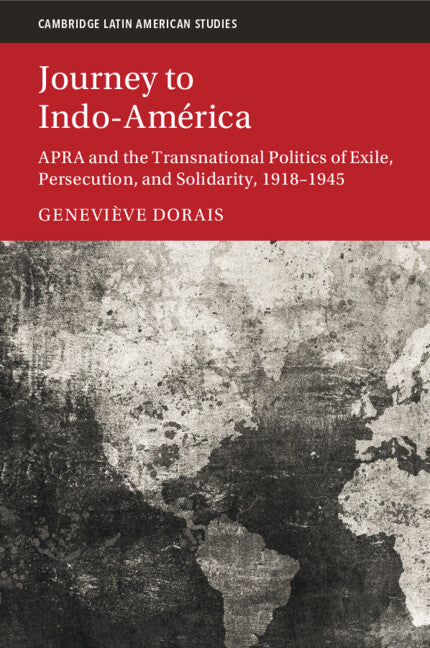
Journey to Indo-América
APRA and the Transnational Politics of Exile, Persecution, and Solidarity, 1918–1945
An examination of how exile and transnational solidarity decisively shaped the formation of a major populist movement in Peru.
Geneviève Dorais (Author)
9781009514484, Cambridge University Press
Paperback / softback, published 29 August 2024
282 pages
23 x 15.3 x 2 cm, 0.476 kg
'Dorais's book is a welcome addition to the most recent scholarship on APRA's transnational dimension. The author convincingly argues that we must take seriously the experience of exile to understand the history of APRA and has modeled an effective methodology for doing so. Hopefully this work will inspire others to pursue similar lines of research to further uncover the intricacies of the transnational networks that stretched throughout the Americas during these crucial decades in world politics.' Inigo Garcıa-Bryce, Hispanic American Historical Review
The American Popular Revolutionary Alliance (APRA) was a Peruvian political party that played an important role in the development of the Latin American left during the first half of the 1900s. In Journey to Indo-América, GenevieÌve Dorais examines how and why the anti-imperialist project of APRA took root outside of Peru as well as how APRA's struggle for political survival in Peru shaped its transnational consciousness. Dorais convincingly argues that APRA's history can only be understood properly within this transnational framework, and through the collective efforts of transnational organization rather than through an exclusive emphasis on political figures like APRA leader, Víctor Raúl Haya de la Torre. Tracing circuits of exile and solidarity through Latin America, the United States, and Europe, Dorais seeks to deepen our appreciation of APRA's ideological production through an exploration of the political context in which its project of hemispheric unity emerged. This title is also available as Open Access on Cambridge Core.
Introduction
1. Crisis and regeneration: Peruvian students and Christian pacifists, 1918–1925
2. Coming of age in exile: Víctor Raúl Haya de la Torre and the genesis of APRA, 1923–1931
3. 'Lo que escribo lo he visto con mis propios ojos': Travels and foreign contacts as regime of authority, 1928–1931
4. Life and freedom for Víctor Raúl Haya de la Torre: Surviving chaos in the Peruvian APRA Party, 1932–1933
5. Transnational solidarity networks in the era of the catacombs, 1933–1939
6. Indo-América looks north: Foreign allies and the inter-American community, 1933–1945
Conclusion.
Subject Areas: Social & cultural history [HBTB], 20th century history: c 1900 to c 2000 [HBLW], History of the Americas [HBJK]