Freshly Printed - allow 7 days lead
Couldn't load pickup availability
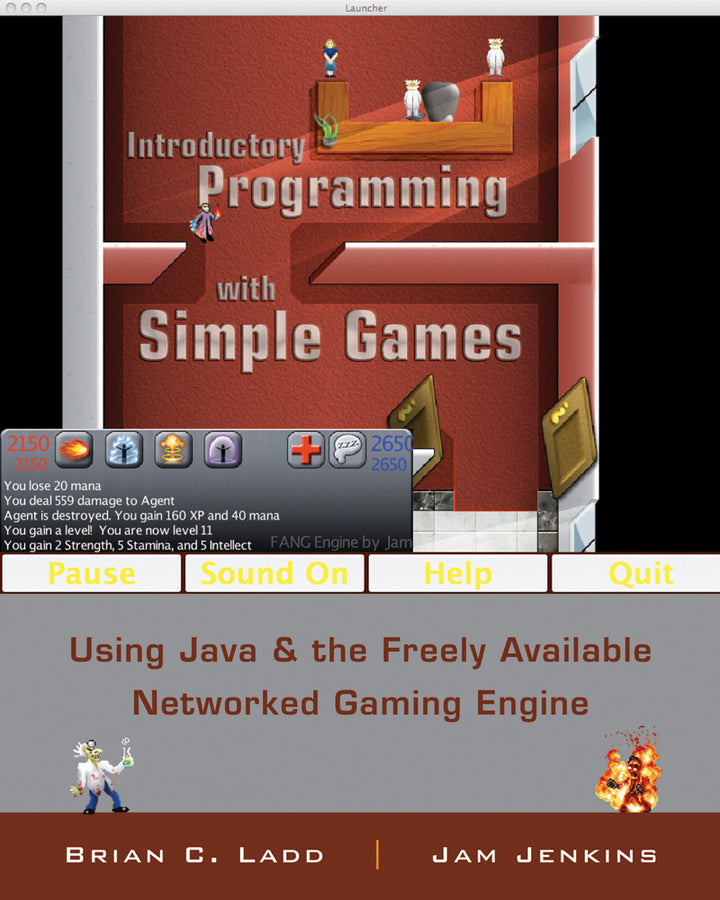
Introductory Programming with Simple Games
Using Java and the Freely Available Networked Game Engine
Brian C. Ladd (Author), Christopher James Jenkins (Author)
9780470212844, Wiley
Paperback / softback, published 28 April 2010
528 pages
25.2 x 19.6 x 1.8 cm, 0.839 kg
This is an excellent resource for programmers who need to learn Java but aren’t interested in just reading about concepts. Introduction to Java Programming with Games follows a spiral approach to introduce concepts and enable them to write game programs as soon as they start. It includes code examples and problems that are easy to understand and motivates them to work through to find the solutions. This game-motivated presentation will help programmers quickly apply what they’ve learned in order to build their skills.
Acknowledgments. Forward. 1 Getting Started: What's in a Game? 1.1 Learning From Simple Computer Games. 1.2 What's In a Game? 1.3 Active and Passive: Rule Followers. 1.4 Running a Game. 1.5 Strategies: Winning a Game. 1.6 What Is in a Computer Program? 1.7 Summary. 1.8 Chapter Review Exercises. 2 Designing Your First Program. 2.1 BasketBall. 2.2 Java. 2.3 Creating Executable Programs. 2.4 Problem Solving. 2.5 FANG. 2.6 Finishing Up BasketBall. 2.7 Summary. 2.8 Chapter Review Exercises. 2.9 Programming Problems. 3 FANG: A Survey of Classes. 3.1 How Computers Work. 3.2 FANG Basics. 3.3 Examining a Public Protocol. 3.4 Summary. 3.5 Chapter Review Exercises. 3.6 Programming Problems. 4 Deciding What Happens: if. 4.1 A Simplest Game. 4.2 Computer Program (Game) Design. 4.3 Sequence. 4.4 Selection. 4.5 Finishing NewtonsApple. 4.6 Summary. 4.7 Chapter Review Exercises. 4.8 Programming Problems. 5 Components: Names, Types, Expressions. 5.1 Chance in Games. 5.2 One More Sprite: CompositeSprite. 5.3 Java Types. 5.4 Calculating with the Computer. 5.5 Naming Things in Java. 5.6 Finishing EasyDice. 5.7 Summary. 5.8 Chapter Review Exercises. 5.9 Programming Problems. 6 Rules: Methods, Parameters, and Design. 6.1 A Simple
Subject Areas: Computer programming / software development [UM]