Freshly Printed - allow 8 days lead
Couldn't load pickup availability
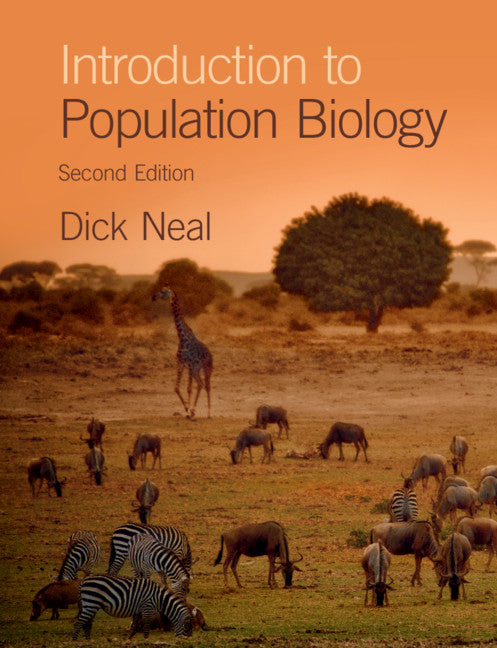
Introduction to Population Biology
Updated to include two new chapters, a modified Part II structure, more recent empirical examples, and online spreadsheet simulations.
Dick Neal (Author)
9781107605121, Cambridge University Press
Paperback / softback, published 29 November 2018
460 pages, 221 b/w illus. 4 maps
24.3 x 18.8 x 2.1 cm, 0.99 kg
'This is by far the best textbook produced so far that combines evolution, ecology and population genetics. A thorough theoretical analysis suitable for advanced-level undergraduates. Fully recommended.' Anthony R. E. Sinclair, University of British Columbia
How do plant and animal populations change genetically to evolve and adapt to their local environments? How do populations grow and interact with one another through competition and predation? How does behaviour influence ecology and evolution? This second edition of Dick Neal's unique textbook on population biology addresses these questions and offers a comprehensive analysis of evolutionary theory in the areas of ecology, population genetics, and behaviour. Taking a quantitative and Darwinian perspective, Neal uses mathematical models to develop the basic theory of population processes. Key features in this edition include new chapters on inbreeding and species interactions and community structure, a modified structure in Part II, more recent empirical examples to illustrate the application of theoretical models to the world around us, and end-of-chapter problems to help students with self-assessment. A series of spreadsheet simulations have also been conveniently located online, for students to further improve their understanding of such models.
Preface
Acknowledgements
Part I. Evolution by Natural Selection: 1. Darwin questions the fixity of species
2. Darwin's evolutionary theories
3. Understanding natural selection
Part II. Population Growth Models: 4. Exponential growth
5. Logistic growth
6. Life tables
7. Growth of age-structured and stage-structured populations
8. Evolution of life histories
Part III. Population Genetics and Evolution
9. The Hardy-Weinberg principle
10. Mutation and the genetic variation of populations
11. Genetic drift and effective population size
12. Inbreeding
13. Migration, gene flow and differentiation of populations
14. Haploid and zygotic selection
15. Applying zygotic selection models to natural systems
16. Polygenic inheritance and quantitative genetics
17. Population genetics: summary and synthesis
Part IV. Interactions between Species, and Community Structure: 18. Interspecific competition
19. Predator-prey interactions
20. Species interactions and community structure
Part V. Animal Behaviour, Altruism, and Sexual Selection: 21. Animal behaviour, altruism, and limiting aggression
22. Sexual selection and mating systems
23. Epilogue
Glossary
Solutions to problems
References
Index.