Freshly Printed - allow 10 days lead
Couldn't load pickup availability
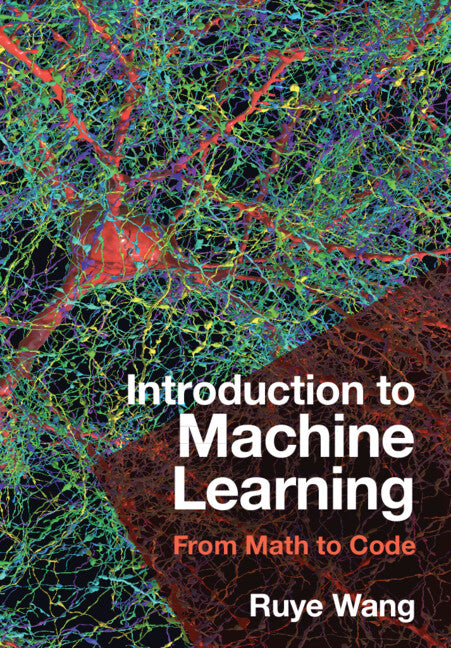
Introduction to Machine Learning
From Math to Code
Explore how and why machine learning algorithms work with this self-contained, hands-on introduction using Matlab and Python.
Ruye Wang (Author)
9781316519509, Cambridge University Press
Hardback, published 18 December 2025
578 pages
26 x 18.5 x 3.5 cm, 1.26 kg
'This is an excellent book for an introduction to machine learning. The chapters are well organized, and the mathematical treatment strikes a thoughtful balance between rigor and accessibility. The examples and problem sets are carefully designed and effectively reinforce the core concepts.' Hom Nath Gharti, Queen's University
Emphasizing how and why machine learning algorithms work, this introductory textbook bridges the gap between the theoretical foundations of machine learning and its practical algorithmic and code-level implementation. Over 85 thorough worked examples, in both Matlab and Python, demonstrate how algorithms are implemented and applied whilst illustrating the end result. Over 75 end-of-chapter problems empower students to develop their own code to implement these algorithms, equipping them with hands-on experience. Matlab coding examples demonstrate how a mathematical idea is converted from equations to code, and provide a jumping off point for students, supported by in-depth coverage of essential mathematics including multivariable calculus, linear algebra, probability and statistics, numerical methods, and optimization. Accompanied online by instructor lecture slides, downloadable Python code and additional appendices, this is an excellent introduction to machine learning for senior undergraduate and graduate students in Engineering and Computer Science.
Part I. Mathematical Foundations: 1. Solving Equations
2. Unconstrained Optimization
3. Constrained Optimization
Part II. Regression: 4. Bias-Variance Tradeoff and Overfitting vs Underfitting
5. Linear Regression
6. Nonlinear Regression
7. Logistic and Softmax Regression
8. Gaussian Process Regression and Classification
Part III. Feature Extraction: 9. Feature Selection
10. Principal Component Analysis
11. Variations of PCA
12. Independent Component Analysis
Part IV. Classification: 13. Statistic Classification
14. Support Vector machine
15. Clustering Analysis
16. Hierarchical Classifiers
17. Biologically Inspired Networks
18. Perceptron-Based Networks
19. Competition-Based Networks
Part VI. Reinforcement Learning: 20. Introduction to Reinforcement Learning
Part VII. Large Language Models: 21. Large Language Models
Appendix A. A Review of Linear Algebra
Appendix B. A Review of Probability and Statistics.
Subject Areas: Communications engineering / telecommunications [TJK]