Freshly Printed - allow 10 days lead
Couldn't load pickup availability
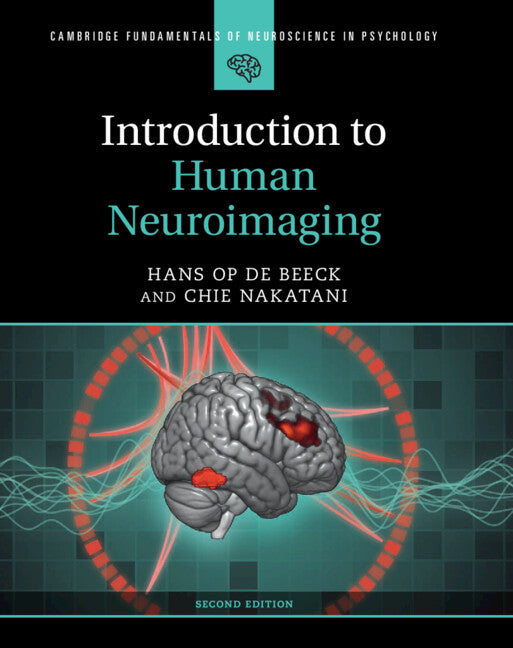
Introduction to Human Neuroimaging
An in-depth description of the major human neuroimaging methods in one textbook that can be mastered in a single course.
Hans Op de Beeck (Author), Chie Nakatani (Author)
9781009349901, Cambridge University Press
Hardback, published 16 October 2025
450 pages
26.1 x 20.6 x 2.5 cm, 1.13 kg
Developed specifically for students in the behavioral and brain sciences, this textbook provides a practical overview of human neuroimaging. The fully updated second edition covers all major methods including functional and structural magnetic resonance imaging, positron emission tomography, electroencephalography, magnetoencephalography, multimodal imaging, and brain stimulation methods. Two new chapters have been added covering computational imaging as well as a discussion of the potential and limitations of neuroimaging in research. Experimental design, image processing, and statistical inference are addressed, with chapters for both basic and more advanced data analyses. Key concepts are illustrated through research studies on the relationship between brain and behavior, and review questions are included throughout to test knowledge and aid self-study. Combining wide coverage with detail, this is an essential text for advanced undergraduate and graduate students in psychology, neuroscience, and cognitive science programs taking introductory courses on human neuroimaging.
1. Introduction and overview
Part I. Structural Neuroimaging: 2. The physics behind magnetic resonance imaging (MRI)
3. Structural imaging methods
Part II. Hemodynamic Neuroimaging: 4. Hemodynamic imaging methods: 5. Designing a hemodynamic imaging experiment
6. Image processing
7. Basic statistical analyses
8. Advanced statistical analyses
Part III. Electrophysiological Neuroimaging: 9. Electromagnetic field of the brain
10. Electroencephalography and magnetoencephalography
11. Basic analysis of electrophysiological signals
12. Advanced data analysis
Part IV. Complementary Methods: 13. Multi-modal imaging
14. Causal methods to modulate brain activity
15. Computational neuroimaging
16. Conclusion.
Subject Areas: Cognition & cognitive psychology [JMR]