Freshly Printed - allow 7 days lead
Couldn't load pickup availability
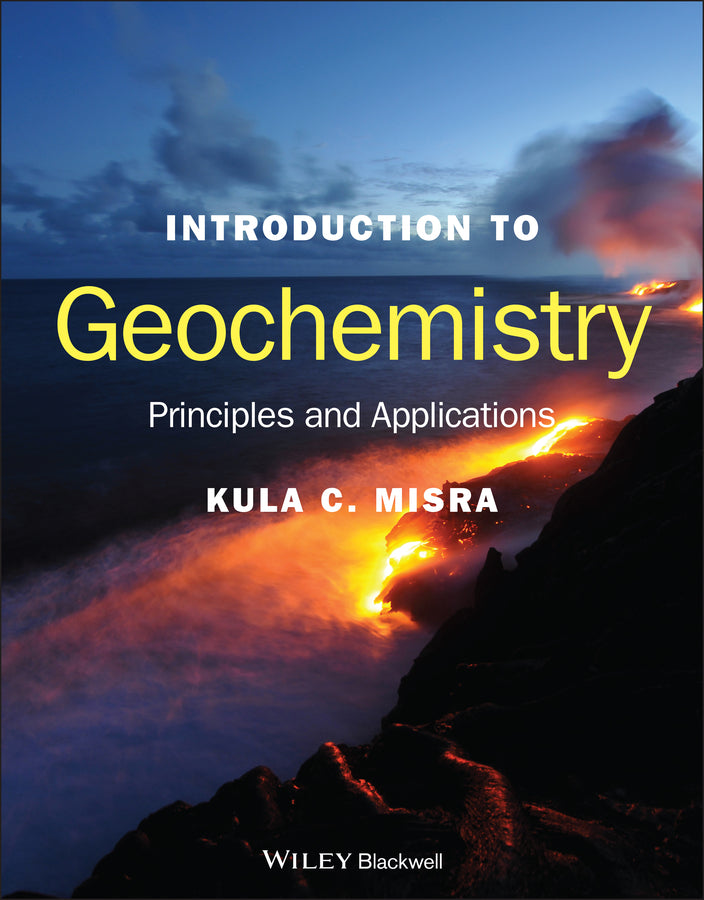
Introduction to Geochemistry
Principles and Applications
Kula C. Misra (Author)
9781405121422, Wiley
Paperback / softback, published 13 April 2012
464 pages
27.7 x 22.1 x 2.2 cm, 1.288 kg
“This is a good book to study if you want to build your understanding of geochemistry on a solid quantitative footing.” (Open University Geological Society Journal, 1 May 2013) “Summing Up: Recommended. Graduate students and above.” (Choice, 1 January 2013) “Overall this is an impressively thorough and up-to-date text that is aimed at the ‘geological’ geochemist and I would certainly recommend it to such an audience.” (Geological Magazine, 2012)
INTRODUCTION TO Geochemistry This book is intended to serve as a text for an introductory course in geochemistry for undergraduate/ graduate students with at least an elementary-level background in earth sciences, chemistry, and mathematics. The text, containing 83 tables and 181 figures, covers a wide variety of topics – ranging from atomic structure to chemical and isotopic equilibria to modern biogeochemical cycles – which are divided into four interrelated parts: Crystal Chemistry; Chemical Reactions (and biochemical reactions involving bacteria); Isotope Geochemistry (radiogenic and stable isotopes); and The Earth Supersystem, which includes discussions pertinent to the evolution of the solid Earth, the atmosphere, and the hydrosphere. In keeping with the modern trend in the field of geochemistry, the book emphasizes computational techniques by developing appropriate mathematical relations, solving a variety of problems to illustrate application of the mathematical relations, and leaving a set of questions at the end of each chapter to be solved by students. However, so as not to interrupt the flow of the text, involved chemical concepts and mathematical derivations are separated in the form of boxes. Supplementary materials are packaged into ten appendixes that include a standard-state (298.15 K, 1 bar) thermodynamic data table and a listing of answers to selected chapter-end questions.
Preface xiii 1 Introduction 1 Part I Crystal Chemistry 7 2 Atomic Structure 9 3 Chemical Bonding 23 Part II Chemical Reactions 49 4 Basic Thermodynamic Concepts 51 5 Thermodynamics of Solutions 79 6 Geothermometry and Geobarometry 107 7 Reactions Involving Aqueous Solutions 134 8 Oxidation–Reduction Reactions 167 9 Kinetics of Chemical Reactions 197 Part III Isotope Geochemistry 223 10 Radiogenic Isotopes 225 11 Stable Isotopes 253 Part IV The Earth Supersystem 281 12 The Core–Mantle–Crust System 283 13 The Crust–Hydrosphere–Atmosphere System 326 Appendix 1 Units of measurement and physical constants 372 Appendix 2 Electronic configurations of elements in ground state 374 Appendix 3 First ionization potential, electron affinity, electronegativity (Pauling scale), and coordination numbers of selected elements 377 Appendix 4 Thermodynamic symbols 379 Appendix 5 Standard state (298.15 K, 105 Pa) thermodynamic data for selected elements, ionic species, and compounds 382 Appendix 6 Fugacities of H2O and CO2 in the range 0.5–10.0 kbar and 200–1000°C 396 Appendix 7 Equations for activity coefficients in multicomponent regular solid solutions 398 Appendix 8 Some commonly used computer codes for modeling of geochemical processes in aqueous solutions 400 Appendix 9 Solar system abundances of the elements in units of number of atoms per 106 silicon atoms 402 Appendix 10 Answers to selected chapter–end questions 403 References 406 Index 431
Subject Areas: Earth sciences [RB]