Freshly Printed - allow 7 days lead
Couldn't load pickup availability
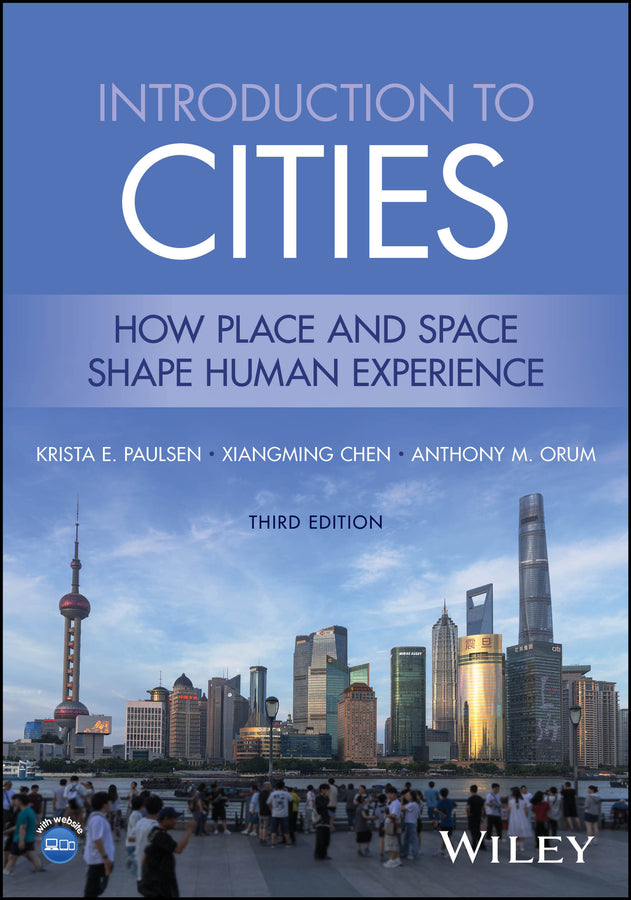
Introduction to Cities
How Place and Space Shape Human Experience
Krista E. Paulsen (Author), Xiangming Chen (Author), Anthony M. Orum (Author)
9781394272044, Wiley
Paperback / softback, published 7 May 2026
416 pages
25.2 x 17.8 x 2.5 cm, 0.839 kg
Understanding how cities shape human life through space and place Cities function as dynamic systems where physical space, social forces, and human experience intersect. Introduction to Cities: How Place and Space Shape Human Experience, Third Edition, provides a robust analytical framework for understanding these relationships. Written by three distinguished urban scholars, this updated edition addresses contemporary challenges including global migration patterns, housing crises, and post-pandemic urban transformation. This book features new chapters on housing and neighborhoods, migration, and the post-pandemic city. Fresh perspectives examine how cities in China, India, and emerging economies respond to regional corridorization and shifting global connectivities. Throughout, Planning and Building the City boxes link chapter themes to urban planning processes, while Making the City Better boxes address practical solutions to urban issues. Readers will also find: Designed for undergraduate and graduate courses in urban sociology, urban studies, and urban planning, this text serves students across sociology, political science, geography, and American studies. Scholars examining cities from varied disciplinary perspectives will find Introduction to Cities an authoritative foundation for urban research and analysis.
Preface ix List of Illustrations x List of Tables xvii List of Boxes xviii About the Authors xix Acknowledgements xx About the Companion Website xxii Part I Foundations 1 1 Cities as places and spaces 2 Cities as places 6 Box 1.1 Studying the city 7 Identity, community, and security 10 Places as the site of our identity 10 Places as the site of community 11 Places as sites of security 13 Human beings make and remake places 13 Box 1.2 Planning and building the city 16 Place and space 17 Box 1.3 Making the city better 20 Cities shape the fates of human beings 21 Cities reflect changes in the contexts around them 22 2 Social theories of urban space and place: The early perspectives 26 The social and theoretical roots of modern urban theory 27 Box 2.1 Studying the city 29 Early European Theories: Tönnies and Simmel 30 Ferdinand Tönnies: Community and society 30 Box 2.2 Planning and building the city 31 Georg Simmel: The metropolis and mental life 32 The Chicago School of Sociology 34 The city as social space 35 The city as concentric zones 36 Assessing concentric zone theory 38 Human ecology 38 Life in the city as a way of life 40 Box 2.3 Making the city better 42 W.E.B. DuBois and the importance of race in the city 43 Evaluating early social theories of urban life 45 3 Social theories of urban space and place: Contemporary perspectives 49 A break with the past 50 Theoretical descendants of Marx 50 Manuel Castells and the urban question 50 David Harvey: Injustice and inequality in the city 51 Box 3.1 Making the city better 52 John Logan and Harvey Molotch: The city as a growth machine 54 Further reflections: Marx and the critique of modern cities 55 The return to place and the turn to culture 56 Jane Jacobs and the discovery of community in the modern metropolis 56 Box 3.2 Studying the city 57 Sharon Zukin and the turn to culture and consumption 59 From spaces of production to spaces of consumption 61 Going global 63 The rise of the global city and its metamorphosis 63 Box 3.3 Planning and building the city 65 A turn to the Global South and East 67 Evaluating theories of the city 68 4 Methods and rules for the study of cities 73 Validity and reliability in the study of cities 74 Box 4.1 Studying the city 77 Cities and the question of numbers 78 The city as a case study 79 The city as a stereotypical or prototypical case 80 Ethnographic and historical case studies 84 Box 4.2 Studying the city 85 Urban analytics 87 Box 4.3 Studying the city 90 From one to multiple cases 91 Theory, methods, and insights 92 Part II The Development of Urban Spaces and Places 97 5 Cities as dynamic spaces 98 Cities as dynamic spaces 99 Remaking the metropolis 99 Planning and metropolitan development 102 Box 5.1 Planning and building the city 105 Toward a postindustrial metropolis 106 Deindustrialization and urban transformation 106 The origins and impacts of global competition 107 The implications of deindustrialization for place and space 109 A changing urban landscape and hierarchy? 110 Los Angeles: The prototype of the postwar metropolis 111 Box 5.2 Studying the city 115 The metropolis’s increasing scale and complexity 116 Infrastructure and technology as new codrivers of city- making 118 Box 5.3 Making the city better 120 Making sense of the changing metropolis 121 6 Housing and neighborhoods 126 Housing and neighborhoods in urban places 127 Housing, home, and neighborhood: Fundamental concepts 127 Housing across time and space 129 Box 6.1 Planning and building cities 129 Housing in the early industrial city 130 Suburban expansion 132 Housing and neighborhoods in context: Policy and markets 136 The politics of housing policies 136 The implications of planning and zoning for housing and neighborhoods 137 Privatization and gated communities 139 Planning, policy, and discrimination in the United States 140 Markets and financial contexts 142 Housing for all: Challenges and solutions 144 Box 6.2 Making the city better 145 Housing instability and homelessness 145 Box 6.3 Studying the city 147 Part III Power and Inequality in Cities 157 7 Difference and inequality in urban places 158 How difference and inequality matter 159 Racial segregation and inequality 159 Box 7.1 Studying the city 161 Origins of segregation in the US 163 Social class and place 165 Social class in the industrial metropolis 165 Gentrification and the remaking of the metropolis 166 New dimensions of gentrification 169 Place and the distribution of opportunity 170 Gender and sexuality in the metropolis 174 Gender and place 174 LGBT+ neighborhoods 175 Box 7.2 Making the city better 176 Difference, inequality, and place 179 Box 7.3 Planning and building the city 180 8 Migration’s impact on cities 187 Migration in context 189 Migration to the United States and Canada 189 Migration to and within Europe 192 China’s unprecedented migration 194 Sociological approaches to cities and migration 196 Immigrant assimilation: The influence of the Chicago School 196 Box 8.1 Studying the city 197 Ethnic enclaves: Places created by and for immigrants 199 Ethnic enclaves across time and place: Case studies 201 Five Points, New York City 202 Pilsen/Little Village, Chicago 204 Baishizhou, Shenzhen 206 Changing immigrant gateways 207 Box 8.2 Planning and building the city 208 Box 8.3 Making the city better 210 Urban migration in a shifting political context 212 9 Power, authority, and conflict in cities 220 The institutional contexts of power and authority 221 States and markets 221 The global economy and neoliberalism 222 Cities today as contested spaces 224 The nature of local governance and politics 225 Box 9.1 Making the city better 226 Local authorities and marginalized peoples 229 Racial minorities and local authorities 230 The homeless and local authorities 231 Box 9.2 Planning and building the city 232 The very poor and local authorities 233 Contesting mistreatment by local authorities 234 Box 9.3 Studying the city 235 Major contests over deep meanings and spaces in the metropolis 237 Jerusalem: The quintessential contested city 237 The contested spaces of Berlin 239 Considering power and space in urban contexts 241 Part IV Cities in a New Era of Globalization 247 10 Urbanization and cities in developing countries 248 Urbanization 249 The basic path of urbanization and its impact on place 249 Developing- country cities in historical perspective 251 Box 10.1 Studying the city 251 The basic dimensions of urbanization 253 Urban hierarchy 253 Urban primacy 254 Over- urbanization versus under- urbanization 255 Natural increase and in- migration 257 From process and system to place 258 A profile with multiple wrinkles 258 Megacities as places: Opportunities and challenges 259 Size and density 259 Creating wealth and sustaining poverty 260 Box 10.2 Making the city better 262 The developing megacity as a lived place 263 Governing the megacities 266 Box 10.3 Planning and building the city 267 Reassessing the developing- country city 268 11 Cities in the global economy 275 Cities in a globalizing world: theoretical background 276 Emerging cities in the global economy 277 Yiwu, China: The world’s central hub for small merchandise 277 Rajarhat, India: A tech city on the metropolitan edge 279 Re- emerging cities in the global economy 280 Hamburg, Germany: Prosperity, challenges, and re- emergence 280 Shanghai: Global rise from local renaissance 283 Deeper and higher into the global economy 285 Dongguan, China: From a rural township into a world factory- city 286 Box 11.1 Studying the city 287 Dubai, United Arab Emirates: From a desert outpost to an urban miracle 289 Cities in a networked and fragmented global economy 290 The regional dimension and reconfiguration of cities 291 The (re)emergence of regional- urban corridors 292 City differentiation in a changing world 294 Box 11.2 Planning and building the city 295 Individual flexibility under systematic constraint 296 The new regional corridorization of cities 297 Box 11.3 Making the city better 298 Part V Changes and Challenges for Resilient Cities 305 12 Cities in a rapidly changing climate 306 Cities and the natural environment 307 Cities’ reliance on nature 307 Risk, hazard, and disaster 309 Challenges and inequities in urban environments 311 Resources and pollution 311 Box 12.1 Studying the city 312 Inequitable distributions of risks 314 Box 12.2 Making the city better 315 Cities in a changing climate 319 Cities’ contributions to climate change 320 The changing profile of disaster 320 Climate adaptation and mitigation 323 Rebuilding vulnerable cities 324 Box 12.3 Planning and building the city 325 Sustainability, resilience, and a “just transition” 327 13 The post- pandemic city 336 Why revisit the pandemic? 337 The pandemic as an urban crisis 337 Wuhan: The original epicenter 340 Box 13.1 Making the city better 342 New York City: Ground Zero, again 343 Economic implications 345 Implications for urban space and infrastructure 346 Changes and challenges in gathering 346 The remote work revolution 348 Box 13.2 Studying the city 350 Lingering implications of new work and social patterns 352 Implications for small and midsized cities 354 Fleeing the city 354 The increasing appeal of midsized cities 355 Box 13.3 Planning and building the city 356 Looking ahead and planning for resilience 358 Glossary 368 Index 376
Subject Areas: Sociology & anthropology [JH]