Freshly Printed - allow 7 days lead
Couldn't load pickup availability
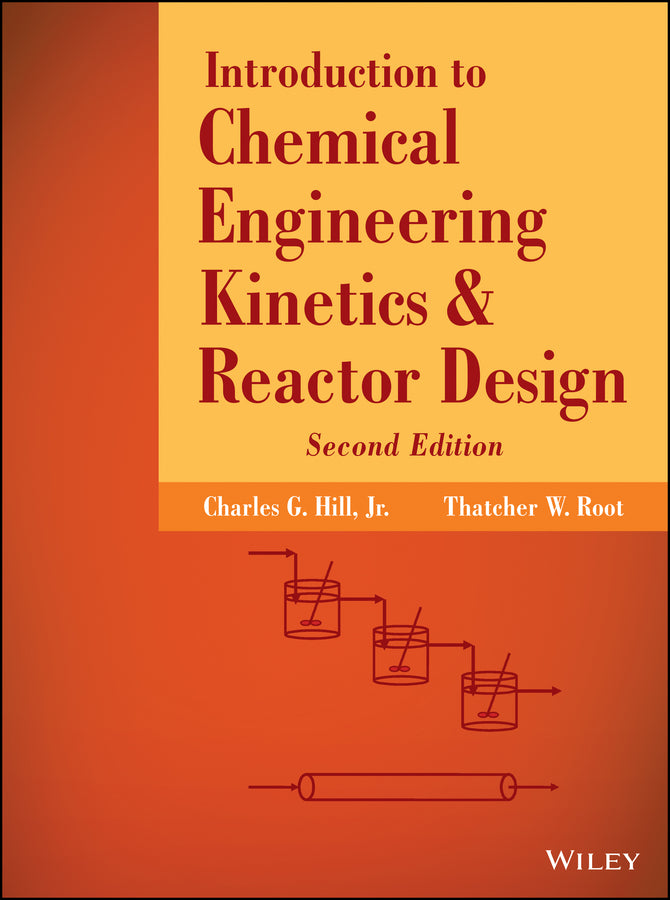
Introduction to Chemical Engineering Kinetics and Reactor Design
Charles G. Hill (Author), Thatcher W. Root (Author)
9781118368251, Wiley
Hardback, published 23 May 2014
576 pages
28.2 x 21.8 x 3.6 cm, 1.52 kg
The Second Edition features new problems that engage readers in contemporary reactor design Highly praised by instructors, students, and chemical engineers, Introduction to Chemical Engineering Kinetics & Reactor Design has been extensively revised and updated in this Second Edition. The text continues to offer a solid background in chemical reaction kinetics as well as in material and energy balances, preparing readers with the foundation necessary for success in the design of chemical reactors. Moreover, it reflects not only the basic engineering science, but also the mathematical tools used by today's engineers to solve problems associated with the design of chemical reactors. Introduction to Chemical Engineering Kinetics & Reactor Design enables readers to progressively build their knowledge and skills by applying the laws of conservation of mass and energy to increasingly more difficult challenges in reactor design. The first one-third of the text emphasizes general principles of chemical reaction kinetics, setting the stage for the subsequent treatment of reactors intended to carry out homogeneous reactions, heterogeneous catalytic reactions, and biochemical transformations. Topics include: About 70% of the problems in this Second Edition are new. These problems, frequently based on articles culled from the research literature, help readers develop a solid understanding of the material. Many of these new problems also offer readers opportunities to use current software applications such as Mathcad and MATLAB. By enabling readers to progressively build and apply their knowledge, the Second Edition of Introduction to Chemical Engineering Kinetics & Reactor Design remains a premier text for students in chemical engineering and a valuable resource for practicing engineers.
Preface ix Preface to the First Edition xi 1. Stoichiometric Coefficients and Reaction Progress Variables 1 1.0 Introduction 1 1.1 Basic Stoichiometric Concepts 2 Literature Citation 3 2. Thermodynamics of Chemical Reactions 4 2.0 Introduction 4 2.1 Chemical Potentials and Standard States 4 2.2 Energy Effects Associated with Chemical Reactions 5 2.3 Sources of Thermochemical Data 7 2.4 The Equilibrium Constant and its Relation to ΔG0 7 2.5 Effects of Temperature and Pressure Changes on the Equilibrium Constant 8 2.6 Determination of Equilibrium Compositions 9 2.7 Effects of Reaction Conditions on Equilibrium Yields 11 2.8 Heterogeneous Reactions 12 2.9 Equilibrium Treatment of Simultaneous Reactions 12 2.10 Supplementary Reading References 15 Literature Citations 15 Problems 15 3. Basic Concepts in Chemical Kinetics: Determination of the Reaction Rate Expression 22 3.0 Introduction 22 3.1 Mathematical Characterization of Simple Reaction Systems 25 3.2 Experimental Aspects of Kinetic Studies 29 3.3 Techniques for the Interpretation of Kinetic Data 34 Literature Citations 53 Problems 54 4. Basic Concepts in Chemical Kinetics: Molecular Interpretations of Kinetic Phenomena 72 4.0 Introduction 72 4.1 Reaction Mechanisms 73 4.2 Chain Reactions 83 4.3 Molecular Theories of Chemical Kinetics 93 Literature Citations 103 Problems 104 5. Chemical Systems Involving Multiple Reactions 117 5.0 Introduction 117 5.1 Reversible Reactions 117 5.2 Parallel or Competitive Reactions 125 5.3 Series or Consecutive Reactions: Irreversible Series Reactions 133 5.4 Complex Reactions 137 Literature Citations 142 Problems 142 6. Elements of Heterogeneous Catalysis 152 6.0 Introduction 152 6.1 Adsorption Phenomena 153 6.2 Adsorption Isotherms 156 6.3 Reaction Rate Expressions for Heterogeneous Catalytic Reactions 160 6.4 Physical Characterization of Heterogeneous Catalysts 170 6.5 Catalyst Preparation, Fabrication, and Activation 174 6.6 Poisoning and Deactivation of Catalysts 177 Literature Citations 178 Problems 179 7. Liquid Phase Reactions 189 7.0 Introduction 189 7.1 Electrostatic Effects in Liquid Solution 191 7.2 Pressure Effects on Reactions in Liquid Solution 192 7.3 Homogeneous Catalysis in Liquid Solution 193 7.4 Correlation Methods for Kinetic Data: Linear Free Energy Relations 202 Literature Citations 207 Problems 207 8. Basic Concepts in Reactor Design and Ideal Reactor Models 216 8.0 Introduction 216 8.1 Design Analysis for Batch Reactors 225 8.2 Design of Tubular Reactors 228 8.3 Continuous Flow Stirred-Tank Reactors 234 8.4 Reactor Networks Composed of Combinations of Ideal Continuous Flow Stirred-Tank Reactors and Plug Flow Reactors 254 8.5 Summary of Fundamental Design Relations: Comparison of Isothermal Stirred-Tank and Plug Flow Reactors 256 8.6 Semibatch or Semiflow Reactors 256 Literature Citations 259 Problems 259 9. Selectivity and Optimization Considerations in the Design of Isothermal Reactors 273 9.0 Introduction 273 9.1 Competitive (Parallel) Reactions 274 9.2 Consecutive (Series) Reactions: A →k1→ B →k2→ C →k3→ D 278 9.3 Competitive Consecutive Reactions 283 9.4 Reactor Design for Autocatalytic Reactions 290 Literature Citations 294 Problems 294 10. Temperature and Energy Effects in Chemical Reactors 305 10.0 Introduction 305 10.1 The Energy Balance as Applied to Chemical Reactors 305 10.2 The Ideal Well-Stirred Batch Reactor 307 10.3 The Ideal Continuous Flow Stirred-Tank Reactor 311 10.4 Temperature and Energy Considerations in Tubular Reactors 314 10.5 Autothermal Operation of Reactors 317 10.6 Stable Operating Conditions in Stirred Tank Reactors 320 10.7 Selection of Optimum Reactor Temperature Profiles: Thermodynamic and Selectivity Considerations 324 Literature Citations 327 Problems 328 11. Deviations from Ideal Flow Conditions 337 11.0 Introduction 337 11.1 Residence Time Distribution Functions, F(t) and dF(t) 337 11.2 Conversion Levels in Nonideal Flow Reactors 352 11.3 General Comments and Rules of Thumb 358 Literature Citations 359 Problems 359 12. Reactor Design for Heterogeneous Catalytic Reactions 371 12.0 Introduction 371 12.1 Commercially Significant Types of Heterogeneous Catalytic Reactors 371 12.2 Mass Transport Processes within Porous Catalysts 376 12.3 Diffusion and Reaction in Porous Catalysts 380 12.4 Mass Transfer Between the Bulk Fluid and External Surfaces of Solid Catalysts 406 12.5 Heat Transfer Between the Bulk Fluid and External Surfaces of Solid Catalysts 413 12.6 Global Reaction Rates 416 12.7 Design of Fixed Bed Reactors 418 12.8 Design of Fluidized Bed Catalytic Reactors 437 Literature Citations 439 Problems 441 13. Basic and Applied Aspects of Biochemical Transformations and Bioreactors 451 13.0 Introduction 451 13.1 Growth Cycles of Microorganisms: Batch Operation of Bioreactors 452 13.2 Principles and Special Considerations for Bioreactor Design 472 13.3 Commercial Scale Applications of Bioreactors in Chemical and Environmental Engineering 495 Literature Citations 516 Problems 517 Appendix A. Fugacity Coefficient Chart 527 Appendix B. Nomenclature 528 Appendix C. Supplementary References 535 Author Index 537 Subject Index 545
Subject Areas: Chemistry [PN]