Freshly Printed - allow 10 days lead
Couldn't load pickup availability
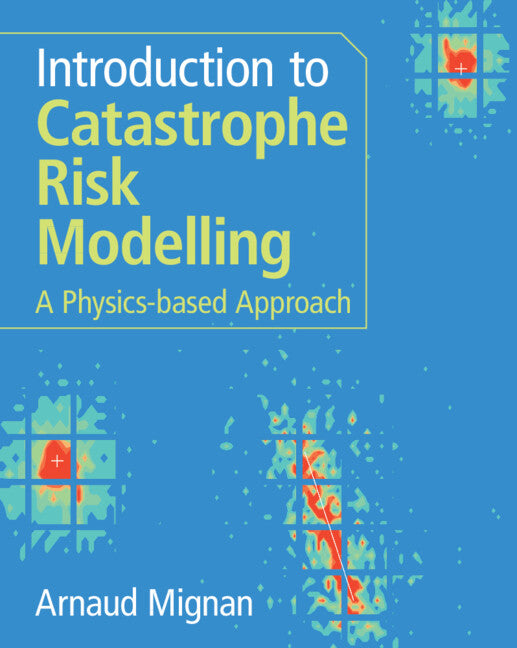
Introduction to Catastrophe Risk Modelling
A Physics-based Approach
Comprehensive textbook on catastrophe risk modelling for grads and advanced undergrads, quantifying dozens of natural and man-made perils.
Arnaud Mignan (Author)
9781009437349, Cambridge University Press
Paperback / softback, published 21 November 2024
368 pages
25.4 x 20.4 x 1.9 cm, 0.9 kg
'This is a great reference, it combines many examples from the classical field of Earth sciences with real world applications. This book can be very useful for researchers and practitioners in the field whereas its physics-based approach makes intuitive for science/engineering students.' Evangelos Moulas, Johannes Gutenberg University Mainz
Focusing on the physics of the catastrophe process and addressed directly to advanced students, this innovative textbook quantifies dozens of perils, both natural and man-made, and covers the latest developments in catastrophe modelling. Combining basic statistics, applied physics, natural and environmental sciences, civil engineering, and psychology, the text remains at an introductory level, focusing on fundamental concepts for a comprehensive understanding of catastrophe phenomenology and risk quantification. A broad spectrum of perils are covered, including geophysical, hydrological, meteorological, climatological, biological, extraterrestrial, technological and socio-economic, as well as events caused by domino effects and global warming. Following industry standards, the text provides the necessary tools to develop a CAT model from hazard to loss assessment. Online resources include a CAT risk model starter-kit and a CAT risk modelling 'sandbox' with Python Jupyter tutorial. Every process, described by equations, (pseudo)codes and illustrations, is fully reproducible, allowing students to solidify knowledge through practice.
Foreword
Preface
Acronyms and Symbols
Part I. Basics of CAT Modelling: 1. Overview of catastrophe risks
2. Probabilistic hazard assessment
3. Probabilistic risk assessment
Part II. Advanced CAT Modelling: 4. Dynamic hazard modelling
5. Modelling of cascading effects
Part III. CAT Risk Management: 6. CAT risk management
Reference
Index.
Subject Areas: Environmental science, engineering & technology [TQ]