Freshly Printed - allow 10 days lead
Couldn't load pickup availability
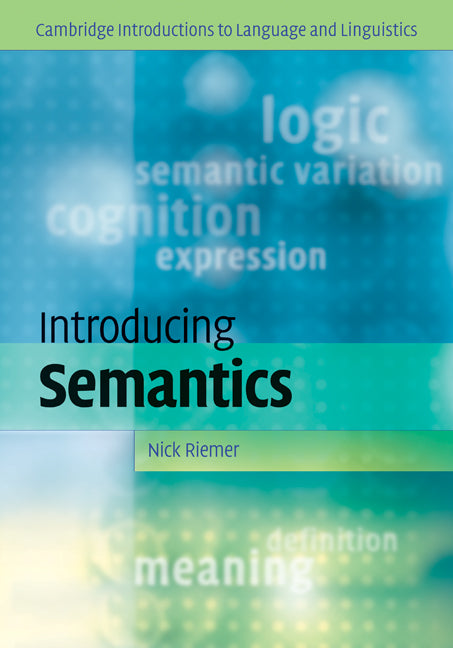
Introducing Semantics
An introduction to the study of meaning in language for undergraduate students.
Nick Riemer (Author)
9780521851923, Cambridge University Press
Hardback, published 25 March 2010
478 pages, 27 b/w illus. 18 tables
25.4 x 18.1 x 2.6 cm, 1.09 kg
'… an excellent introductory textbook for the instruction of meaning in language, presenting complex concepts in a clear but detailed fashion. It remains remarkably neutral without sacrificing rigor, and will be an extremely useful teaching tool given the correct setting.' The Linguist List
Semantics is the study of meaning in language. This clear and comprehensive textbook provides an introduction to the subject for undergraduate students. It not only equips students with the concepts they need in order to understand the main aspects of semantics, it also introduces the styles of reasoning and argument which characterise the field. It contains more than 200 exercises and discussion questions designed to test and deepen readers' understanding. More inclusive than other textbooks, it clearly explains and contrasts different theoretical approaches, summarises current debates, and provides helpful suggestions for further reading. Examples are drawn both from major world languages, such as Mandarin Chinese, Japanese, Arabic, Spanish and English, and from minority ones. The book also highlights the connections between semantics and the wider study of human language in psychology, anthropology, and linguistics itself.
1. Meaning in the empirical study of language
2. Meaning and definition
3. The scope of meaning I: external context
4. The scope of meaning II: interpersonal context
5. Analysing and distinguishing meanings
6. Logic as a representation of meaning
7. Meaning and cognition I: categorisation and cognitive semantics
8. Meaning and cognition II: formalising and simulating conceptual representations
9. Meaning and morphosyntax I: the semantics of grammatical categories
10. Meaning and morphosyntax II: verb meaning and argument structure
11. Semantic variation and change.
Subject Areas: Semantics, discourse analysis, etc [CFG], Sociolinguistics [CFB]