Freshly Printed - allow 10 days lead
Couldn't load pickup availability
Intersectional Advocacy
Redrawing Policy Boundaries Around Gender, Race, and Class
A call to action to redraw policy boundaries until they transform U.S. democracy to be more inclusive, equitable, and just.
Margaret Perez Brower (Author)
9781009433099, Cambridge University Press
Hardback, published 4 January 2024
320 pages
23.5 x 15.5 x 2.3 cm, 0.6 kg
'This book focuses on the Violence against Women Act, which Brower uses to analyze the importance of linking policy issues to better reflect women's lived experiences … The book synthesizes literature that this reviewer is both familiar and unfamiliar with, despite being immersed in the subject, indicating that readers can trust the author's conclusions; she brings a unique perspective to the topic. Overall, this is an excellent book on how public policy can both challenge and reproduce intersecting systems of oppression and a model for how to do intersectional public policy analysis … Highly recommended.' I. Ken, Choice
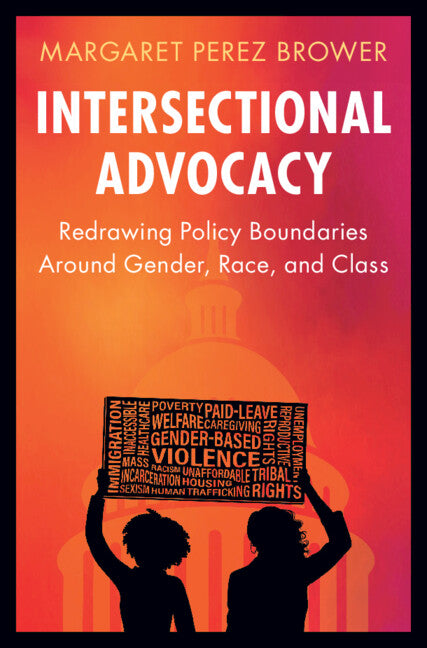
What happens to those living at the margins of US politics and policy – trapped between multiple struggles: gender-based violence, poverty, homelessness, unaffordable healthcare, mass incarceration and immigration? In this book, Margaret Perez Brower offers the concept of 'intersectional advocacy' to reveal how select organizations addressing gender-based violence are closing policy gaps that perpetuate inequalities by gender, race, ethnicity, and class. Intersectional advocacy is a roadmap for rethinking public policy. The book captures how advocacy groups strategically contest, reimagine, and reconfigure policy institutions using comprehensive new strategies that connect issues together. As these groups challenge traditional ways of addressing the most pressing social issues in the US, they uncover deep inequities that are housed within these institutions. Ultimately, organizations practicing intersectional advocacy illuminate how to redraw the boundaries of policies in ways that transform US democracy to be more representative, equitable, and just.
Introduction: movements to end gender-based violence and rethinking feminist advocacy
1. Theory of intersectional advocacy
2. Setting the policy boundaries of the Vawa
3. Reconfiguring the Vawa
4. Policy linkages & organizational strategy
5. Intersectional advocates and organizations
6. Mobilization and intersectional advocacy
Conclusion: the challenges and possibilities ahead
References
Research Appendix: Vawa textual analysis
Research Appendix: Qualitative case studies
Research Appendix: Experimental methods.
Subject Areas: Constitution: government & the state [JPHC]