Freshly Printed - allow 8 days lead
Couldn't load pickup availability
Interpreting the Images of Greek Myths
An Introduction
A concise introduction highlighting theoretical and methodological issues and describing the strategies ancient artists used in order to instruct and persuade.
Klaus Junker (Author), Annemarie Künzl-Snodgrass (Translated by), Anthony Snodgrass (Translated by)
9780521895828, Cambridge University Press
Hardback, published 24 November 2011
240 pages, 48 b/w illus. 1 table
25.4 x 18.2 x 1.7 cm, 0.62 kg
'Junker's work is an excellent tool for myth classes, both for undergraduates and graduates, since he stimulates discussion in his text and gives good suggestions for further reading in the bibliography … [This book] leaves the reader with many thoughts that yield a fresh and well- instructed way to view myths depicted in ancient art.' Eric M. Moormann, Bryn Mawr Classical Review
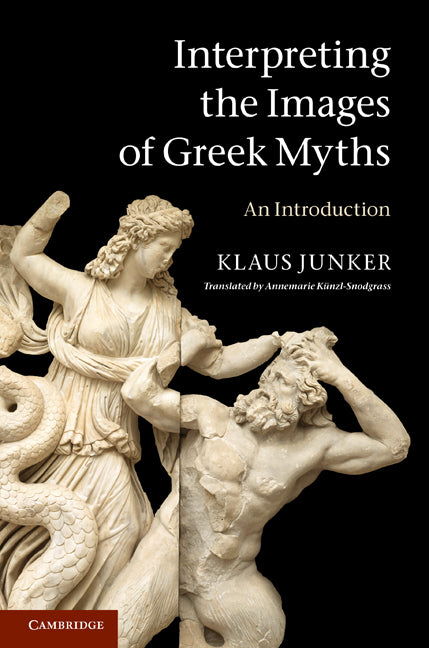
From the age of Homer until late antiquity the culture of ancient Greece and Rome was permeated by images of Greek myths. Gods and heroes were represented as statues, on vase and wall paintings, on temples, on sarcophagi as well as in other media. This 2011 book provides a concise introduction to the interpretation of the images of Greek myths. Its main aim is to make the pictorial versions of the myths comprehensible on their own terms. Ancient artists were well aware of the potential - but also the limitations - of these 'silent' images and of the strategies that made them 'speak' to the audience/viewer. The book explains the theoretical and methodological issues at stake and discusses in detail a number of case studies. It will be useful and stimulating for all undergraduate and graduate students taking courses in classical mythology and ancient art.
1. Achilles and Patroklos in the Trojan War: an introductory case study
2. Definitions: myth and mythological image
3. The production of myths and of mythological images - stages in the historical development
4. Types of monument and fields of function
5. Methods
6. Content and intention.
Subject Areas: Ancient history: to c 500 CE [HBLA], History of art: ancient & classical art,BCE to c 500 CE [ACG]