Freshly Printed - allow 10 days lead
Couldn't load pickup availability
International Law and Governance of Natural Resources in Conflict and Post-Conflict Situations
An assessment of the role of international law in preventing natural resources from fuelling armed conflict and improving their governance.
Daniëlla Dam-de Jong (Author)
9781107474819, Cambridge University Press
Paperback / softback, published 13 December 2018
514 pages
22.9 x 15.1 x 2.8 cm, 0.75 kg
'The purpose of Dam-de Jong's volume goes beyond early efforts to develop a more coherent regulatory framework for the exploitation of natural resources in armed conflict. … In this regard, the book is topical, original, and it fills a gap in the literature. … [Dam-de Jong's] balanced conclusion is the result of a comprehensive, rigorous inquiry that highlights the strengths of the existing international legal framework and practice, as well as its inconsistencies and limitations.' Eliana Cusato, Asian Journal of International Law
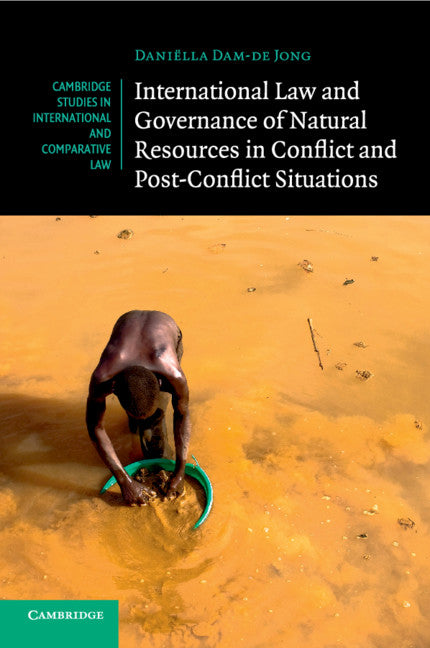
Natural resource wealth is conducive to a country's development. Nevertheless, the last few decades have shown a harsher reality, where natural resources have also triggered, financed or fuelled a number of internal armed conflicts. Examples include the armed conflicts in Cambodia, Sierra Leone, Liberia and the Democratic Republic of the Congo, which have been financed with the exploitation of a variety of valuable natural resources, including diamonds, gold, timber, oil and cocoa. The aim of this book is to assess the contribution of international law in ensuring that natural resources are used to promote development and to achieve sustainable peace instead of financing armed conflict. For this purpose, the author discusses the international legal framework for the governance of natural resources in States in general, in situations of armed conflict and as part of conflict resolution and post-conflict peacebuilding efforts.
1. Introduction
Part I. The Legal Framework for the Governance of Natural Resources in States: 2. Defining the right of peoples and States to freely exploit their natural resources: permanent sovereignty over natural resources
3. A closer look at peoples as subjects and beneficiaries of the principle of permanent sovereignty over natural resources
4. Environmental law obligations relevant for the governance of natural resources
Part II. The Governance of Natural Wealth and Resources in Situations of Armed Conflict: 5. The role of international human rights and environmental law in situations of armed conflict
6. Protection of natural resources and the environment under international humanitarian law
Part III. The Governance of Natural Resources as Part of Conflict Resolution and Post-Conflict Peacebuilding Efforts: 7. The UN Security Council and Resource-related Armed Conflicts
8. Addressing resource-related armed conflicts with informal normative processes
9. The contribution of international law to addressing the challenges ensuing from resource-related armed conflicts.
Subject Areas: International humanitarian law [LBBS], International environmental law [LBBP], Public international law [LBB], Law [L], International relations [JPS]