In Stock - same-working day dispatch
Couldn't load pickup availability
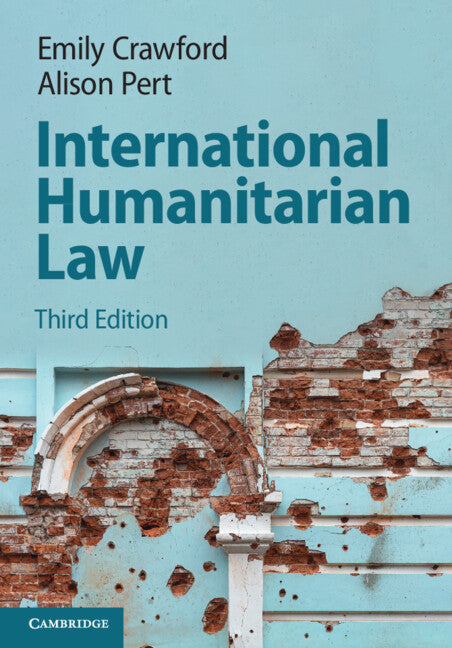
International Humanitarian Law
Now in its third edition, this textbook provides an accessible and up-to-date examination of international humanitarian law, with relevant cases, examples, and discussion questions.
Emily Crawford (Author), Alison Pert (Author)
9781009326728, Cambridge University Press
Paperback / softback, published 9 May 2024
430 pages
24.5 x 16.9 x 2.3 cm, 0.75 kg
'The third edition of International Humanitarian Law by Emily Crawford and Alison Pert offers a well-structured and accessible exploration of the laws governing armed conflict. The authors adeptly intertwine theoretical foundations with contemporary practical examples, enabling students to grasp the application of legal principles in real-world scenarios.' Liv Christiansen, University of Kiel
The law that regulates armed conflicts is one of the oldest branches of international law, and yet continues to be one of the most dynamic and relevant areas of law today. Now in its third edition, this textbook provides an accessible, scholarly, and up-to-date examination of international humanitarian law, offering students and teachers a comprehensive and logical discussion and analysis of the law. The textbook contains detailed examples, extracts from relevant cases, and useful discussion questions and a recommended reading list for each chapter, to help students and teachers alike engage with the subject matter, and grasp how the theory and the practice interact. Developing and emerging trends in theory and practice of international humanitarian law are also explored and examined, allowing for readers to build on their knowledge, and grapple with some of the biggest challenges facing the law of armed conflict in the twenty-first century.
Introduction
1. Historical development of international humanitarian law
2. The contemporary legal basis of international humanitarian law and its fundamental principles
3. Types of armed conflict
4. Individual status in armed conflict – combatants, non-combatants, direct participation in hostilities and prisoners of war, and detention in non-international armed conflicts
5. Protection of the wounded, sick and shipwrecked
6. The protection of civilians and the law of occupation
7. Targeting
8. Means and methods of warfare
9. The interaction between international humanitarian law and international human rights law
10. Implementation, enforcement and accountability
11. Conclusion.
Subject Areas: International humanitarian law [LBBS]