Freshly Printed - allow 7 days lead
Couldn't load pickup availability
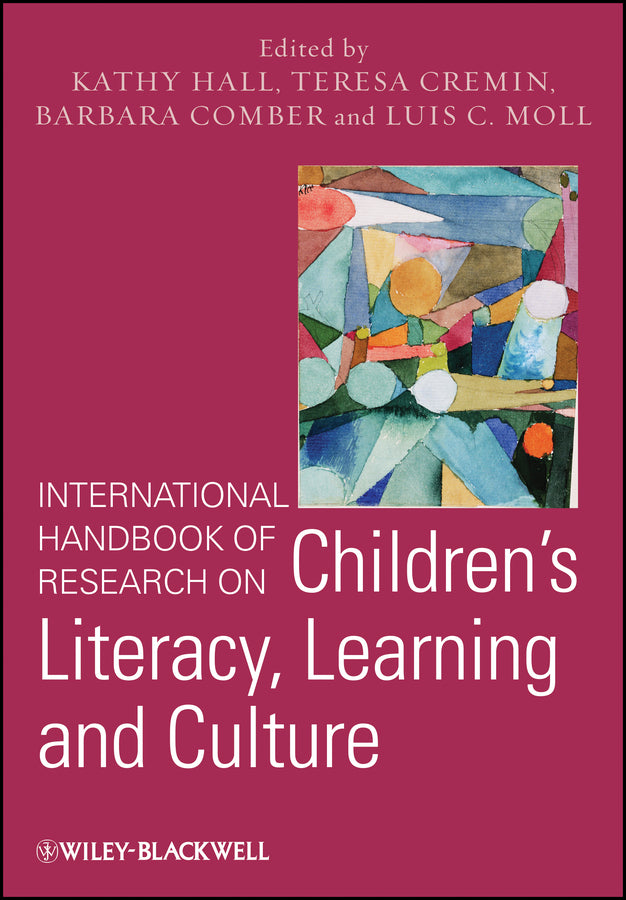
International Handbook of Research on Children's Literacy, Learning and Culture
As literacy teachers, scholars, and researchers, it is truly up to us to define the issues of most importance, talk with each other about them, and advance the field together. The International Handbook of Research on Children’s Literacy, Learning and Culture does just that. Itis the most comprehensive collection of authors who present some of the biggest issues facing us today, leaving room for its readers to advance the field and envision possibilities for tomorrow.—Dawnene D. Hassett, University of Wisconsin-Madison One expects in a handbook of this nature, to find a comprehensive survey of the complex field of literacy around the globe. However, what sets this book apart from others is the undoubted ability of the editors to bring together a diverse group of highly talented scholars pursuing innovative lines of inquiry. The HB thus encapsulates their willingness to be proactive in fostering exciting, innovative directions for the future. All this will ensure that the volume will remain highly topical and current – a real pacesetter in the field for years to come. —Roger Openshaw, Professor and Personal Chair in History of Education,Massey University Institute of Education,New Zealand.
Kathy Hall (Edited by), Teresa Cremin (Edited by), Barbara Comber (Edited by), Luis C. Moll (Edited by)
9780470975978, Wiley
Hardback, published 19 April 2013
584 pages
25.4 x 18 x 3.4 cm, 1.043 kg
The International Handbook of Research in Children's Literacy, Learning and Culture presents an authoritative distillation of current global knowledge related to the field of primary years literacy studies.
Notes on Contributors ix List of Reviewers xxvii Foreword xxix Editors’ Introduction: Literacy, Learning, and Culture xxxvii Part I Society, Culture, and Community 1 Literacies in Homes and Communities 3 2 Critical Multimodal Literacies: Synergistic Options and Opportunities 15 3 Books, Toys, and Tablets: Playing and Learning in the Age of Digital Media 28 4 Literacy Education in the Age of New Media 42 5 Connecting with Parents and the Community in an Urban Primary School: Creative Partnerships to Build Literacy/ies 54 6 At Home and at School: Bridging Literacy for Children from Poor Rural or Marginalized Urban Communities 67 7 Temporality, Trajectory, and Early Literacy Learning 83 8 ‘This is a Job for Hazmat Guy!’: Global Media Cultures and Children’s Everyday Lives 96 9 Literacy as Shared Consciousness: A Neurocultural Analysis 108 10 An Ethnographic Long Look: Language and Literacy Over Time and Space in Alaska Native Communities 121 11 Understanding English Language Learners’ Literacy from a Cultural Lens: An Asian Perspective 139 12 Exploring Multiple Literacies from Homes and Communities: A Cross-cultural Comparative Analysis 155 13 Funds of Knowledge in Changing Communities 172 14 The Hand of Play in Literacy Learning 184 Part II School, Culture, and Pedagogy 15 Building Word and World Knowledge in the Early Years 201 16 The Unfulfilled Pedagogical Promise of the Dialogic in Writing: Intertextual Writing Instruction for Diverse Settings 215 17 Reading Engagement Research: Issues and Challenges 228 18 Opening the Classroom Door to Children’s Literature: A Review of Research 241 19 Writing in Childhood Cultures 258 20 Children’s and Teachers’ Creativity In and Through Language 275 21 Educational Dialogues 291 22 Literacy and Curriculum: Language and Knowledge in the Classroom 304 23 The Digital Challenge 319 24 Digital Literacies in the Primary Classroom 333 25 Developing Online Reading Comprehension: Changes, Challenges, and Consequences 344 26 Hybrid Literacies in a Post-hybrid World: Making a Case for Navigating 359 27 Official Literacy Practices Co-construct Racialized Bodies: Three Key Ideas to Further Integrate Cultural and ‘Racially Literate’ Research 373 28 Emotional Investments and Crises of Truth: Gender, Class, and Literacies 388 29 What Does Human Geography Have To Do With Classrooms? 400 30 Space, Place, and Power: The Spatial Turn in Literacy Research 412 Part III Teachers, Culture, and Identity 31 On Becoming Teachers: Knowing and Believing 427 32 Reforming How We Prepare Teachers to Teach Literacy: Why? What? How? 440 33 Teachers’ Literate Identities 456 34 Constructing a Collective Identity: Professional Development for Twenty-first Century Pedagogy 469 35 Raising Literacy Achievement Levels through Collaborative Professional Development 485 36 Teacher Research on Literacy: Turning Around to Students and Technology 499 Index 515
Kris D. Guti´errez
Kathy Hall, Teresa Cremin, Barbara Comber, and Luis C. Moll
Kate Pahl and Cathy Burnett
Margaret Mackey and Margaret Shane
Helen Nixon and Erica Hateley
Bill Green and Catherine Beavis
Pat Thomson and Johanne Clifton
Celia R. Rosemberg, Alejandra Stein, and Florencia Alam
Catherine Compton-Lilly
Victoria Carrington and Clare Dowdall
Alicia Curtin and Kathy Hall
Perry Gilmore and Leisy Wyman
Guofang Li
Iliana Reyes and Mois´es Esteban-Guitart
Luis C. Moll, Sandra L. Soto-Santiago, and Lisa Schwartz
Shirley Brice Heath
Susan B. Neuman, Ashley M. Pinkham, and Tanya Kaefer
Rebecca Jesson, Judy Parr, and Stuart McNaughton
Sue Ellis and Cassandra S. Coddington
Evelyn Arizpe, Maureen Farrell, and Julie McAdam
Anne Haas Dyson and Sophie Dewayani
Teresa Cremin and Janet Maybin
Karen Littleton and Neil Mercer
Peter Freebody, Eveline Chan, and Georgina Barton
Sandra Schamroth Abrams and Guy Merchant
Rachael Levy, Dylan Yamada-Rice, and Jackie Marsh
Bernadette Dwyer
Elizabeth Birr Moje
Karl Kitching
Stephanie Jones and Kristy Shackelford
Margaret Sheehy
Kathy A. Mills and Barbara Comber
Jennifer I. Hathaway and Victoria J. Risko
Brian Cambourne and Julie Kiggins
Toni Gennrich and Hilary Janks
Catherine M. Weber and Taffy E. Raphael
Eithne Kennedy and Gerry Shiel
Christopher S. Walsh and Barbara Kamler
Subject Areas: Education [JN]