Freshly Printed - allow 7 days lead
Couldn't load pickup availability
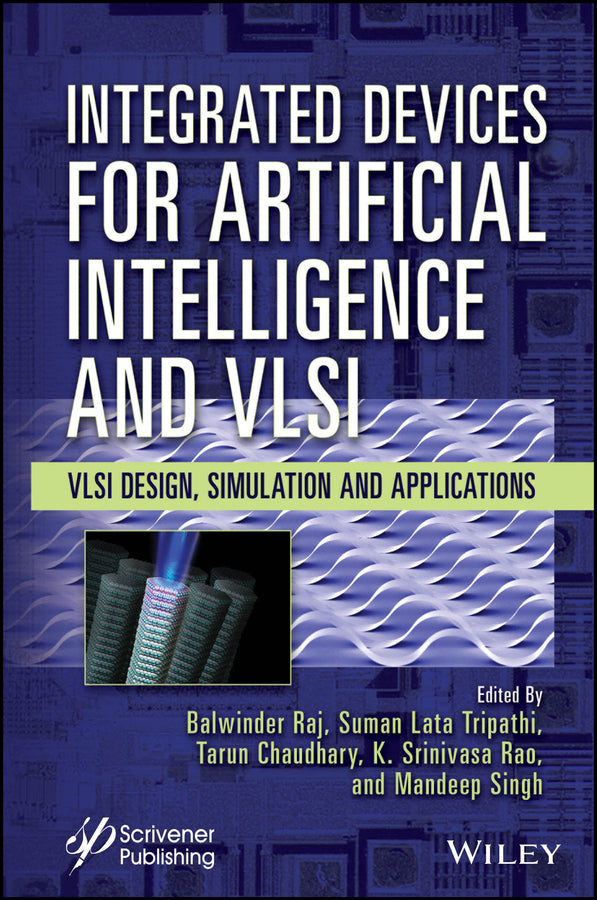
Integrated Devices for Artificial Intelligence and VLSI
VLSI Design, Simulation and Applications
Balwinder Raj (Edited by), Suman Lata Tripathi (Edited by), Tarun Chaudhary (Edited by), K. Srinivasa Rao (Edited by), Mandeep Singh (Edited by)
9781394204359, Wiley
Hardback, published 13 August 2024
384 pages
22.9 x 15.2 x 2.4 cm, 0.771 kg
With its in-depth exploration of the close connection between microelectronics, AI, and VLSI technology, this book offers valuable insights into the cutting-edge techniques and tools used in VLSI design automation, making it an essential resource for anyone seeking to stay ahead in the rapidly evolving field of VLSI design. Very large-scale integration (VLSI) is the inter-disciplinary science of utilizing advanced semiconductor technology to create various functions of computer system. This book addresses the close link of microelectronics and artificial intelligence (AI). By combining VLSI technology, a very powerful computer architecture confinement is possible. To overcome problems at different design stages, researchers introduced artificial intelligent (AI) techniques in VLSI design automation. AI techniques, such as knowledge-based and expert systems, first try to define the problem and then choose the best solution from the domain of possible solutions. These days, several CAD technologies, such as Synopsys and Mentor Graphics, are specifically created to increase the automation of VLSI design. When a task is completed using the appropriate tool, each stage of the task design produces outcomes that are more productive than typical. However, combining all of these tools into a single package offer has drawbacks. We can’t really use every outlook without sacrificing the efficiency and usefulness of our output. The researchers decided to include AI approaches into VLSI design automation in order to get around these obstacles. AI is one of the fastest growing tools in the world of technology and innovation that helps to make computers more reliable and easy to use. Artificial Intelligence in VLSI design has provided high-end and more feasible solutions to the difficulties faced by the VLSI industry. Physical design, RTL design, STA, etc. are some of the most in-demand courses to enter the VLSI industry. These courses help develop a better understanding of the many tools like Synopsis. With each new dawn, artificial intelligence in VLSI design is continually evolving, and new opportunities are being investigated.
Preface xiii 1 Comparative Analysis of MOSFET and FinFET 1 1.1 Introduction 2 1.2 Double Gate 4 1.3 Advantages and Disadvantage of MOSFET 10 1.4 MOSFET Drawbacks 10 1.5 FinFET 10 1.6 SOI-FinFET 11 1.7 Issues with FinFET-Based Technology 12 1.8 Advantage of FinFET 13 1.9 Drawbacks of FinFET 13 1.10 Applications of FinFET Technology 14 1.11 Conclusion 16 2 Nanosheet FET for Future Technology Scaling 25 2.1 Introduction 26 2.2 Device Description and Simulation Parameters 28 2.3 Conclusions 39 3 Comparison of Different TFETs: An Overview 49 3.1 Introduction 49 3.2 Tunnel FET 50 3.3 Gate Engineering 53 3.4 Tunneling-Junction Engineering 59 3.5 Materials Engineering 61 3.6 Conclusion 66 4 GaAs Nanowire Field Effect Transistor 75 4.1 Introduction 75 4.2 Properties of Nanowires 81 4.3 Nanowire-FET 83 4.4 Proposed Work (GaAs Nanowire-FET) 84 4.5 Conclusion 91 5 Graphene Nanoribbon for Future VLSI Applications: A Review 101 5.1 Introduction 102 5.2 Future Applications of Graphene and Graphene-Based FETs 114 6 Ferroelectric Random Access Memory (FeRAM) 125 6.1 Introduction 125 6.2 Structure of Ferroelectric Memory Cells in Capacitor-Type FRAM Devices 131 6.3 Write/Read Operations in the FRAM Using a Capacitor-Type Memory Cell that Resembles a DRAM 132 6.4 Other Capacitor-Type FRAM 135 6.5 FRAM of FET Type 135 6.6 Memory Utilizing a Ferroelectric Tunnel Junction 137 6.7 Cross Point Matrix Array 137 6.8 Ferroelectric Shadow RAMs 138 6.9 2T2C Ferroelectric RAM Architecture 140 6.10 FeRAM vs. EEPROM 145 6.11 FeRAM vs. Static RAM 145 6.12 FeRAM vs. Dynamic RAM 146 6.13 FeRAM vs. Flash Memory 146 6.14 Conclusion and Upcoming Trends 147 7 Applications of AI/ML Algorithms in VLSI Design and Technology 157 7.1 Introduction 157 7.2 Artificial Intelligence and Machine Learning 159 7.3 AI/ML Algorithms 160 7.4 Supervised Machine Learning (SML) 162 7.5 Classification Techniques 163 7.6 K-Nearest Neighbors (KNN) 164 7.7 Support Vector Machine (SVM) 166 7.8 Linearly Separable Classification 167 7.9 Decision Tree Classifier (DTC) 168 7.10 Performance Measures in Classification 170 7.11 Unsupervised Machine Learning (UML) 173 7.12 Hierarchical Clustering 174 7.13 Partitional Clustering 176 7.14 K-Means 176 7.15 Fuzzy (soft) Clustering 177 7.16 Cluster Validation Measures 178 7.17 Internal Clustering Validation Measures 179 7.18 External Clustering Validation Criteria 180 7.19 Limitation and Challenges — VLSI 181 8 Advancement of Neuromorphic Computing Systems with Memristors 193 8.1 Introduction 194 8.2 Summary 206 9 Neuromorphic Computing and Its Application 217 9.1 Introduction 218 9.2 Evolution of Neuroinspired Computing Chips 218 9.3 Science Behind Brain Physics 220 9.4 Limitations of Semiconductor Devices 221 9.5 Various Combination of Networks 225 9.6 Artificial Intelligence 228 9.7 A Summary of Neuromorphic Hardware Methodologies 229 9.8 Neuromorphic Computing in Robotics 231 9.9 Challenges in Neuromorphic Computing 232 9.10 Applications of Neuromorphic Computing 234 9.11 Conclusion 237 10 Performance Evaluation of Prototype Microstrip Patch Antenna Fabrication Using Microwave Dielectric Ceramic Nanocomposite Materials for X-Band Applications 247 10.1 Introduction 248 10.2 Materials and Methods 250 10.3 Results and Discussion 251 10.4 Conclusions 258 11 Build and Deploy a Smart Speaker with Biometric Authentication and Advanced Voice Interaction Capabilities 271 11.1 Introduction 272 11.2 Cybersecurity Risk as Smart Speakers Don't Have an Authentication Process 273 11.3 Related Work 275 11.4 Overview of Biometric Authentication and the Voice Algorithm-Based Smart Speaker 275 11.5 Conclusion and Discussion 283 12 Boron-Based Nanomaterials for Intelligent Drug Delivery Using Computer-Aided Tools 295 12.1 Introduction 296 12.2 Computational Details 297 12.3 Results and Discussion 298 13 Design and Analysis of Rectangular Wave Guide Using an HFSS Simulator 329 13.1 Background 329 13.2 Introduction 331 13.3 Mathematical Computations 333 13.4 Numerical Analysis 336 13.5 Conclusion 344 References 344 Index 355
Mandeep Singh, Tarun Chaudhary, Balwinder Raj, Girish Wadhwa and Suman Lata Tripathi
Aruru Sai Kumar, V. Bharath Sreenivasulu, M. Deekshana, G. Shanthi and K. Srinivasa Rao
Rama Satya, Nageswara Rao and K. Srinivasa Rao
Shailendra Yadav, Mandeep Singh, Tarun Chaudhary, Balwinder Raj, Alok Kumar Shukla and Brajesh Kumar Kaushik
Himanshu Sharma
B. Vimala Reddy, Tarun Chaudhary, Mandeep Singh and Balwinder Raj
Jaswinder Singh and Damanpreet Singh
Jeetendra Singh, Shailendra Singh, Balwant Raj, Vikas Patel and Balwinder Raj
Tejasvini Thakral, Lucky Lamba, Manjeet Singh, Tarun Chaudhary and Mandeep Singh
Srilali Siragam
Gur Sharan Kant and Kavi Bhushan
Jupinder Kaur, Ravinder Kumar and Rajan Vohra
Srilali Siragam
Subject Areas: Electronics & communications engineering [TJ]