Freshly Printed - allow 10 days lead
Couldn't load pickup availability
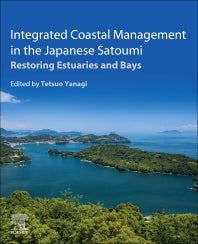
Integrated Coastal Management in the Japanese Satoumi
Restoring Estuaries and Bays
Introduces methods of Integrated Coastal Management in the Japanese Satoumi and explores how these methods can be reflected in other locations
Tetsuo Yanagi (Edited by)
9780128130605
Paperback / softback, published 14 August 2019
250 pages
27.6 x 21.5 x 1.7 cm, 0.7 kg
Integrated Coastal Management in the Japanese Satoumi: Restoring Estuaries and Bays provides an in-depth exploration of the integrated costal management (ICM) used in the Japanese Satoumi. The lessons of Satoumi?coastal areas where biological productivity and biodiversity have increased through human interaction?are important for the rest of the world, given the political consensus reached in Japan to truly restore estuaries and bays. The book will discuss and explain how this method could be modified to apply to other cultures in the world. Integrated Coastal Management in the Japanese Satoumi: Restoring Estuaries and Bays presents chapters from experts in the relevant fields and includes chapters about each study field of the Satoumi, making it a valuable resource for researchers, field practitioners, and policymakers in coastal area management and development. This includes the Shizukawa Bay as an open coastal sea, the Seto Inland Sea as semi-enclosed coastal sea, and the Japan Sea. The book moves on to explore the economic evaluation of ecosystem services, a four-step management system, and the negotiation between marine protected areas and fisheries, and concludes with a full section covering a comparison of ICM with Europe and the United States, and how Japan’s policies could be integrated.
1. Introduction 2. Sustainability of Aquaculture 3. Management of Nutrient Concentration 4. International Environmental Management of the Coastal Sea 5. Environmental Economics, Culture and Negotiation in the Coastal Sea 6. Integrated Numerical Model of the Coastal Area 7. What can we learn from Satoumi to guide international ocean policies? 8. Conclusions
Subject Areas: The environment [RN], Oceanography [seas RBKC], Hydrology & the hydrosphere [RBK]