Special Order - allow 2+ weeks lead
Couldn't load pickup availability
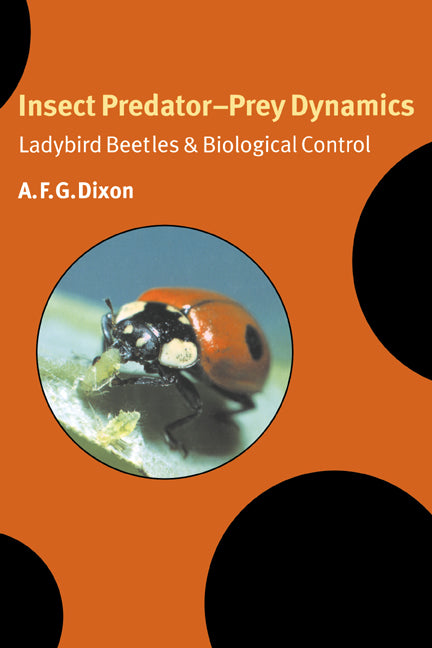
Insect Predator-Prey Dynamics
Ladybird Beetles and Biological Control
Investigates predator-prey dynamics of ladybird beetles, and the implications for biological control.
A. F. G. Dixon (Author)
9780521017701, Cambridge University Press
Paperback / softback, published 21 July 2005
268 pages, 110 b/w illus. 14 tables
22.8 x 15.3 x 1.7 cm, 0.412 kg
'… a really interesting and worthwhile book, which can be recommended to anyone who is concerned with population dynamics, biological control or general insect ecology.' Mark Young, Bulletin of the British Ecological Society
Much of our understanding about insect predator-prey dynamics has been due to studies on insect parasitoids. But do true predators such as ladybird beetles really operate in a similar way and how does this affect their use in biological control? The extensive literature on ladybirds as biocontrol agents shows that their size and rate of development is very dependent on the nature of their prey. This volume explores basic ladybird biology, their association with their prey and its effect on development rate and body size. Optimal foraging theory, field observations and laboratory experiments are used to illustrate how ladybird larvae maximise their rate of energy intake, and ladybird adults their fitness. The interdependence of these life history parameters is then used to develop a simple predator-prey model which, with an analysis of the literature, highlights the specific attributes of potentially successful biocontrol agents for all those interested in predator-prey dynamics.
Preface
1. Introduction
2. Basic biology and structure
3. Body size
4. Slow-fast continuum in life history parameters
5. Foraging behaviour
6. Cannibalism
7. Theory of predator-prey interactions
8. Intraguild predation
9. Biological control
10. Epilogue
11. References
Taxonomic index
Subject index.
Subject Areas: Insects [entomology PSVT7], Animal ecology [PSVS]