Special Order - allow 2+ weeks lead
Couldn't load pickup availability
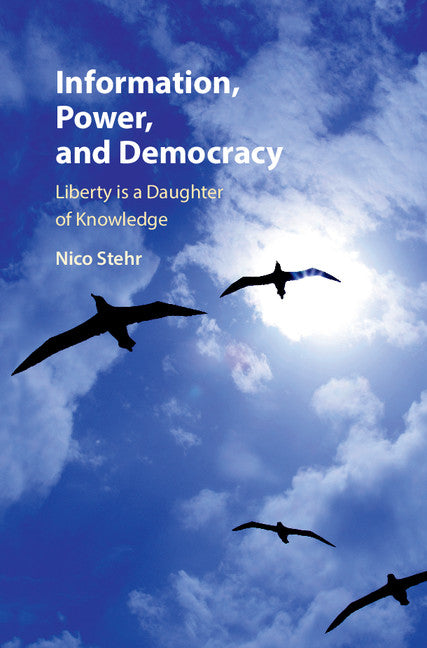
Information, Power, and Democracy
Liberty is a Daughter of Knowledge
The shifting dynamics of knowledge present unique challenges for societies today. This book explores new connections between knowledge and freedom.
Nico Stehr (Author)
9781107120754, Cambridge University Press
Hardback, published 12 November 2015
418 pages, 2 b/w illus. 2 tables
23.6 x 16 x 2.9 cm, 0.76 kg
'Nico Stehr has provided a characteristically subtle and comprehensive account of the role of knowledge in modern democratic societies - but one that goes against the grain of much academic opinion on the topic. Whereas many see the increasing political importance of scientific knowledge as pointing towards an anti-democratic technocracy, Stehr observes the opposite tendency: namely, that the increase in the production - but especially the distribution - of knowledge has the potential to empower the vast majority of people in unprecedented, as well as unexpected, ways.' Steve Fuller, Auguste Comte Chair in Social Epistemology, University of Warwick
The link between liberty and knowledge is neither static nor simple. Until recently the mutual support between knowledge, science, democracy and emancipation was presupposed. Recently, however, the close relationship between democracy and knowledge has been viewed with skepticism. The growing societal reliance on specialized knowledge often appears to actually undermine democracy. Is it that we do not know enough, but that we know too much? What are the implications for the freedom of societies and their citizens? Does knowledge help or heed them in unraveling the complexity of new challenges? This book systematically explores the shifting dynamics of knowledge production and the implications for the conditions and practices of freedom. It considers the growth of knowledge about knowledge and the impact of an evolving media. It argues for a revised understanding of the societal role of knowledge and presents the concept of 'knowledge societies' as a major resource for liberty.
Introduction
1. Coming to terms
2. Accounts of the conditions for the possibility and resilience of liberty
3. The economic order ensures (defeats) liberty
4. Scientia est libertas
5. The knowledge of the powerful
6. The knowledge of the weak
Knowledge and democracy: summary and conclusions.
Subject Areas: Political control & freedoms [JPV], Political structures: democracy [JPHV], Political science & theory [JPA], Sociology [JHB], Social & political philosophy [HPS]