Freshly Printed - allow 7 days lead
Couldn't load pickup availability
INCOSE Needs and Requirements Manual
Needs, Requirements, Verification, Validation Across the Lifecycle
Louis S. Wheatcraft (Author), Michael J. Ryan (Author), Tami Edner Katz (Author), (Edited by)
9781394152742, Wiley
Hardback, published 25 November 2024
528 pages
25.7 x 18.5 x 3.3 cm, 0.93 kg
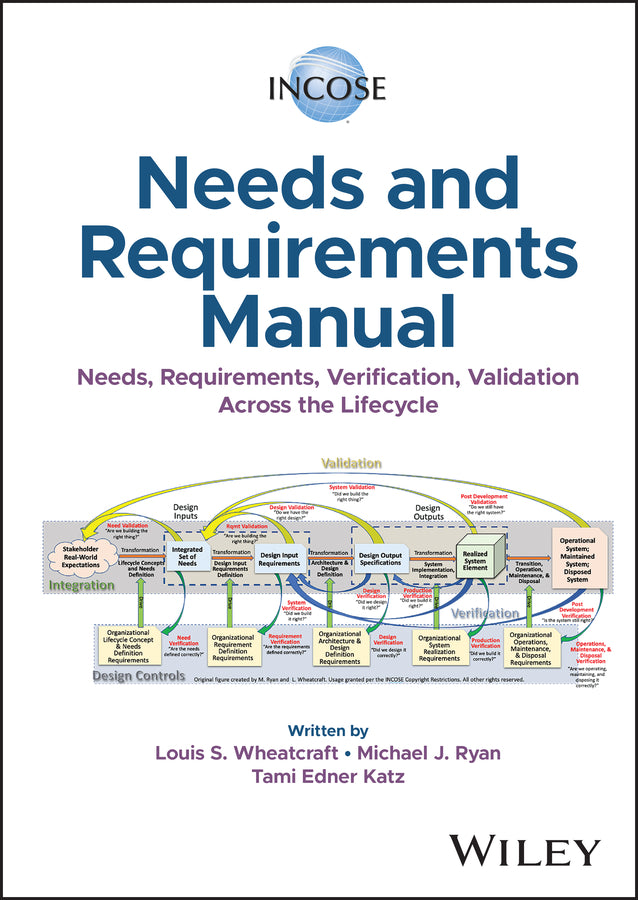
Complete and comprehensive manual for eliciting, defining, and managing needs and requirements, integration, verification, and validation across the lifecycle The INCOSE Needs and Requirements Manual presents product development and systems engineering practices, activities, and artifacts from the perspective of needs, requirements, verification, and validation across the system lifecycle. Composed of 16 chapters, this book provides practical guidance to help organizations understand the importance of lifecycle concepts, needs, requirements, verification, and validation activities, enabling them to successfully and effectively implement these activities during product development, systems engineering, and project management. The parent handbook published by Wiley, INCOSE Systems Engineering Handbook, divides the system lifecycle into a series of processes, with each process described in terms of a series of activities. This Manual provides more detail needed by practitioners to successfully implement these activities, with guidance and lessons learned from hundreds of years of collective experience of the authors, contributors, and reviewers. For example, while the Handbook mentions the need to define the problem statement, mission, goals, and objectives for a system, the Manual provides detailed guidance on doing so. Sample topics covered in the INCOSE Needs and Requirements Manual include: The INCOSE Needs and Requirements Manual is an essential accompanying reference to the INCOSE Systems Engineering Handbook for novice and seasoned system engineers, software engineers, project managers, product developers, tool vendors, course developers, educators, trainers, customers, suppliers, non-SE stakeholders , as well as researchers and students studying systems engineering and systems design.
INCOSE Notices xv Preface xvi Authors xvii Major Contributors xviii Reviewers xix Revision History xx List of Figures xxi List of Tables xxiv 1 Introduction 1 1.1 Purpose 1 1.2 Scope 2 1.3 Audience 3 1.4 Approach 3 1.5 Mapping of NRVV Across Standards 5 1.6 The Five NRVV Activity Areas Discussed in this Manual 7 1.7 Needs and Requirements Manual Organization 8 2 Definitions and Concepts 11 2.1 Ontology used in this Manual 11 2.2 Definitions 16 2.3 Basic Concepts 20 3 Information-Based Needs and Requirement Development and Management 63 3.1 Information-Based Needs and Requirements Definition and Management 64 3.2 Expression of Text-Based Needs and Requirements within RMTS Versus Models and Diagrams 70 4 Lifecycle Concepts and Needs Definition 77 4.1 Introduction 77 4.2 Prepare for Lifecycle Concepts and Needs Definition 81 4.3 Define Inputs to Lifecycle Concepts Analysis and Maturation 82 4.4 Capture Preliminary Integrated Set of Lifecycle Concepts 130 4.5 Lifecycle Concepts Analysis and Maturation 135 4.6 Define and Record the Integrated Set of Needs 162 4.7 Plan for System Validation 176 4.8 Baseline and Manage Lifecycle Concepts and Needs Definition Outputs 177 5 Needs Verification and Validation 179 5.1 Needs Verification 180 5.2 Needs Validation 184 5.3 Manage Needs Verification and Validation Results 186 5.4 Use of Attributes to Manage Needs Verification and Validation 187 6 Design Input Requirements Definition 189 6.1 Prepare for Design Input Requirements Definition 190 6.2 Perform Design Input Requirements Definition 191 6.3 Baseline and Manage Design Input Requirements 252 6.4 Architectural Levels, Flow Down, Allocation, and Budgeting 257 6.5 Summary of Design Input Requirements Definition 275 7 Requirements Verification and Validation 277 7.1 Requirements Verification 278 7.2 Requirements Validation 283 7.3 Manage Requirements Verification and Validation Results 286 7.4 Use of Attributes to Manage Requirements Verification and Validation 286 8 Design Verification and Design Validation 289 8.1 Design Definition Process Overview 290 8.2 Early System Verification and Validation 293 8.3 Updating System Verification and Validation Artifacts 295 8.4 Design Verification 296 8.5 Design Validation 299 8.6 Manage Design Verification and Validation Results 302 8.7 Use of Attributes to Manage Design Verification and Design Validation 303 9 Production Verification 305 9.1 Production Verification Defined 305 9.2 Scalability, Repeatability, and Yield 306 9.3 Production Verification Versus System Verification 307 9.4 Verification and Validation of the Manufacturing System 308 9.5 Special Considerations 308 9.6 Production Verification 310 10 System Verification and Validation Common Principles 311 10.1 Planning Stage 315 10.2 Defining Stage 345 10.3 Execution Stage: Performing the Procedures 352 10.4 Reporting Stage: Documenting the Results 358 10.5 Approval Stage 362 10.6 Use of Attributes to Manage System Verification and Validation Activities 363 10.7 Maintaining the System Verification and Validation Artifacts 364 11 System Verification and System Validation Processes 367 11.1 System Verification and Validation per Level 368 11.2 Managing the Project’s System Verification and Validation Programs 370 11.3 System Verification Activities 371 11.4 System Validation Process 374 12 The Use of OTS System Elements 379 13 Supplier-Developed SOI 385 13.1 Customer/Supplier Relationships 385 13.2 Customer/Supplier Verification Versus Validation Considerations 392 13.3 Addressing the Evolutionary Nature of Interface Definitions 395 14 Needs, Requirements, Verification, and Validation Management 397 14.1 Prepare for Needs, Requirements, Verification, and Validation Management 399 14.2 Perform Needs, Requirements, Verification, and Validation Management 402 15 Attributes for Needs and Requirements 427 15.1 Attributes to Help Define Needs and Requirements and Their Intent 428 15.2 Attributes Associated with System Verification and System Validation 430 15.3 Attributes to Help Manage the Needs and Requirements 432 15.4 Attributes to Show Applicability and Enable Reuse 440 15.5 Attributes to Aid in Product Line Management 441 15.6 Guidance for Using Attributes 442 16 Desirable Features of an SE Toolset 445 16.1 Choosing an Appropriate Toolset 445 16.2 Desirable Features of an SE Toolset 447 Appendix A: References 455 Appendix B: Acronyms and Abbreviations 459 Appendix C: Glossary 465 Appendix D: Comment Form 487 Index 489
Subject Areas: Electronics & communications engineering [TJ]