In Stock - dispatch within 48 hours
Couldn't load pickup availability
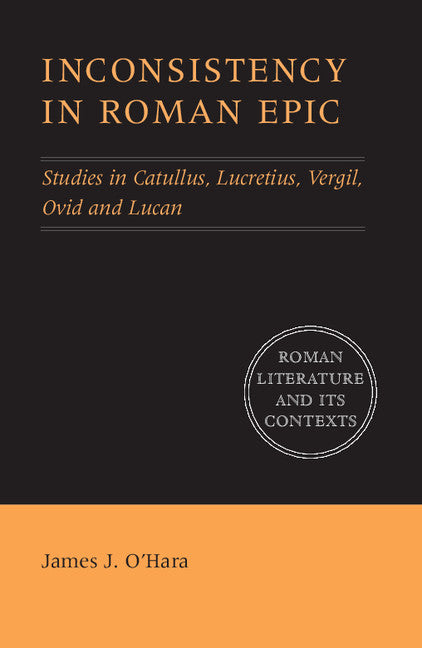
Inconsistency in Roman Epic
Studies in Catullus, Lucretius, Vergil, Ovid and Lucan
Explores the possibility of providing literary interpretations of inconsistencies in five Roman epics.
James J. O'Hara (Author)
9780521641395, Cambridge University Press
Hardback, published 19 April 2007
178 pages
20.6 x 13.5 x 1 cm, 0.304 kg
"The book is written in a clear language which abstains from an artificially complicated vocabulary and convoluted sentences. O'Hara convincingly suggests many reasons why Roman poets chose discrepancies."
Journal of the Classical Association of Canada, Sabine Grebe, University of Guelph
How should we react as readers and as critics when two passages in a literary work contradict one another? Classicists once assumed that all inconsistencies in ancient texts needed to be amended, explained away, or lamented. Building on recent work on both Greek and Roman authors, this book explores the possibility of interpreting inconsistencies in Roman epic. After a chapter surveying Greek background material including Homer, tragedy, Plato and the Alexandrians, five chapters argue that comparative study of the literary use of inconsistencies can shed light on major problems in Catullus' Peleus and Thetis, Lucretius' De Rerum Natura, Vergil's Aeneid, Ovid's Metamorphoses, and Lucan's Bellum Civile. Not all inconsistencies can or should be interpreted thematically, but numerous details in these poems, and some ancient and modern theorists, suggest that we can be better readers if we consider how inconsistencies may be functioning in Greek and Roman texts.
Introduction
1. Greek versions
2. Catullus 64: variants and the virtues of heroes
3. Death, inconsistency and the Epicurean poet
4. Voices, variants and inconsistency in the Aeneid
5. Inconsistency and authority in Ovid's Metamorphoses
6. Postscript: Lucan's Bellum Civile and the inconsistent Roman epic.
Subject Areas: Literary studies: classical, early & medieval [DSBB]