Special Order - allow 2+ weeks lead
Couldn't load pickup availability
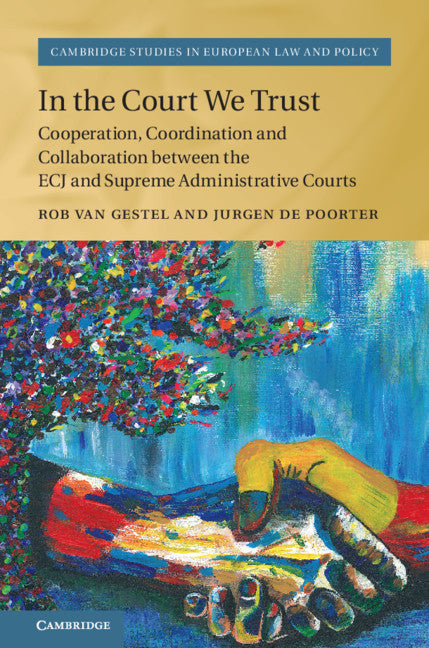
In the Court We Trust
Cooperation, Coordination and Collaboration between the ECJ and Supreme Administrative Courts
Explains the lack of dialogue between the CJEU and Supreme Administrative Courts, offering scenarios for fruitful co-actorship between them.
Rob van Gestel (Author), Jurgen de Poorter (Author)
9781108481274, Cambridge University Press
Hardback, published 19 December 2019
256 pages, 4 b/w illus. 4 colour illus.
23.5 x 15.7 x 1.7 cm, 0.48 kg
'Rob van Gestel and Jurgen de Poorter get to the bottom of the buzzword 'Judicial Dialogue', empirically and theoretically. With verve and enthusiasm, they meticulously analyse the existing and non-existent interaction between national and European courts. They describe the judicial reality of the European Union, which reflects all the open questions about the future direction of European integration. It is so easy to write: this book is a 'must-read'. For once, and now, it is true. In the Court We Trust will immediately become a standard work. It is not only an extremely successful but also a necessary work on the role and function of the Judicial Dialogue, addressed to lawyers, judges, politicians.' Hans-Wolfgang Micklitz, European University Institute, Florence
The preliminary reference procedure has long been envisaged as a judicial dialogue between the European Court of Justice and national courts. However, in reality the relationship appears to be closer to one of growing separation rather than to a happy marriage between equal partners. This book tries to find out: what is behind this? A study of the existing literature, combined with a case law analysis and interviews with judges, has shown that there are a number of important stumble blocks hindering the communication between these courts, such as language barriers, time constraints, and a failing digital infrastructure. However, on a deeper level there also appears to be a lack of mutual trust that prevents Supreme Administrative Courts from using the possibilities the procedure provides, such as the opportunity to offer provisional answers to the Court of Justice and the use of requests for clarification by the latter.
1. Why don't we talk?
2. Dialogue as a concept
3. Case law analysis
4. Results from the interviews
5. Trust and dialogue
6. Conclusion and future scenarios.
Subject Areas: Constitutional & administrative law [LND], International law [LB], Comparative law [LAM], Jurisprudence & general issues [LA], Law [L], Public administration [JPP], Political science & theory [JPA], Politics & government [JP]