Freshly Printed - allow 7 days lead
Couldn't load pickup availability
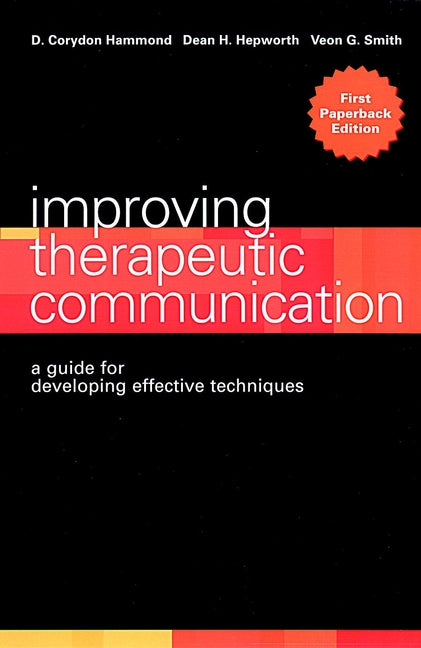
Improving Therapeutic Communication
A Guide for Developing Effective Techniques
D. Corydon Hammond (Author), Dean H. Hepworth (Author), Veon G. Smith (Author)
9780787948061, Wiley
Paperback / softback, published 18 April 2002
400 pages
23.2 x 15.3 x 2.7 cm, 0.533 kg
"Contains a great wealth of clinical information." (PsychiatricServices, April 2003)
Throughout the book, the authors focus on the basic skills thatfacilitate communications in therapy (empathy, respect,authenticity, relating in the here-and-now, and confrontation) andexplore specific methods of using them. These skills--whichresearch shows are crucial to effective therapy--enable therapistsand counselors to
* Empathize in a caring way with the feelings of clients
* Become receptive to clients in a warm, respectful, andnonjudgmental way
* Constructively share feelings with clients in a natural, openmanner
* Therapeutically utilize moment-to-moment, here-and-nowinteraction
* Make clients aware of their inconsistencies and discrepancieswithout arousing antagonism or defensiveness
Foreword.
Preface.
The Authors.
1. Effective Elements in Counseling and Psychotherapy.
2. Processes and Phases in Counseling and Psychotherapy.
3. Barriers to Effective Communication.
4. Developing Perceptiveness to Feelings.
5. Responding Empathically to the Client's Expressions: ReciprocalResponses.
6. Expanding the Client's Meaning: Additive Responses.
7. Relating to Clients with Respect.
8. Relating to Clients with Genuineness.
9. Examining Here-and-Now Feelings and Interactions Within theCounseling Relationship.
10. Using Confrontation to Remove Barriers to Communication andChange.
11. Communication Processes in Effective Therapy:SummaryReferences.
Index.
Subject Areas: Psychology [JM]