Freshly Printed - allow 10 days lead
Couldn't load pickup availability
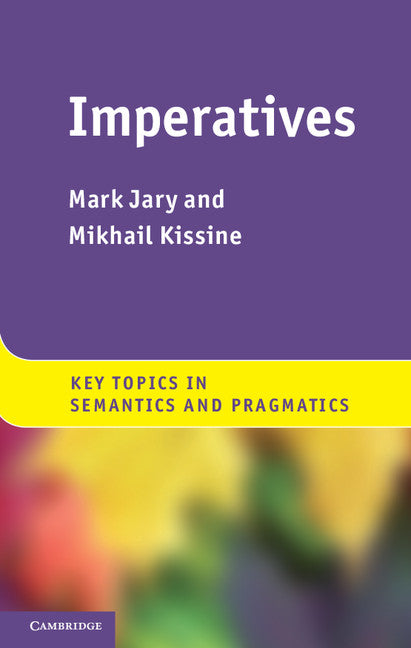
Imperatives
An engaging overview of imperatives and a close examination of how different theoretical traditions have tried to explain them.
Mark Jary (Author), Mikhail Kissine (Author)
9781107012349, Cambridge University Press
Hardback, published 17 July 2014
336 pages, 2 b/w illus.
21.6 x 14 x 1.9 cm, 0.54 kg
'An impressively compendious distillation of work on the imperative, which is both original and accessible. The book is rich in (cross-linguistic) data, sound argument and insightful analysis. If you are interested in the semantics/pragmatics of linguistic mood and illocutionary force, read this book!' Robyn Carston, University College London and CSMN, Oslo
Imperative sentences usually occur in speech acts such as orders, requests, and pleas. However, they are also used to give advice, and to grant permission, and are sometimes found in advertisements, good wishes and conditional constructions. Yet, the relationship between the form of imperatives, and the wide range of speech acts in which they occur, remains unclear, as do the ways in which semantic theory should handle imperatives. This book is the first to look systematically at both the data and the theory. The first part discusses data from a large set of languages, including many outside the Indo-European family, and analyses in detail the range of uses to which imperatives are put, paying particular attention to controversial cases. This provides the empirical background for the second part, where the authors offer an accessible, comprehensive and in-depth discussion of the major theoretical accounts of imperative semantics and pragmatics.
Part I. The Data: 1. What is the imperative mood?
2. Imperative mood and directive force
3. Imperatives with conditional meanings
Part II. The Theories
Introduction to Part II: from data to theory
4. The imperative is directive force
5. Declarative-like semantics for imperatives
6. The imperative as a distinct semantic type
An opinionated conclusion
Appendix A. Possible worlds and semantics
Appendix B. Modality in possible-word semantics
Appendix C. Stalnaker's common-ground model of assertion
Glossary.
Subject Areas: Semantics, discourse analysis, etc [CFG], Linguistics [CF]