Freshly Printed - allow 10 days lead
Couldn't load pickup availability
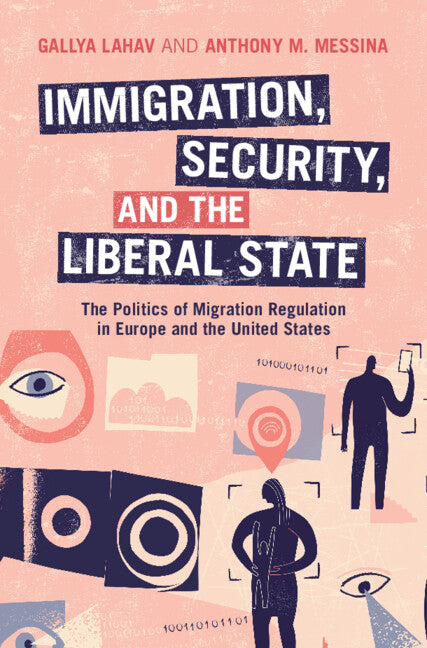
Immigration, Security, and the Liberal State
The Politics of Migration Regulation in Europe and the United States
Shows how liberal states reconcile the migration trilemma which has pitted markets, rights and security against each other since 9/11.
Gallya Lahav (Author), Anthony M. Messina (Author)
9781009298018, Cambridge University Press
Hardback, published 18 January 2024
514 pages, 94 b/w illus. 29 tables
23.5 x 15.5 x 3 cm, 0.946 kg
'[This] book will be useful to anyone interested in immigration policy. Its extensive examination of the role of noncentral state actors - subnational governments and private entities - in immigration policy addresses an important development that has received little attention … Recommended.' A. L. Aoki, CHOICE
Contextualizing the regulation of human mobility in a new security framework, this book offers an original perspective on the dominant mode of politics and evolving norms shaping the immigration policies of contemporary liberal states. In doing so, the authors challenge existing paradigms that privilege economic and cultural factors over new security ones in explaining the critical institutional and normative changes in migration management, from the early post-WWII through the post-Cold War era. Drawing on evidence from multiple sources, including media and elite discourse, policy tracking, party manifesto data and public opinion across Europe and the US, the book exposes the restrictive nature of immigration politics and policies when immigration is framed as a security threat, and considers its implications for civil liberties. Informed by a rich breadth of scholarly sub-disciplines, the findings contribute both empirically and theoretically to the literatures on international migration, security and public opinion.
1. Introduction: the migration trilemma
2. Framing and reframing immigration: the politics of (in)security
3. Expanding the migration policy playing field: enlisting the cooperation of non-central state actors
4. Popular attitudes towards immigration regulation
5. Immigration and the politics of threat
6. Securitizing and politicizing immigration: political party competition in Spain, UK, and US
7. Conclusions: liberalism compromised?
References
Index.
Subject Areas: Comparative politics [JPB]