Freshly Printed - allow 10 days lead
Couldn't load pickup availability
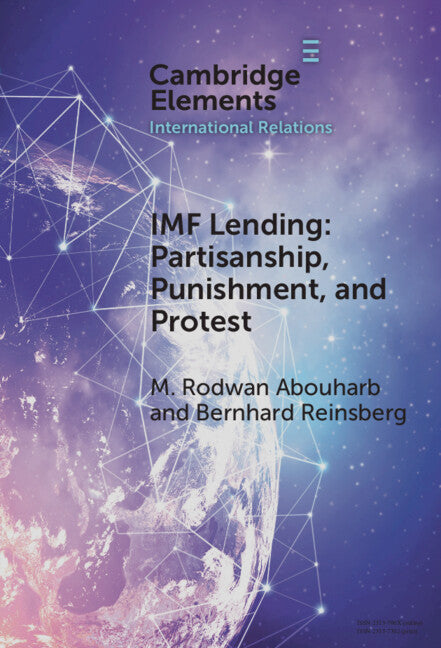
IMF Lending
Partisanship, Punishment, and Protest
This Element argues that governments seek political advantage during turbulent economic times from IMF programs to protect their supporters.
M. Rodwan Abouharb (Author), Bernhard Reinsberg (Author)
9781009451154, Cambridge University Press
Hardback, published 31 October 2024
126 pages
22.9 x 15.2 x 1 cm, 0.325 kg
This Element argues that governments allocate adjustment burdens strategically to protect their supporters, imposing adjustment costs upon the supporters of their opponents, who then protest in response. Using large-N micro-level survey data from three world regions and a global survey, it discusses the local political economy of International Monetary Fund (IMF) lending. It finds that opposition supporters in countries under IMF structural adjustment programs (SAP) are more likely to report that the IMF SAP increased economic hardships than government supporters and countries without IMF exposure. In addition, it finds that partisan gaps in IMF SAP evaluations widen in IMF program countries with an above-median number of conditions, suggesting that opposition supporters face heavier adjustment burdens, and that opposition supporters who think SAPs made their lives worse are more likely to protest. This title is also available as Open Access on Cambridge Core.
1. Introduction
2. Theoretical framework
3. Data
4. How IMF programs affect distributive politics
5. How distributive politics under IMF programs affect protest
6. Discussion and conclusion
References
Appendices.
Subject Areas: International relations [JPS]