Freshly Printed - allow 7 days lead
Couldn't load pickup availability
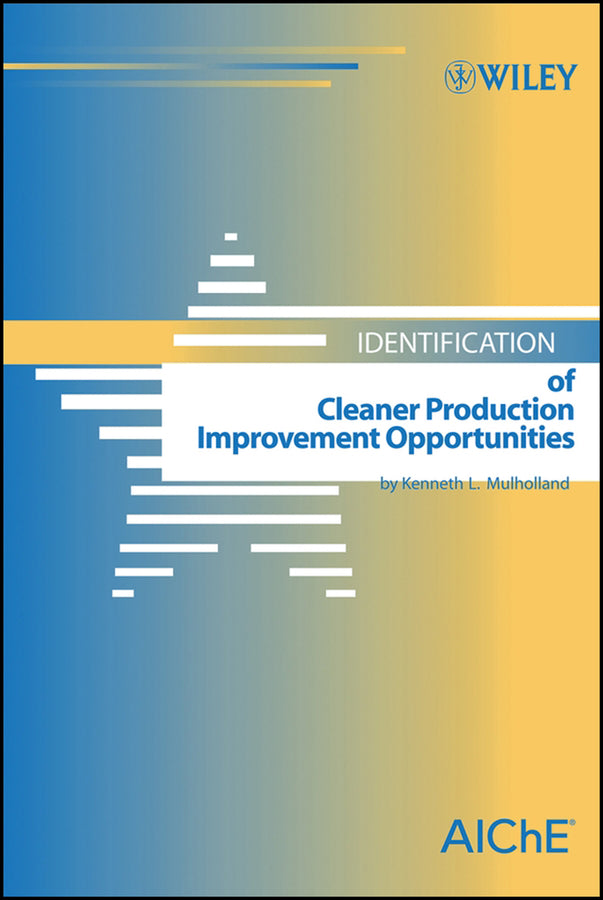
Identification of Cleaner Production Improvement Opportunities
Kenneth L. Mulholland (Author)
9780471794400, Wiley
Hardback, published 10 March 2006
224 pages
26 x 18 x 2 cm, 0.526 kg
"...a practical how-to manual for implementing the best pollution prevention strategies that are economical and efficient for eliminating costly end-of-pipe treatments." (Chemical Engineering Progress, April 2006)
Regardless of its size or nature, every industry generates waste and is responsible for imple-menting the practices of pollution prevention and waste minimization in its day-to-day operations. Whether it's dirty water or toxic wastes, industrial pollution is all the same in one way: it reduces a business's profitability. Identification of Cleaner Production Improvement Opportunities urges environmental, health, and safety department managers, industrial environmental consultants, and personnel across all chemical engineering industries to employ a forward-thinking and tested technology of process improvements that will reduce waste generation, reduce the resources requirements to manufacture a product, and, most important to the life of a business, increase revenues.
This new publication consists of the following five sections:
* Section I: The relationships among cleaner production, waste, cleaner production analyses, and their business values
* Section II: How to develop a cleaner production program
* Section III: The data requirements and data analyses for the opportunity identification step
* Section IV: The opportunity identification step
* Section V: How to assess and rank the best ideas
Industry expert and chair of AIChE's Environmental Division, Kenneth Mulholland introduces methodology in this manual that has been used to identify process improvement opportunities for more than fifty processes, including pharmaceutical intermediates, elastomer monomers and polymers, polyester intermediates and polymers, batch processes such as agricultural products and paints, chlorofluoro-hydrocarbon and chlorocarbon processes, and specialty chemicals and waste water treatment facilities. With no product changes or new technology necessary, these process improvements have produced a 200 percent internal rate of return and reduced waste generation by 40 percent to 50 percent.
Acknowledgments vii Foreword ix Preface xi Section I: Cleaner Production and Waste 1 Section II: Waste Stream Selection 23 Section III: Preparation for Opportunity Identification 33 Section IV: Opportunity Identification 53 Section V: Opportunity Evaluation and Final Report 65 Appendix A: Forms and Handouts 85 Appendix B: Chemical Plant Final Report 119 Index 193
Subject Areas: Chemistry [PN]