Special Order - allow 2+ weeks lead
Couldn't load pickup availability
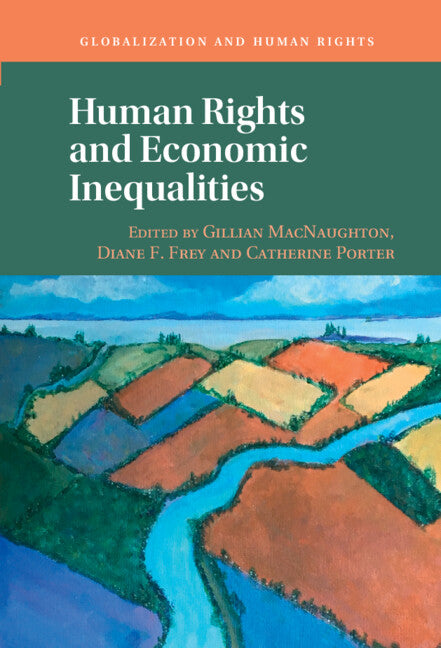
Human Rights and Economic Inequalities
This interdisciplinary volume examines the potential of human rights to challenge economic inequalities and their adverse impacts on human wellbeing.
Gillian MacNaughton (Edited by), Diane Frey (Edited by), Catherine Porter (Edited by)
9781316518694, Cambridge University Press
Hardback, published 2 September 2021
446 pages
23.5 x 15.8 x 3 cm, 0.8 kg
'It is now clear that economic inequality profoundly affects both the workings of democracy, and equal opportunities that the law holds dear. However, human rights law remedies economic ills only when civil rights and political rights are directly harmed. This volume contributes to restoring the rightful breadth of human rights, acknowledging economic inequality as both a moral and practical human rights concern.' Julia Harrington Reddy, Director, Equality & Inclusion, Justice Initiative, Open Society Foundation
Economic inequalities are among the greatest human rights challenges the world faces today due to the past four decades of neoliberal policy dominance. Globally, there are now over 2,000 billionaires, while 3.4 billion people live below the poverty line of US $5.50 per day. Many human rights scholars and practitioners read these statistics with alarm, asking what impact such extreme inequalities have on realizing human rights and what role, if any, should human rights have in challenging them? This edited volume examines these questions from multiple disciplinary perspectives, seeking to uncover the relationships between human rights and economic inequalities, and the barriers and pathways to greater economic equality and full enjoyment of human rights for all. The volume is a unique contribution to the emerging literature on human rights and economic inequality, as it is interdisciplinary, global in reach and extends to several under-researched areas in the field.
Introduction Gillian MacNaughton, Diane F. Frey and Catherine Porter
Part I. Conceptualizing and Measuring Human Rights and Economic Inequalities: 1. Emerging human rights norms and standards on vertical inequalities Gillian MacNaughton
2. Constraints on economic inequality: comparing Canada and the United States Rhoda E. Howard-Hassmann
3. What the UN human rights treaty bodies tell us about economic inequalities and human rights: an empirical analysis of 20 years of practice Sylvain Aubry, Katherine James, Lucy McKernan, Beth Munro and Caroline Noyrez
4. How can economists help human rights practitioners measure changes in economic inequalities? Catherine Porter
Part II. Causes and Consequences of Economic Inequalities: 5. A framework for fiscal justice: how human rights can change public finance Anja Rudiger
6. Global tax justice and human rights Alex Cobham, Fariya Mohiuddin and Liz Nelson
7. Growing inequality and risks to social rights in our new data economy Carmel Williams
8. Caste, economic inequality and climate justice in India Dadasaheb Tandale
Part III. Socio-Economic Rights and Economic Inequalities: 9. Distributive justice, and economic and social rights Joo-Young Lee
10. Fair wages and a decent living: paths to greater vertical equality Diane F. Frey and Gillian MacNaughton
11. The right to social security and economic inequality: contested meanings and potential roles Beth Goldblatt
12. Education, income inequality and the right to participate in cultural life James Murphy
13. Implications of the health equity perspective for the right to health Chuan-Feng Wu
14. The potential impact of the right to housing to address vertical inequalities Vicente Silva.
Subject Areas: International human rights law [LBBR], Human rights [JPVH]