Freshly Printed - allow 6 days lead
Couldn't load pickup availability
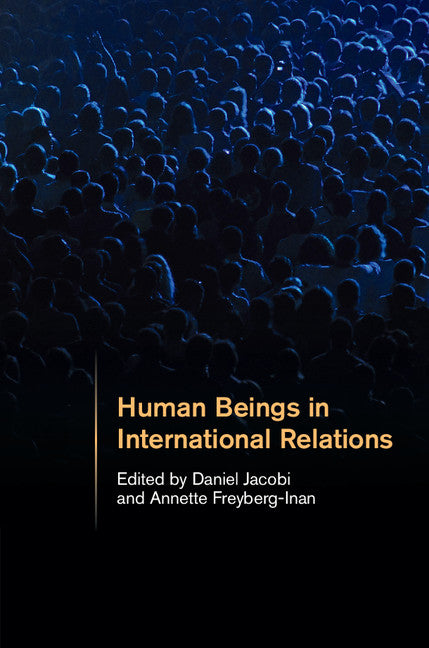
Human Beings in International Relations
Asks how, why and to what ends humans appear in international relations theories and how this makes us interpret world politics.
Daniel Jacobi (Edited by), Annette Freyberg-Inan (Edited by)
9781107116252, Cambridge University Press
Hardback, published 11 September 2015
394 pages, 1 table
22.9 x 15.2 x 2.2 cm, 0.69 kg
'It is a collection that accomplishes to a large extent what the editors Jacobi and Freyberg-Inan in their introduction promise to deliver: 'a comprehensive, balanced, open-minded, and up-to-date study of the human element, its relation to world politics, and our ways of producing knowledge about them.' Asli Calkivik, International Studies Review
Since the 1980s, the discipline of International Relations has seen a series of disputes over its foundations. However, there has been one core concept that, although addressed in various guises, had never been explicitly and systematically engaged with in these debates: the human. This volume is the first to address comprehensively the topic of the human in world politics. It comprises cutting-edge accounts by leading scholars of how the human is (or is not) theorized across the entire range of IR theories, old and new. The authors provide a solid foundation for future debates about how, why, and to which ends the human has been or must (not) be built into our theories, and systematically lay out the implications of such moves for how we come to see world politics and humanity's role within it.
Introduction: human being(s) in international relations Daniel Jacobi and Annette Freyberg-Inan
Part I. International Political Anthropology: 1. Between fear and despair: human nature in realism Annette Freyberg-Inan
2. 'Human nature' and the paradoxical order of liberalism Stephen J. Rosow
3. Disciplining human nature: the evolution of American social scientific theorizing Jennifer Sterling-Folker and Jason F. Charrette
4. The Marxist perspective from 'species-being' to natural justice Chris Brown
5. In biology we trust: biopolitical science and the elusive self Duncan Bell
6. Greeks, neuroscience, and international relations Richard Ned Lebow
7. Constructivism, realism, and the variety of human natures Samuel Barkin
8. Feminism and the figure of Man Elisabeth Prügl
Part II. International Political Post-Anthropology: 9. Realism, agency, and the politics of nature Colin Wight
10. A global human condition Mauro J. Caraccioli
11. Imagining man – forgetting society? Benjamin Herborth
12. On the social (re)construction of the human in world politics Daniel Jacobi
13. Observing visions of man Oliver Kessler
14. Who is acting in international relations? Jan-Hendrik Passoth and Nicholas J. Rowland
Conclusion: toward an International Political (Post-)Anthropology Annette Freyberg-Inan and Daniel Jacobi.
Subject Areas: International relations [JPS], Political science & theory [JPA], Social & political philosophy [HPS]