Freshly Printed - allow 10 days lead
Couldn't load pickup availability
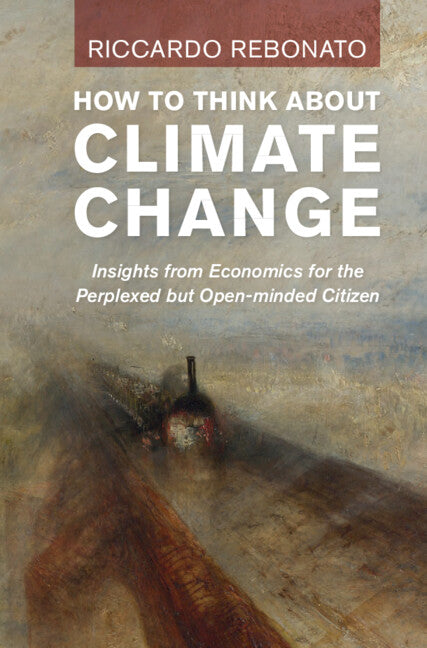
How To Think About Climate Change
Insights from Economics for the Perplexed but Open-minded Citizen
Looking at climate change through the lens of economics is interesting, useful and rewarding for the perplexed but interested citizen.
Riccardo Rebonato (Author)
9781009405003, Cambridge University Press
Hardback, published 25 January 2024
360 pages
23.5 x 15.9 x 2.4 cm, 0.63 kg
'As a long-time environmental reviewer, I found this volume on climate change one of the most extraordinary books to come to my attention. It is directed to the 'perplexed but open-minded citizen' and does so in an engaging style and with wide-spaced print for easy reading. It deals with complex issues involved with climate change with a clarity and depth that can benefit the most advanced scientist or policy expert. … Essential.' F. T. Manheim, Choice
Caught in the crossfire between climate deniers and catastrophists, the intelligent layperson is understandably bewildered when faced with the complexity of climate change. How To Think About Climate Change shows that economics provides not just a suitable, but an indispensable perspective to understand the root causes of the climate-change problem: scarcity of resources, externalities and free riding. Riccardo Rebonato argues that there are no silver bullets or easy solutions. However, he shows that the new-generation economics models offer a radically different insight about our best course of action from what most early models recommended – in particular, they suggest that fast and large-scale climate action can now be justified as the most cost-effective strategy without requiring the 'infinite altruism' of earlier models. Given the conceptual tools provided in this book, readers can decide whether they agree with these conclusions – and, if they do, what the most effective courses of action are.
1. Introduction
2. The facts on the ground
3. Deep changes
4. How economists think about climate change
5. How economists look at choice
6. How utility theory works
7. From choice to utility
8. What are integrated assessment models?
9. How much should we care about future generations? 10. Growth
11. Population
12. So, what should we do? 13. Taking the dirty stuff out
14 The role of nuclear energy
15. Constraints
16. The plumbing
17. Unfinished business.
Subject Areas: Macroeconomics [KCB]