Freshly Printed - allow 7 days lead
Couldn't load pickup availability
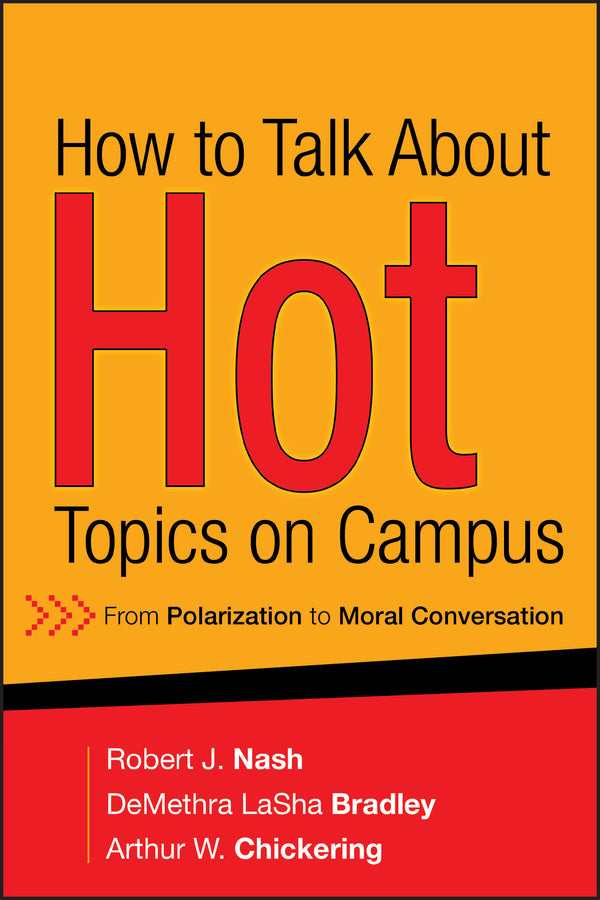
How to Talk About Hot Topics on Campus
From Polarization to Moral Conversation
Robert J. Nash (Author), DeMethra LaSha Bradley (Author), Arthur W. Chickering (Author)
9780787994365, Wiley
Hardback, published 18 March 2008
288 pages
23.6 x 16 x 2.5 cm, 0.476 kg
"This book is an excellent read for faculty, staff, and students on any type of college campus….The real gem in this book is its framework on how to conduct conversations on controversial issues…While the authors focus moral conversations around pluralism, the premise of moral conversations could readily apply to interactions around governance, accountability, fiscal challenges, pedagogy, curriculum development, and other important issues that can be uncomfortable to discuss, cause participants to be disrespectful of differing opinions, and ultimately be divisive to a campus community." “I believe this is brilliant, timely and instructive book, not only for educators, but one that reaches across disciplines and functions in higher education and beyond for anyone that wants to improve the outcomes of their conversations about controversial topics…. It conveys the need to create spaces for these conversations on college campuses, but also instructs how to do it.
–Tracy M. Tyree, Associate Vice President of Student Affairs in "Community College Journal of Research and Practice," 32:9, 733-735
” – Andrea Silva McManus in Education Book Reviews (staff.lib.msu.edu/corby/reviews/posted/nash.) and excerpted in ASA Chairlink, January 2009
How to Talk About Hot Topics on Campus fills a gap in the student services and teaching and learning literature by providing a resource that shows how to construct and carry out difficult conversations from various vantage points in the academy. It offers a theory-to-practice model of conversation for the entire college campus that will enable all constituencies to engage in productive and civil dialogue on the most difficult and controversial social, religious, political, and cultural topics.
Preface ix Acknowledgments xv The Authors xvii Part I: Laying the Theoretical Groundwork for Moral Conversation 1 1. Igniting the Fire of Moral Conversation 3 2. Promoting a Spirit of Pluralism on College Campuses 35 Part II: Practicing the Moral Conversation 63 3. A Faculty Member’s View on Moral Conversation from the Classroom 65 4. An Administrator’s View on Moral Conversation from the Division of Student Affairs 99 5. A Senior Administrator’s Systemic View on Facilitating Moral Conversations Across Campus 133 Part III: Final Words on Moral Conversation 173 6. Opportunities, Risks, and Caveats for Moral Conversation 175 Appendix A: A Step-by-Step How-To Guide for Facilitators and Participants When Doing Moral Conversation 205 Appendix B: Additional Text References and Internet Resources 219 Appendix C: Western Stereotypes About Islam from Both the Left and the Right 221 Appendix D: A Whole-Campus Teaching and Learning Rationale for Moral Conversation: Inspired by the 2004 NASPA Report Learning Reconsidered: A Campus-Wide Focus on the Student Experience 229 Appendix E: Naturalistic and Narrativistic Paradigms in Academia: Implications for Moral Conversation 241 References 251 Index 261
Robert J. Nash
DeMethra LaSha Bradley
Arthur W. Chickering
Robert J. Nash and Alissa B. Strong
Robert J. Nash
Robert J. Nash
Robert J. Nash
Subject Areas: Education [JN]