Freshly Printed - allow 7 days lead
Couldn't load pickup availability
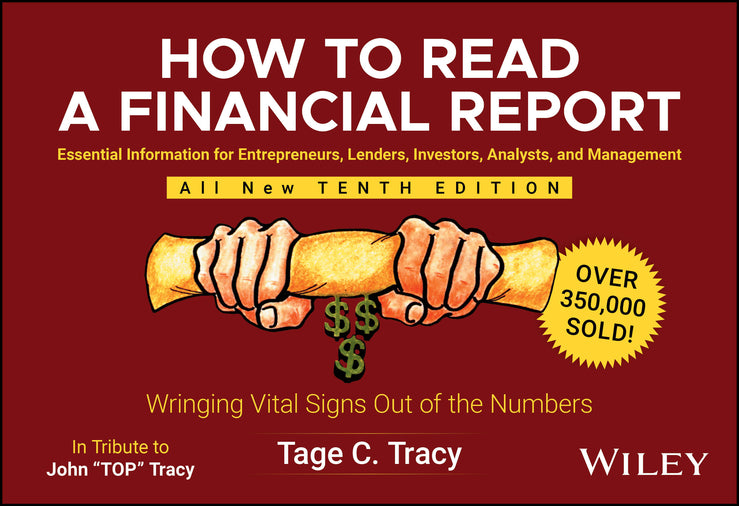
How to Read a Financial Report
Wringing Vital Signs Out of the Numbers
Tage C. Tracy (Author)
9781394268696, Wiley
Paperback / softback, published 7 October 2024
272 pages
16.3 x 24.6 x 2.3 cm, 0.386 kg
Learn how to read, understand, analyze, and interpret different types of financial reports In the newly revised and updated 10th Edition of How to Read a Financial Report, seasoned accounting, financial, and business consultant Tage C. Tracy guides readers through reading, understanding, analyzing, and interpreting various types of financial reports, including cash flow, financial condition, and profit performance reports. This book also reveals the various connections between different financial metrics, reports, and statements, discusses changes in accounting and finance reporting rules, current practices, and recent trends, and explains how financial information can be manipulated, such as through inclusion or omission of certain KPIs. This bestselling guide uses jargon-simplified and easy-to-understand language to make the information accessible to all, regardless of finance or accounting background. Updates to the 10th Edition include: An essential all-in-one guide on the art of reading a financial report and avoiding common pitfalls and misconceptions, How to Read a Financial Report earns a well deserved spot on the bookshelves of all business leaders and investors who want to be able to read and understand financial reports and statements like a professional.
List of Exhibits vii Preface to the Tenth Edition ix Part One—Fundamentals 1 1 Arming You with Essential Knowledge 3 2 Starting with Cash Flows 13 3 Bedrock Financial Statement #1: The Income Statement 23 4 Bedrock Financial Statement #2: The Balance Sheet 31 5 Reporting Cash Flows 39 Part Two— Connections 49 6 Fitting Together Financial Statements 51 7 Sales Revenue and Accounts Receivable 59 8 Cost of Sales Revenue, Inventory, and Accounts Payable 65 9 Operating Expenses and Prepaid Expenses 77 10 Depreciation and Amortization Expense, and Fixed and Other Long- Term Assets 83 11 Operating Expenses and Accounts Payable 95 12 Accruing Liability for Unpaid Expenses 101 13 Income Tax Expense and Its Liability 107 14 Interest Expense, Accrued Liabilities, and Loans Payable 113 15 Net Income, Retained Earnings, and Earnings per Share (EPS) 123 16 Connecting the Cash Flow Dots 129 Part Three— Using and Analyzing Financial Statements 145 17 Footnotes and Management Discussions 147 18 Financial Statement Ratios and Analysis: Strength 159 19 Financial Statement Ratios and Analysis: Performance 173 20 Financial Engineering 187 21 Financial Fraud, aka Cooking the Books 199 22 CPAs and Financial Reports 211 23 Basic Questions, Basic Answers 219 About the Author 235 Index 237
Subject Areas: Finance & accounting [KF]