Freshly Printed - allow 10 days lead
Couldn't load pickup availability
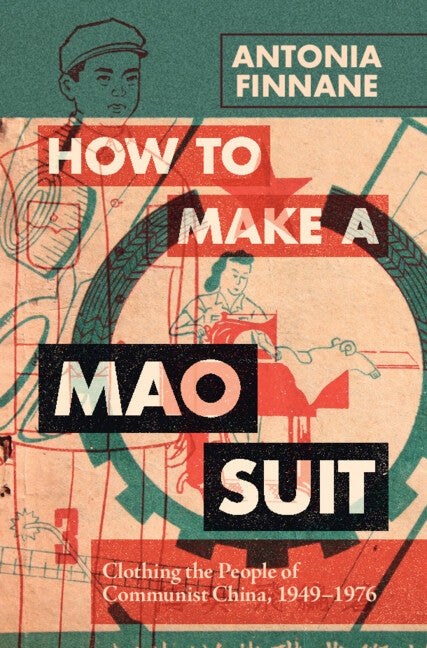
How to Make a Mao Suit
Clothing the People of Communist China, 1949–1976
Revisionist history of the transformation of clothing in China during the Mao years, 1949–1976.
Antonia Finnane (Author)
9781009359955, Cambridge University Press
Hardback, published 3 August 2023
386 pages
23.5 x 15.8 x 2.4 cm, 0.7 kg
'Finnane's book will be a fantastically useful resource for researchers on the history of the Chinese clothing and fashion industry, on social and cultural history, on the interface between technological innovation and everyday life, on gender issues in the Republic and the early PRC, and no doubt many other fields of study as well. As readers familiar with Finnane's work will expect, the book is not just scholarly but also fluently written and highly readable. For her contemporaries, it will also be a trip down memory lane, as we recall the surprising variety of styles of clothing - concealed among apparent uniformity - in the China of the 1970s and 1980s. … a magisterial study.' Alison Hardie, Europe-Asia Studies
When the People's Republic of China was founded in 1949, new clothing protocols for state employees resulted in far-reaching changes in what people wore. In a pioneering history of dress in the Mao years (1949–1976), Antonia Finnane traces the transformation, using industry archives and personal stories to reveal a clothing regime pivoted on the so-called 'Mao suit'. The time of the Mao suit was the time of sewing schools and sewing machines, pattern books and homemade clothes. It was also a time of close economic planning, when rationing meant a limited range of clothes made, usually by women, from limited amounts of cloth. In an area of scholarship dominated by attention to consumption, Finnane presents a revisionist account focused instead on production. How to Make a Mao Suit provides a richly illustrated account of clothing that links the material culture of the Mao years to broader cultural and technological changes of the twentieth century.
List of figures
List of maps
List of tables
Acknowledgements
Technical notes
Introduction
1. The Red Group tailors and the Zhongshan suit
2. Notions and sewing tools
3. Making zhifu
4. Sewing like a girl
5. Rationing
6. The time of the sewing machine
7. Pattern books I: origins, authors, readers
8. Pattern books II: how to take a measurement
9. What should Chinese women wear?
Conclusion
Appendices
Glossary
References
Index.
Subject Areas: Asian history [HBJF]