Freshly Printed - allow 10 days lead
Couldn't load pickup availability
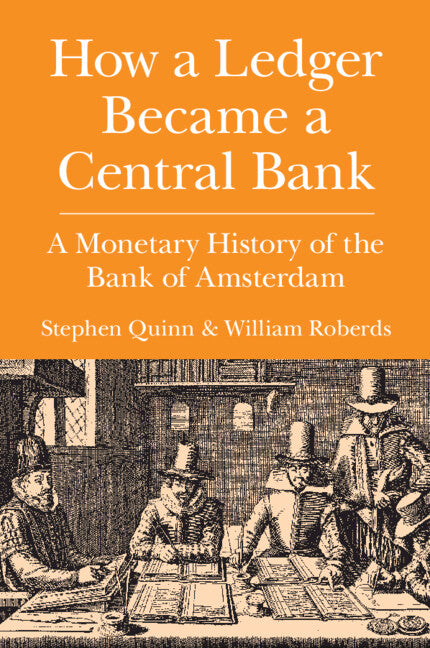
How a Ledger Became a Central Bank
A Monetary History of the Bank of Amsterdam
A quantitative history of the Bank of Amsterdam, a dominant central bank over much of the seventeenth and eighteenth centuries.
Stephen Quinn (Author), William Roberds (Author)
9781108706155, Cambridge University Press
Paperback / softback, published 30 November 2023
400 pages
22.7 x 15.2 x 2.1 cm, 0.54 kg
'In my view, this book is the new standard work on the Amsterdam Exchange Bank and the early development of central banking. It synthesizes over twenty years of research already published in various articles by economists Stephen Quinn and William Roberds. They enrich the historical understanding of financial development and the Republic of the Seven United Netherlands by analyzing the functioning of the Amsterdam Exchange Bank with their economic toolkit.' Alberto Feenstra, BMGN – Low Countries Historical Review
Before the US Federal Reserve and the Bank of England, the Bank of Amsterdam ('Bank') was a dominant central bank with a global impact on money and credit. How a Ledger Became a Central Bank draws on extensive archival data and rich secondary literature, to offer a new and detailed portrait of this historically significant institution. It describes how the Bank struggled to manage its money before hitting a modern solution: fiat money in combination with a repurchase facility and discretionary open market operations. It describes techniques the Bank used to monitor and stabilize money stock, and how foreign sovereigns could exploit the liquidity of the Bank for state finance. Closing with a discussion of commonalities of the Bank of Amsterdam with later central banks, including the Federal Reserve, this book has generated a great deal of excitement among scholars of central banking and the role of money in the macroeconomy.
1. Similar yet different?
2. The world of the bank
3. Coins in eighteenth-century Amsterdam
4. First steps, 1609–1659
5. Emergence of the receipt system, 1660–1710
6. Metal in motion: the mechanics of receipts
7. Two banks and one money, 1711–1791
8. Prussia's debasement during the Seven Years War: the role of the Bank
9. The bank's place in central bank history.
Subject Areas: Macroeconomics [KCB]