Special Order - allow 2+ weeks lead
Couldn't load pickup availability
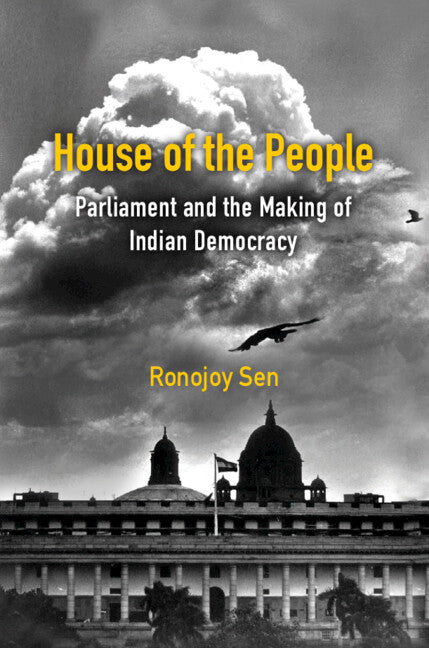
House of the People
Parliament and the Making of Indian Democracy
An institutional history of Indian parliament, democracy and politics combining archival materials, interviews and visuals.
Ronojoy Sen (Author)
9781009180252, Cambridge University Press
Hardback, published 16 February 2023
324 pages
23.7 x 16.1 x 2.3 cm, 0.53 kg
'… provides valuable insight into the workings and evolution of an institution at the centre of what may prove to be India's coming political storm.' Eugene L. Wolfe, LSE Review of Books
While there is overwhelming support for democracy in India and voter turnout is higher than in many Western democracies, there are low levels of trust in political parties and elected representatives. This book is an attempt to look beyond Indian elections, which has increasingly occupied analysts and commentators. It focuses on the Lok Sabha (The House of the People), comprising 543 members directly elected for five years by a potential 800 million plus voters in 2019. The book seeks to answer two questions: Is the Indian Parliament, which has the unenviable task of representing a diverse nation of a billion-plus people, working, if not in an exemplary manner, at least reasonably well, to articulate the diverse demands of the electorate and translate them into legislation and policy? To what extent has the practice of Indian democracy transformed the institution of parliament, which was adopted from the British, and its functioning?
Introduction
1. The road to parliamentary democracy: The Constituent Assembly and its prehistory
2. Protean institution: The changing composition of parliament
3. 'Please take your seat!': Disruptions in parliament
4. Inside out: The parliamentary committee system
5. Corruption, criminality and immunity
6. Conclusion.
Subject Areas: Law & society [LAQ], Political parties [JPL], Political structures: democracy [JPHV], Political science & theory [JPA], Politics & government [JP], Sociology [JHB], History [HB]