Freshly Printed - allow 10 days lead
Couldn't load pickup availability
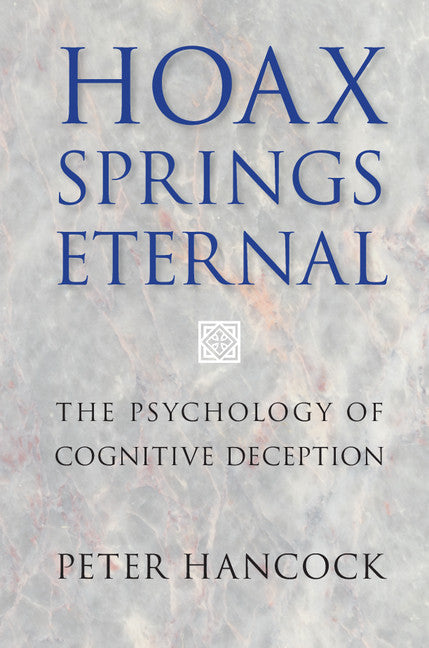
Hoax Springs Eternal
The Psychology of Cognitive Deception
This book examines and extrapolates from famous historical case studies to illustrate principles of cognitive deception and how to avoid being deceived.
Peter Hancock (Author)
9781107071681, Cambridge University Press
Hardback, published 22 January 2015
276 pages, 38 b/w illus. 4 maps
22.9 x 15.2 x 1.9 cm, 0.58 kg
'The book is not just a scientific Fedora-fueled foray into intriguing artefacts. It is a gift of knowledge and long-bottled passion, something everyone should read for work or for pleasure and a text that would not be out of place next to other great tomes on your bookshelf.' Anjum Naweed, Ergonomics
Unlike sleights of hand, which fool the senses, sleights of mind challenge cognition. This book defines and explains cognitive deception and explores six prominent potential historical instances of it: the Cross of King Arthur, Drake's Plate of Brass, the Kensington Runestone, the Vinland Map, the Piltdown Man, and the Shroud of Turin. In spite of evidence contradicting their alleged origins, their stories continue to persuade many of their authenticity. Peter Hancock uses these purported hoaxes as case studies to develop and demonstrate fundamental principles of cognitive psychology. By dissecting each ostensible artifact, he illustrates how hoaxes can deceive us and offers us defenses against them. This book further examines how and why we allow others to deceive us and how and why we even deceive ourselves at times. Accessible to beginner and expert alike, Hoax Springs Eternal provides an essential interdisciplinary guide to cognitive deception.
1. The tangled web
2. Case one: the Cross of King Arthur
3. Case two: Drake's Plate of Brass
4. The psychology of deception
5. Case three: the Kensington Runestone
6. Case four: the Vinland Map
7. Deciding on deception
8. Case five: the Piltdown Man
9. Case six: the Shroud of Turin
10. Deception redux
11. Summary: hoax springs eternal.
Subject Areas: History of science [PDX], Cognition & cognitive psychology [JMR], Psychology [JM]