Freshly Printed - allow 10 days lead
Couldn't load pickup availability
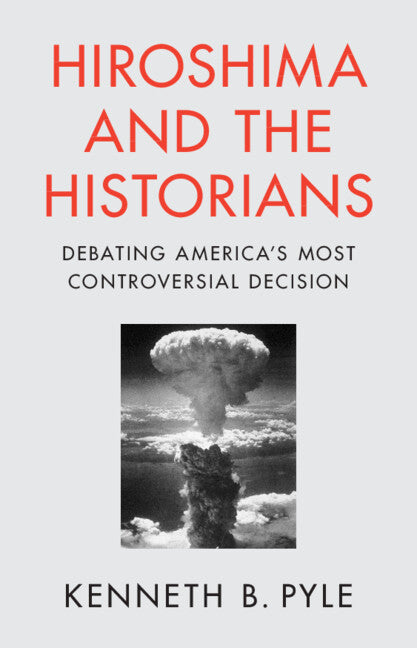
Hiroshima and the Historians
Debating America's Most Controversial Decision
A thought-provoking analysis of the historian's craft through a case study of the Hiroshima decision and ongoing historical debates.
Kenneth B. Pyle (Author)
9781009477451, Cambridge University Press
Hardback, published 6 June 2024
286 pages
22.3 x 14.6 x 2 cm, 0.48 kg
'Drawing on years of teaching, this concise book offers an accessible and reflective overview of the Hiroshima and Nagasaki bombings at the end of WW II … Pyle raises key questions about the moral responsibility of historians, the inevitability of their differing perspectives, and the role of the search for truth in their work. He also examines the interplay among memory, narrative, and evidence in shaping historical accounts. Without offering definitive answers, Pyle invites readers to join in this intellectual exploration - a valuable experiment that encourages reflection, debate, and a deeper engagement with the complexities of history. It is also a valuable read for students and instructors of modern Japanese history … Recommended.' Q. E. Wang, Choice
The decision to use atomic bombs on Hiroshima and Nagasaki has been considered the most important – and perhaps most controversial - event in twentieth-century history. It ushered in many of the major developments of our time: the end of World War II, the beginning of the atomic age, the establishment of the American world order, and the start of the Cold War arms race. Kenneth B. Pyle illuminates both the complexities of the event itself and the debates among historians that continue today, as they wrestle with the moral issues of the decision, its necessity and its alternatives. While producing no final resolution to the controversy, historians have nevertheless advanced and deepened our understanding of this event. This accessible and thought-provoking analysis is a case study in the intricate nature of the historian's craft and a reminder of the value of historians in a free society.
Introduction
1. The historian's craft
2. The Hiroshima decision
3. Participants and their first draft of history
4. The revisionists
5. Historians and moral judgments
6. Military historians
7. Gauging Japanese responsibility
8. The wider perspective
9. Controversy as a way of life.
Subject Areas: History of the Americas [HBJK]