Freshly Printed - allow 10 days lead
Couldn't load pickup availability
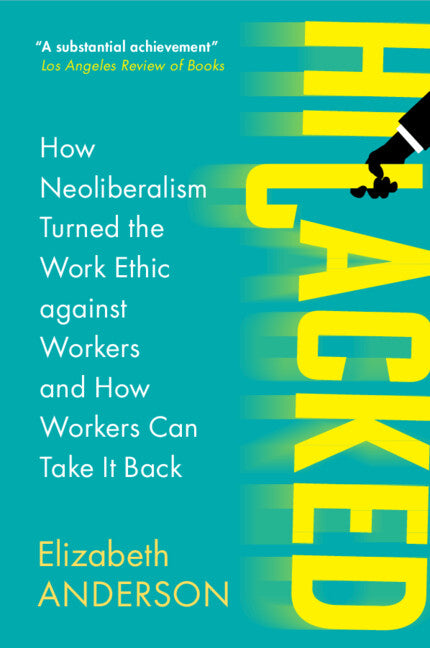
Hijacked
How Neoliberalism Turned the Work Ethic against Workers and How Workers Can Take It Back
Shows how the work ethic has been used to oppress workers, and also to liberate them.
Elizabeth Anderson (Author)
9781009275392, Cambridge University Press
Paperback / softback, published 6 March 2025
392 pages
22.9 x 15.2 x 2.1 cm, 0.63 kg
'All of Anderson's scholarly virtues are displayed in this book: rigor, subtlety, and commitments to both historicism and confronting present-day political dilemmas. She is careful to note how the work ethic emerged amid pivotal historical episodes of profound political and economic change, with dutiful references to historians as varied as Holly Brewer and Robert Allen. She has also mastered recent contemporary policy debates on issues ranging from private equity's impact on employment and welfare reform's effects on poverty. All of this is accomplished with her trademark clarity and moral urgency.' Joel Suarez, Journal of the History of Economic Thought
What is the work ethic? Does it justify policies that promote the wealth and power of the One Percent at workers' expense? Or does it advance policies that promote workers' dignity and standing? Hijacked explores how the history of political economy has been a contest between these two ideas about whom the work ethic is supposed to serve. Today's neoliberal ideology deploys the work ethic on behalf of the One Percent. However, workers and their advocates have long used the work ethic on behalf of ordinary people. By exposing the ideological roots of contemporary neoliberalism as a perversion of the seventeenth-century Protestant work ethic, Elizabeth Anderson shows how we can reclaim the original goals of the work ethic, and uplift ourselves again. Hijacked persuasively and powerfully demonstrates how ideas inspired by the work ethic informed debates among leading political economists of the past, and how these ideas can help us today.
Preface
1. The dual nature of the Protestant work ethic and the birth of utilitarianism
2. Locke and the progressive work ethic
3. How conservatives hijacked the work ethic and turned it against workers
4. Welfare reform, famine, and the ideology of the conservative work ethic
5. The progressive work ethic (1): Smith, Ricardo, and Ricardian socialists
6. The progressive work ethic (2): J. S. Mill
7. The progressive work ethic (3): Marx
8. Social democracy as the culmination of the progressive work ethic
9. Hijacked again: Neoliberalism as the return of the conservative work ethic
10. Conclusion: What should the work ethic mean for us today?
Acknowledgments
Major works cited
Notes
Index.
Subject Areas: History of ideas [JFCX]