Freshly Printed - allow 10 days lead
Couldn't load pickup availability
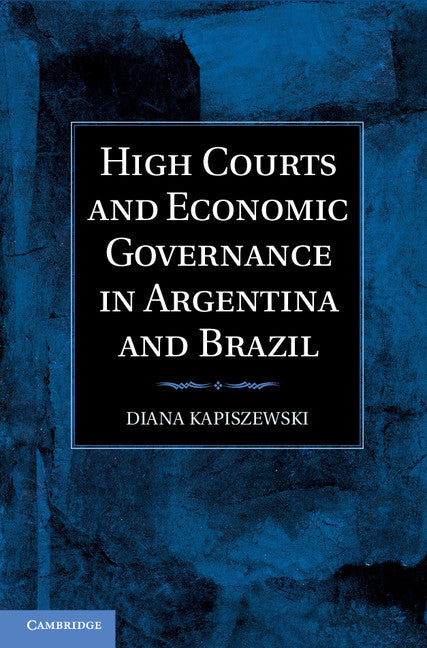
High Courts and Economic Governance in Argentina and Brazil
This study analyzes how elected leaders and high courts in Argentina and Brazil interact over economic governance.
Diana Kapiszewski (Author)
9781107008281, Cambridge University Press
Hardback, published 24 September 2012
300 pages, 3 b/w illus. 8 tables
24.2 x 16 x 1.8 cm, 0.55 kg
'High Courts and Economic Governance in Argentina and Brazil is an important empirical and theoretical contribution to the burgeoning literature on judicial politics in Latin America and to the broader literature on historical institutionalism. Diana Kapiszewski shows that high courts developed identifiable, relatively stable characters that help explain the pattern of interactions between courts and elected officials. By emphasizing court character, she challenges accounts that focus exclusively on judges' or politicians' short-term strategic incentives. Kapiszewski also skilfully analyzes the origins of the differences in court character in Argentina and Brazil.' Scott Mainwaring, Eugene and Helen Conley Professor of Political Science, University of Notre Dame
High Courts and Economic Governance in Argentina and Brazil analyzes how high courts and elected leaders in Latin America interacted over neoliberal restructuring, one of the most significant socioeconomic transformations in recent decades. Courts face a critical choice when deciding cases concerning national economic policy, weighing rule of law concerns against economic imperatives. Elected leaders confront equally difficult dilemmas when courts issue decisions challenging their actions. Based on extensive fieldwork in Argentina and Brazil, this study identifies striking variation in inter-branch interactions between the two countries. In Argentina, while the high court often defers to politicians in the economic realm, inter-branch relations are punctuated by tense bouts of conflict. The Brazilian high court and elected officials, by contrast, routinely accommodate one another in their decisions about economic policy. Diana Kapiszewski argues that the two high courts' contrasting characters - political in Argentina and statesman-like in Brazil - shape their decisions on controversial cases and condition how elected leaders respond to their rulings, channeling inter-branch interactions into persistent patterns.
1. High court-elected branch institutions in Latin America
2. Setting the scene: Latin America's triple transition and the judicialization of economic governance
3. Politicization and the political court in Argentina
4. Professionalism and the statesman court in Brazil
5. The political court and high court submission and inter-branch confrontation in Argentina
6. The statesman court and inter-branch accommodation in Brazil
7. Conclusions and implications.
Subject Areas: Comparative law [LAM], Comparative politics [JPB]