Freshly Printed - allow 10 days lead
Couldn't load pickup availability
Hierarchies at Home
Domestic Service in Cuba from Abolition to Revolution
This book destabilizes racialized and gendered assumptions about labour in Cuba and challenges traditional chronologies of 20th-century Cuban history.
Anasa Hicks (Author)
9781009074513, Cambridge University Press
Paperback / softback, published 8 August 2024
222 pages
22.9 x 15.2 x 1.3 cm, 0.367 kg
'Hicks's work fills a significant void in the historiography of Cuba, which has long been dominated by narratives of slavery and revolution. She (rightly) centers domestic labor in the debates over what it meant to be Cuban, both before and after the revolution. Her work calls on historians to reevaluate how we examine traditional studies of labor and activism, much as has been done for studies of slavery and resistance, and is essential reading for scholars of Cuba.' Sarah L. Franklin, Hispanic American Historical Review
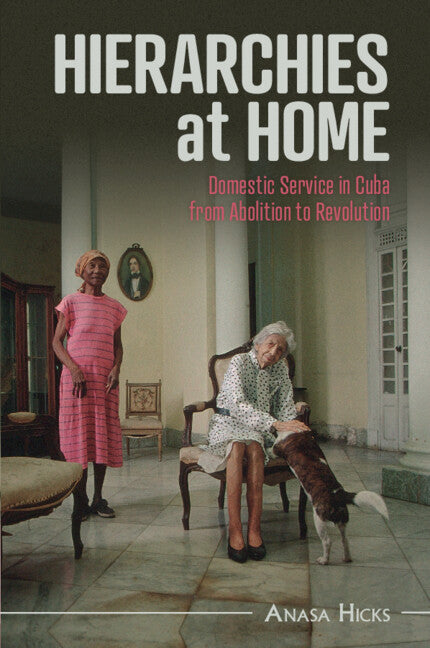
Hierarchies at Home traces the experiences of Cuban domestic workers from the abolition of slavery through the 1959 revolution. Domestic service – childcare, cleaning, chauffeuring for private homes – was both ubiquitous and ignored as formal labor in Cuba, a phenomenon made possible because of who supposedly performed it. In Cuban imagery, domestic workers were almost always black women and their supposed prevalence in domestic service perpetuated the myth of racial harmony. African-descended domestic workers were 'like one of the family', just as enslaved Cubans had supposedly been part of the families who owned them before slavery's abolition. This fascinating work challenges this myth, revealing how domestic workers consistently rejected their invisibility throughout the twentieth century. By following a group marginalized by racialized and gendered assumptions, Anasa Hicks destabilizes traditional analyses on Cuban history, instead offering a continuous narrative that connects pre- and post-revolutionary Cuba.
Introduction: Violent intimacies: Constructions of nation, race, and gender inside Cuban households
1. Embodied anxieties: Hygiene, honor, and domestic service in republican Cuba
2. Of domestic (and other) offices: Black Cubans' claims after independence
3. Stopping 'Creole Bolshevism'
Liberal correctives to increasing labor radicalism
4. Patio fascists and domestic worker syndicates: Communism, constitutions, and the push for labor organization
5. Pushing the present into the past: The revolution's solution to domestic service in the 1960s
6. Conjuring ghosts: Domestic service's remains after 1959
Conclusion: Revisiting a racial democracy: Cuban history from inside out.
Subject Areas: Slavery & abolition of slavery [HBTS], 20th century history: c 1900 to c 2000 [HBLW], Modern history to 20th century: c 1700 to c 1900 [HBLL]