Freshly Printed - allow 7 days lead
Couldn't load pickup availability
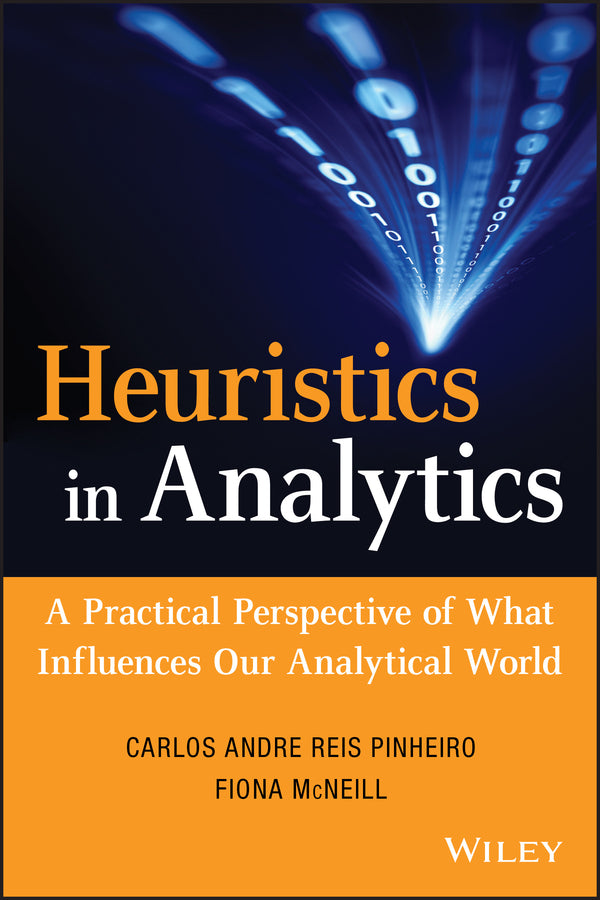
Heuristics in Analytics
A Practical Perspective of What Influences Our Analytical World
Carlos Andre Reis Pinheiro (Author), Fiona McNeill (Author)
9781118347607, Wiley
Hardback, published 11 April 2014
256 pages
23.6 x 16.3 x 2.7 cm, 0.435 kg
Employ heuristic adjustments for truly accurate analysis Heuristics in Analytics presents an approach to analysis that accounts for the randomness of business and the competitive marketplace, creating a model that more accurately reflects the scenario at hand. With an emphasis on the importance of proper analytical tools, the book describes the analytical process from exploratory analysis through model developments, to deployments and possible outcomes. Beginning with an introduction to heuristic concepts, readers will find heuristics applied to statistics and probability, mathematics, stochastic, and artificial intelligence models, ending with the knowledge applications that solve business problems. Case studies illustrate the everyday application and implication of the techniques presented, while the heuristic approach is integrated into analytical modeling, graph analysis, text analytics, and more. Robust analytics has become crucial in the corporate environment, and randomness plays an enormous role in business and the competitive marketplace. Failing to account for randomness can steer a model in an entirely wrong direction, negatively affecting the final outcome and potentially devastating the bottom line. Heuristics in Analytics describes how the heuristic characteristics of analysis can be overcome with problem design, math and statistics, helping readers to: Every single factor, no matter how large or how small, must be taken into account when modeling a scenario or event—even the unknowns. The presence or absence of even a single detail can dramatically alter eventual outcomes. From raw data to final report, Heuristics in Analytics contains the information analysts need to improve accuracy, and ultimately, predictive, and descriptive power.
Preface xi Acknowledgments xix About the Authors xxiii Chapter 1: Introduction 1 The Monty Hall Problem 5 Evolving Analytics 8 Summary 18 Chapter 2: Unplanned Events, Heuristics, and the Randomness in Our World 23 Heuristics Concepts 26 The Butterfly Effect 30 Random Walks 37 Summary 44 Chapter 3: The Heuristic Approach and Why We Use It 45 Heuristics in Computing 47 Heuristic Problem-Solving Methods 51 Genetic Algorithms: A Formal Heuristic Approach 54 Summary 67 Chapter 4: The Analytical Approach 69 Introduction to Analytical Modeling 71 The Competitive-Intelligence Cycle 74 Summary 97 Chapter 5: Knowledge Applications That Solve Business Problems 101 Customer Behavior Segmentation 102 Collection Models 106 Insolvency Prevention 113 Fraud-Propensity Models 120 Summary 127 Chapter 6: The Graph Analysis Approach 129 Introduction to Graph Analysis 130 Summary 143 Chapter 7: Graph Analysis Case Studies 147 Case Study: Identifying Influencers in Telecommunications 149 Case Study: Claim Validity Detection in Motor Insurance 162 Case Study: Fraud Identification in Mobile Operations 178 Summary 188 Chapter 8: Text Analytics 191 Text Analytics in the Competitive-Intelligence Cycle 193 Linguistic Models 198 Text-Mining Models 200 Summary 207 Bibliography 209 Index 217
Subject Areas: Business & management [KJ]