Freshly Printed - allow 10 days lead
Couldn't load pickup availability
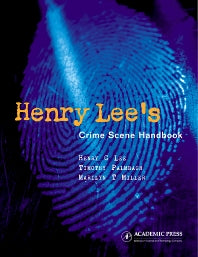
Henry Lee's Crime Scene Handbook
Announcing the most detailed, authoritative "how-to" book for conducting crime scene investigations!
Henry C. Lee (Author), Timothy Palmbach (Author), Marilyn T. Miller (Author)
9780124408302
Hardback, published 26 June 2001
432 pages
24.6 x 18.7 x 2.8 cm, 1.38 kg
"...presents a unique systematic and logical approach to crime scene processing." --Law Enforcement Technology
"…one of the most well-compiled, easy to read and understand, thorough and beautifully written books that can go a long way in making one a better crime scene investigator." --Internet Journal of Forensic Medicine
Henry Lee's Crime Scene Handbook outlines proven methods to help you collect and process physical evidence correctly, analyze it thoroughly, and understand its relevance to the case involved. It evaluates the newest chemical and instrumental techniques, and covers new areas such as forensic analysis of computers and advanced shooting scene reconstruction methods. This "must-have" guide is enhanced with dozens of color photographs, logic trees, check lists, worksheets, case studies, lists of suppliers, and more. Henry Lee has consulted on thousands of criminal cases around the world and is highly sought after to help solve difficult cases. Now he and his co-authors share more than 50 years of combined experience in this systematic approach to crime scene processing. It provides the information you need for initial training, to take with you in the field, and to refer to again and again during the course of each investigation. KEY FEATURES:* Presents a unique, systematic approach to crime scene processing * Covers in detail how to manage a crime scene, collect information, search for, collect, and preserve physical evidence, conduct field tests, and reconstruct a sequence of events * Describes how to use the latest chemical and instrumental techniques for each kind of crime scene * Outlines common problems and provides clear recommendations for overcoming them * Includes logic trees, checklists, and worksheets that help investigators evaluate the evidence in specific types of crimes
General Crime Scene Considerations
Elements of Crime Scene Management
General Crime Scene Procedures
Crime Scene Documentation
Searching for Physical Evidence
Collection and Preservation of Physical Evidence
Logic Trees
Field Tests and Enhancement Reagents
Special Scene Techniques
Crime Scene Reconstruction
Appendix I: Crime Scene Investigation Equipment Inventory
Appendix II: Game Plan for Processing
Appendix III: Resources and Supplies
Appendix IV: Bibliography
Case Study 1: Partial Reconstruction
Case Study 2: Complete Reconstruction
Case Study 3: Limited Reconstruction
Index
Subject Areas: Forensic science [JKVF1]