Freshly Printed - allow 10 days lead
Couldn't load pickup availability
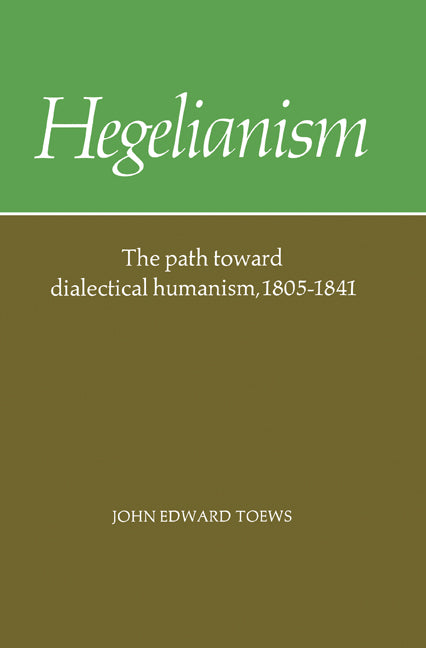
Hegelianism
The Path Toward Dialectical Humanism, 1805–1841
This is a study of the rise of Hegelian thought in the nineteenth century.
John Edward Toews (Author)
9780521316361, Cambridge University Press
Paperback / softback, published 26 April 1985
464 pages
23.7 x 16 x 3 cm, 0.682 kg
'Hegelianism is a rich, complex and ambitious book which can be considered from several viewpoints … an impressive scholarly achievement which succeeds at most of the levels which it tackles … The range of problems and the number of thinkers discussed in the book are remarkable, and the use of first-hand sources and general scholarship are exceptional.' The Times Higher Education Supplement
This is a study of the rise of Hegelian thought throughout the intellectual world and in Germany in the first half of the nineteenth century. The book has three interrelated purposes. First, it constitutes the first synthetic description and comprehensive reconstruction of the historical genesis and humanist transformation of Hegelian ideology. Secondly, the study addresses the problem of recurrent patterns of hope and disillusionment in the successive phases of dialectical thought. Finally, the book is concerned with ideological responses to the experience of communal and religious disintegration.
Preface
Introduction
Part I. Philosophy and Cultural Integration: Hegel in Context: 1. The origins of the Hegelian project: tensions in the father's world
2. Revolution and Romanticism: the generational context of Hegel's ideology of cultural integration
3. The reconciliation of Reason and reality: Hegel's differentiation from Romanticism
Part II. The Historical Appropriation of the Absolute: Unity and Diversity in the Hegelian School, 1805–1831: 4. Hegel and Hegelianism: disciples and sympathisers in the formation of the Hegelian school
5. Hegelian politics during the Restoration: accommodation, critique, and historical transcendence
6. Christian religion and Hegelian philosophy during the Restoration: accommodation, critique, and historical transcendence
Part III. The Reduction of the Absolute to 'Man': The Division of the School and the Emergence of the Hegelian Left, 1830–1841: 7. Right, centre, and left: the division of the Hegelian school in the 1830s
8. Strauss and the principle of immanence
9. Bruno Bauer and the reduction of absolute spirit to human self-consciousness
10. Feuerbach and the reduction of absolute spirit to human 'species being'
Epilogue
Notes
Bibliography
Index.
Subject Areas: History of ideas [JFCX]