Freshly Printed - allow 7 days lead
Couldn't load pickup availability
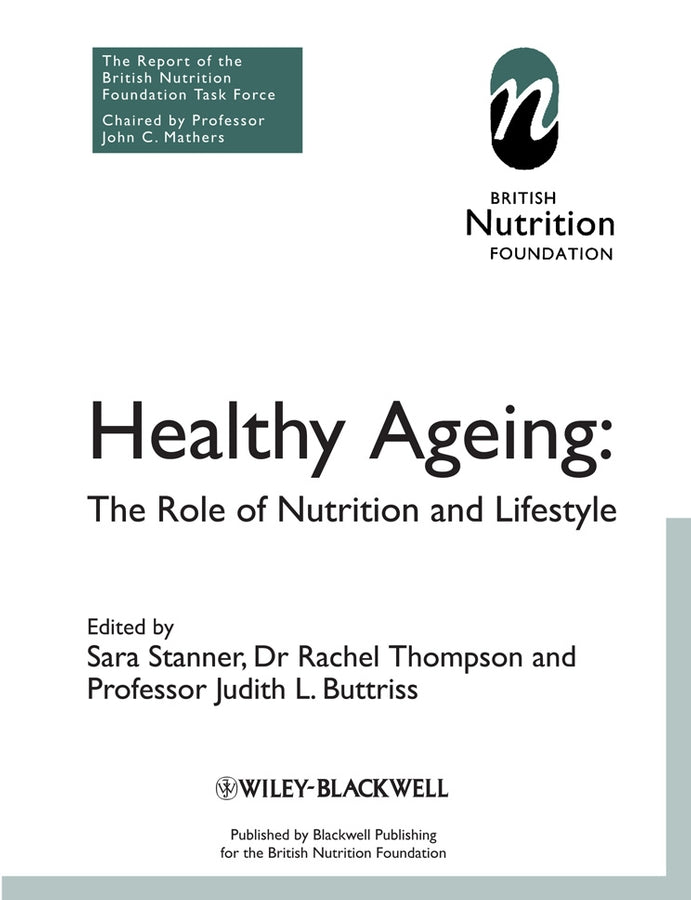
Healthy Ageing
The Role of Nutrition and Lifestyle
(Author), Sara Stanner (Edited by), Rachel Thompson (Edited by), Judith L. Buttriss (Edited by)
9781405178778, Wiley
Paperback / softback, published 2 January 2009
448 pages
24.6 x 19.1 x 2.4 cm, 1.071 kg
January 2009's British Nutrition Foundation’s healthy ageing conference in London was produced to mark the launch of a new book called Health Ageing:The Role of Nutrition and Lifestyle, published by Wiley-Blackwell for the BNF. (Food Manufacture)
Year on year, countries across the world continue to see an increase in life expectancy, largely attributed to the impact of modern medicine and disease eradication. There is now increasing evidence that environmental factors such as diet and lifestyle also have a significant role to play. However with this increase in years there often comes an unfortunate rise in chronic morbidity, with the quality of later life severely compromised by ill health. With age being the single greatest risk factor for a large proportion of common medical conditions, this latest report from the British Nutrition Foundation looks in detail at the role nutrition and physical activity can play in ensuring that the older adults of tomorrow can lead not only longer, but healthier lives. Full of invaluable information on a subject which is set to increase in importance as the average age of populations rise worldwide, this book is crucial reading for students of nutrition, dietetics and food science, clinical nutritionists, public health nutritionists and policy makers. It will also provide an excellent reference for those working in the food industry and for nutritional supplement manufacturers and pharmaceutical companies.
Foreword xvii 1 Diet and Nutrition Issues Relevant to Older Adults 1 1.1 Introduction 1 2 The Basic Biology of Ageing 26 2.1 Definitions 26 3 Healthy Ageing: Teeth and the Oral Cavity 36 3.1 Changing oral health status with age 36 4 Healthy Ageing: Bone Health 54 4.1 Introductory remarks 54 5 Healthy Ageing: The Joints 74 5.1 Introduction 74 6 Healthy Ageing: Skeletal Muscle 88 6.1 Introduction 88 7 Healthy Ageing: The Skin 107 7.1 Introduction 107 8 Healthy Ageing: The Brain 125 8.1 Introduction 125 9 Healthy Ageing: The Eye 143 9.1 Introduction 143 10 Healthy Ageing: The Cardiovascular System 159 10.1 Pathophysiology 159 11 Healthy Ageing: The Immune System 191 11.1 Overview of the immune system 191 12 Healthy Ageing: The Gastrointestinal Tract 208 12.1 Introduction 208 13 Healthy Ageing: The Endocrine System 230 13.1 Introduction 230 14 Taking the Science Forward: Public Health Implications 246 14.1 Introduction 246 15 Conclusions of the Task Force 295 16 Recommendations of the Task Force 305 17 Healthy Ageing: Answers to Common Questions 313 Glossary 334
Terms of Reference xviii
Task Force Membership xix
Brigid McKevith
1.2 Ageing and health 3
1.3 Ageing, gender and ethnicity 7
1.4 Costs of an ageing population 9
1.5 Nutritional requirements of older people and current recommendations 9
1.6 Food patterns, nutrient intakes and nutritional status of older people 14
1.7 Determinants of food and nutrient intake and status in older people 20
1.8 Conclusions 24
1.9 Key points 24
1.10 Recommendations for future research 25
1.11 Key references 25
Professor Thomas B.L. Kirkwood and Professor John C. Mathers
2.2 Current understanding of ageing and its genetic basis 26
2.3 Mechanisms of cellular damage 28
2.4 Metabolic factors affecting ageing 30
2.5 Energy (calorie) restriction in rodents 31\
2.6 Early life effects 32
2.7 Nutrition and antioxidants 33
2.8 Nutrition and inflammation 33
2.9 Nutrigenomics 34
2.10 Conclusions 34
2.11 Key points 34
2.12 Recommendations for future research 35
2.13 Key references 35
Professor Angus Walls
3.2 Impact of nutrition on oral disease 36
3.3 Impact of the oral environment on nutrition 45
3.4 Taste and smell 49
3.5 Texture 51
3.6 Key points 52
3.7 Recommendations for future research 53
3.8 Key references 53
Dr Nigel Loveridge and Dr Susan A. Lanham-New
4.2 Nutritional influences on bone health 57
4.3 Discussion 70
4.4 Key points 71
4.5 Recommendations for future research 72
4.6 Key references 73
Professor Paul Dieppe
5.2 The inflammatory arthropathies 75
5.3 Osteoarthritis 78
5.4 Conclusion 85
5.5 Key points 86
5.6 Recommendations for future research 86
5.7 Key references 87
Dr Emilie A. Wilkes and Professor Michael J. Rennie
6.2 Functions of skeletal muscle 88
6.3 Sarcopenia 89
6.4 Muscle fibre type composition and ageing 94
6.5 Proximal causes of age-related changes in skeletal muscle 96
6.6 Ageing and glucose metabolism 98
6.7 Protein turnover 99
6.8 Implications for protein requirements 101
6.9 Caloric restriction 102
6.10 The effects of physical activity/exercise 102
6.11 Can nutraceuticals help maintain muscle mass? 103
6.12 Skeletal muscle spasms with progressive ageing 104
6.13 Summary and recommendations 104
6.14 Key points 105
6.15 Recommendations for future research 105
6.16 Key references 106
Dr Gail Jenkins, Dr Linda J. Wainwright and Dr Martin R. Green
7.2 Skin structure and function 107
7.3 Intermediate metabolism 109
7.4 Skin research models 109
7.5 Vitamin D and health 110
7.6 Skin ageing 111
7.7 Nutritional influences on skin health 113
7.8 Vitamins essential for skin 113
7.9 Nutrition, UV protection and skin ageing 115
7.10 Nutrition and wound healing 118
7.11 Dietary intake and skin conditions 120
7.12 Gene–nutrient interactions and skin 121
7.13 Skin nutrition: topical or dietary? 122
7.14 Key points 123
7.15 Recommendations for future research 123
7.16 Key references 124
Dr Robert Clarke
8.2 Stroke 125
8.3 Dementia 133
8.4 Depression 138
8.5 Parkinson's disease 139
8.6 Implications for research and public health 140
8.7 Key points 141
8.8 Recommendations for future research 141
8.9 Key references 142
Dr Astrid E. Fletcher
9.2 AMD and cataract: classic conditions of ageing? 147
9.3 Brief review of structure and function of the lens 148
9.4 Brief overview of retinal structure and function 149
9.5 The role of diet: evidence from epidemiological studies 151
9.6 Role of diet: evidence from randomised trials 156
9.7 Key points 157
9.8 Recommendations for future research 158
9.9 Key references 158
Sara Stanner
10.2 The scale of the problem 159
10.3 Ageing and CVD risk 160
10.4 Risk factors for CVD in the general population 161
10.5 Age trends in CVD risk factors 166
10.6 Relevance of CVD risk factors after the age of 65 years 168
10.7 The role of dietary and nutritional factors in CVD prevention 173
10.8 Physical activity and CVD 185
10.9 The need for a life-course approach 186
10.10 Treating and preventing CVD in the elderly 187
10.11 Key points 188
10.12 Recommendations for future research 189
10.13 Key references 190
Dr Rosalyn J. Forsey, Julie M. Thompson, Dr Graham Pawelec and Dr Jonathan R. Powell
11.2 Immune changes during ageing 192
11.3 Genetics and immune ageing 197
11.4 Inflammation and ageing 197
11.5 Immune ageing and infections 200
11.6 Immune ageing and cancer 200
11.7 Diet and lifestyle routes to control inflammation 201
11.8 Nutrition and immunity 202
11.9 Key points 205
11.10 Recommendations for future research 206
11.11 Key references 207
Professor Ian R. Rowland and Professor John C. Mathers
12.2 The oesophagus 208
12.3 The stomach 211
12.4 The small intestine 215
12.5 The large intestine 220
12.6 Key points 227
12.7 Recommendations for future research 228
12.8 Key references 229
Brigid McKevith: Professor Judith L. Buttriss and Sara Stanner
13.2 The endocrine system and the effects of ageing 231
13.3 Effect of age-related changes in hormonal status on risk of disease 235
13.4 The influence of diet and physical activity on the endocrine system 239
13.5 Key points 244
13.6 Recommendations for future research 245
13.7 Key references 245
Professor Judith L. Buttriss
14.2 Current trends in morbidity and quality of life 249
14.3 Summary of the Task Force's findings for different organ systems 260
14.4 Common themes 275
14.5 Current trends in diet and the way forward 275
14.6 Current trends in physical activity and the way forward 283
14.7 Recommendations: life-course strategies 288
14.8 Key points 293
14.9 Key references 294
15.1 Chapter 1 296
15.2 Chapter 2 296
15.3 Chapter 3 296
15.4 Chapter 4 297
15.5 Chapter 5 298
15.6 Chapter 6 298
15.7 Chapter 7 298
15.8 Chapter 8 299
15.9 Chapter 9 300
15.10 Chapter 10 300
15.11 Chapter 11 301
15.12 Chapter 12 302
15.13 Chapter 13 303
15.14 Chapter 14 304
16.1 Recommendations for the research community 305
16.2 General recommendations to other key stakeholders 310
17.1 The causes and consequences of our ageing population 313
17.2 The effect of ageing on diet and nutritional needs 314
17.3 Impact of genes vs. environmental factors on life expectancy 314
17.4 Ageing and oral health 315
17.5 Ageing and bone health 317
17.6 Effect of nutrient intake/status on bone health 318
17.7 Ageing and joint health 319
17.8 Ageing and muscle loss 321
17.9 Ageing and skin damage 322
17.10 Effect of lifestyle factors on stroke and cognitive function in later life 323
17.11 Vision problems in ageing adults 324
17.12 Nutrition and lifestyle factors and the ageing eye 325
17.13 Ageing and cardiovascular disease 325
17.14 Effect of diet and lifestyle on risk of cardiovascular disease 326
17.15 Ageing and the immune system 327
17.16 Ageing and the digestive system 328
17.17 Ageing and hormones 330
17.18 Dietary and lifestyle advice to promote healthy ageing 331
17.19 Dietary interventions and policies 333
References 345
Index 415
Subject Areas: Family & health [VF]