Freshly Printed - allow 7 days lead
Couldn't load pickup availability
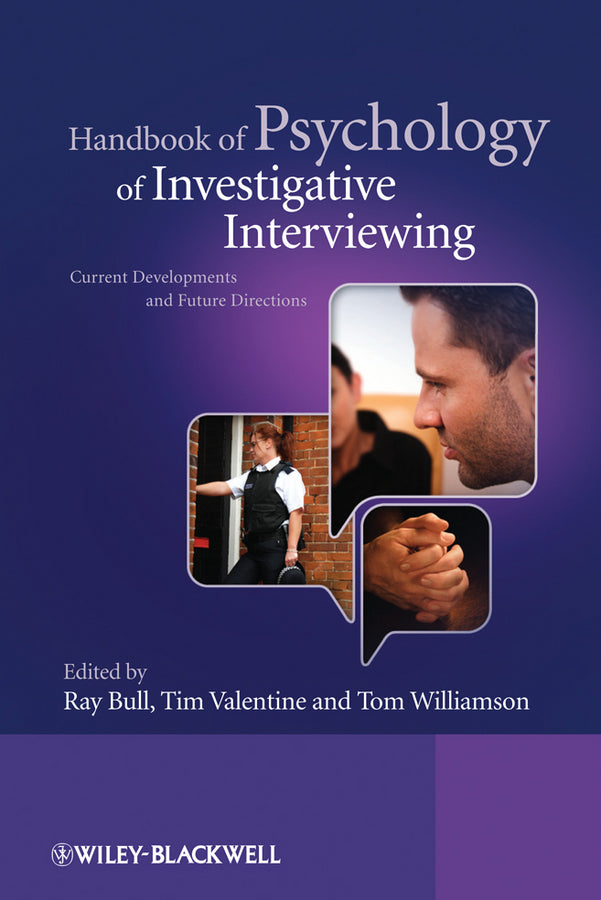
Handbook of Psychology of Investigative Interviewing
Current Developments and Future Directions
"In this book, experts from around the world outline the cutting edge of research and practice in investigative interviewing. This book is important reading for those interested in ensuring that investigative interviewing is both effective and ethical." "Bringing together the contributions of academics and practitioners who are leading authorities in the field, this handbook is essential reading for anyone wanting to update their knowledge and practice of investigative interviewing. Adopting an international perspective, this comprehensive text examines how changes in institutional practices, priorities and values in the post 9/11 climate have impacted the questioning of suspects. Empirical research and case studies are used to illustrate some of the common errors that can occur during an investigation. Among the topics covered are the interrogation of terror suspects for criminal justice and intelligence gathering purposes, suspects’ strategies and decision-making, false confessions, eyewitness testimony, the questioning of vulnerable witnesses, cross-examination in the courtroom and the detection of truths and lies in forensic contexts. Informed by scientific research and knowledge about best practice this international handbook will be a valuable resource for researchers, students and legal professionals for many years to come."
–Associate Professor Mark Kebbell, ARC Centre of Excellence in Policing and Security (CEPS) and School of Psychology, Griffith University, Brisbane, Australia
–Professor Amina Memon, School of Psychology, University of Aberdeen, Scotland, UK
Ray H. Bull (Edited by), . Bull (Author), Tim Valentine (Edited by), Tom Williamson (Edited by)
9780470512685, Wiley
Paperback / softback, published 11 September 2009
360 pages
24.5 x 17 x 2.1 cm, 0.626 kg
Investigative interviewing, and the information obtained from witnesses and victims, plays a vital role in criminal investigations. This comprehensive handbook explores current developments taking place in this rapidly developing field.
About the Editors. About the Contributors. Preface. Chapter 1 The Psychology of Suspects’ Decision-Making during Interrogation (Michel St-Yves and Nadine Deslauriers-Varin). Chapter 2 A Typology of Denial Strategies by Suspects in Criminal Investigations (Stephen Moston and Geoffrey M. Stephenson). Chapter 3 A Structured Model for Investigative Interviewing of Suspects (Jannie van der Sleen). Chapter 4 Finding False Confessions (Peter J. van Koppen). Chapter 5 The Investigation of Terrorist Offences in the United Kingdom: The Context and Climate for Interviewing Offi cers (John Pearse). Chapter 6 From Criminal Justice to Control Process: Interrogation in a Changing Context (David Dixon). Chapter 7 Major Crime (Investigative Powers) Act 2004: The Chief Examiner and Coercive Powers (Damien B. Maguire). Chapter 8 The Relation between Consistency and Accuracy of Eyewitness Testimony: Legal versus Cognitive Explanations (Ronald P. Fisher, Neil Brewer and Gregory Mitchell). Chapter 9 The Cognitive Interview: Research and Practice across the Lifespan (Robyn E. Holliday, Charles J. Brainerd, Valerie F. Reyna and Joyce E. Humphries). Chapter 10 Investigative Interviewing in the Courtroom: Child Witnesses under Cross-Examination (Rachel Zajac). Chapter 11 Recovered Memories (James Ost). Chapter 12 Obtaining and Interpreting Eyewitness Identifi cation Test Evidence: The Infl uence of Police–Witness Interactions (Neil Brewer and Gary L. Wells). Chapter 13 Recent Developments in Eyewitness Identifi cation Procedures in the United Kingdom (Tim Valentine, Carwyn Hughes and Rod Munro). Chapter 14 A Method to Enhance Person Description: A Field Study (Samuel Demarchi and Jacques Py). Chapter 15 Recent Developments in North American Identifi cation Science and Practice (Steven D. Penrod and Margaret Bull Kovera). Chapter 16 Truthfulness in Witnesses’ and Suspects’ Reports (A. Daniel Yarmey). Chapter 17 Evaluating Truthfulness: Detecting Truths and Lies in Forensic Contexts (Barry S. Cooper, Hugues Hervé and John C. Yuille). Index.
Subject Areas: Psychology [JM]