Freshly Printed - allow 7 days lead
Couldn't load pickup availability
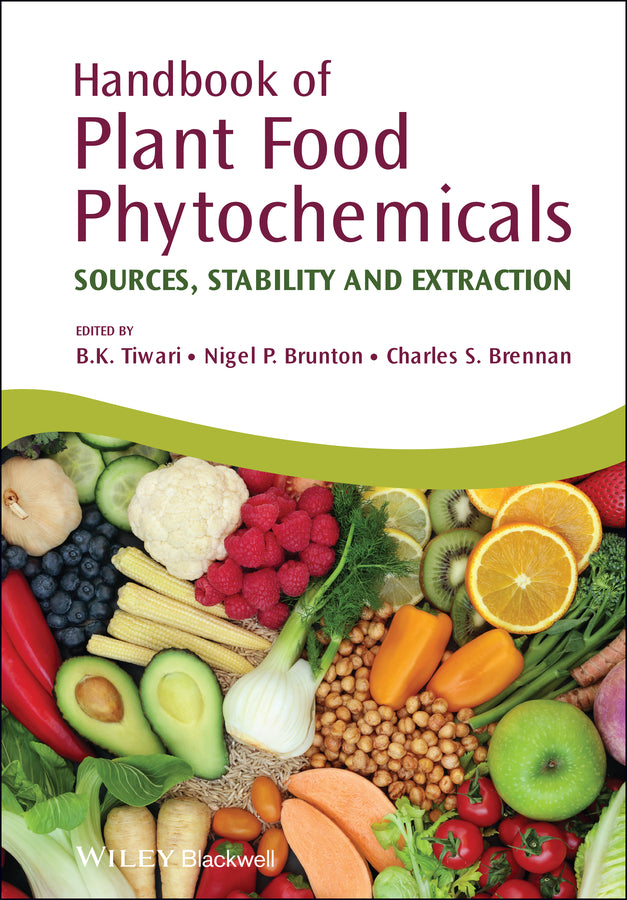
Handbook of Plant Food Phytochemicals
Sources, Stability and Extraction
Brijesh K. Tiwari (Edited by), Nigel P. Brunton (Edited by), Charles Brennan (Edited by)
9781444338102, Wiley
Hardback, published 22 February 2013
528 pages
25.2 x 17.8 x 2.8 cm, 1.175 kg
“This book provides a comprehensive overview of the occurrence, significance and factors affecting phytochemicals in plant foods . . . It covers the processing techniques aimed at the production of phytochemical-rich foods that can have a role in disease prevention, making it ideal for the food industry and those who are researching the health benefits of particular foods.” (South African Food Science and Technology magazine, 1 May 2015)
Handbook of Plant Food Phytochemicals Phytochemicals are plant-derived chemicals which may bestow health benefits when consumed, whether medicinally or as part of a balanced diet. Given that plant foods are a major component of most diets worldwide, it is unsurprising that these foods represent the greatest source of phytochemicals for most people. Yet it is only relatively recently that due recognition has been given to the importance of phytochemicals in maintaining our health. New evidence for the role of specific plant food phytochemicals in protecting against the onset of diseases such as cancers and heart disease is continually being put forward. The increasing awareness of consumers of the link between diet and health has exponentially increased the number of scientific studies into the biological effects of these substances. The Handbook of Plant Food Phytochemicals provides a comprehensive overview of the occurrence, significance and factors affecting phytochemicals in plant foods. A key objective of the book is to critically evaluate these aspects. Evaluation of the evidence for and against the quantifiable health benefits being imparted is expressed in terms of the reduction in the risk of disease conferred through the consumption of foods that are rich in phytochemicals. With world-leading editors and contributors, the Handbook of Plant Food Phytochemicals is an invaluable, cutting-edge resource for food scientists, nutritionists and plant biochemists. It covers the processing techniques aimed at the production of phytochemical-rich foods which can have a role in disease prevention, making it ideal for both the food industry and those who are researching the health benefits of particular foods. Lecturers and advanced students will find it a helpful and readable guide to a constantly expanding subject area.
Contributor list xiii 1 Plant food phytochemicals 1 1.1 Importance of phytochemicals 1 1.2 Book objective 2 1.3 Book structure 2 Part I CHEMISTRY AND HEALTH 5 2 Chemistry and classification of phytochemicals 7 2.1 Introduction 7 2.2 Classification of phytochemicals 8 2.3 Chemical properties of phytochemicals 21 2.4 Biochemical pathways of important phytochemicals 34 3 Phytochemicals and health 49 3.1 Introduction 49 3.2 Bioavailability of phytochemicals 50 3.3 Phytochemicals and their health-promoting effects 55 3.4 General conclusions 63 4 Pharmacology of phytochemicals 68 4.1 Introduction 68 4.2 Medicinal properties of phytochemicals 69 4.3 Phytochemicals and disease prevention 78 4.4 Phytochemicals and cardiovascular disease 82 4.5 Phytochemicals and cancer 88 4.6 Summary and conclusions 95 Part II SOURCES OF PHYTOCHEMICALS 105 5 Fruit and vegetables 107 5.1 Introduction 107 5.2 Polyphenols 107 5.3 Carotenoids 113 5.4 Glucosinolates 117 5.5 Glycoalkaloids 120 5.6 Polyacetylenes 121 5.7 Sesquiterpene lactones 123 5.8 Coumarins 124 5.9 Terpenoids 125 5.10 Betalains 125 5.11 Vitamin E or tocols content in fruit and vegetables 126 5.12 Conclusions 129 6 Food grains 138 6.1 Introduction 138 6.2 Phytochemicals in cereal grains 139 6.3 Phytochemicals in legume grains 144 6.4 Stability of phytochemicals during processing 149 6.5 Food applications and impact on health 152 6.6 Cereal-based functional foods 152 6.7 Legume-based functional foods 153 7 Plantation crops and tree nuts: composition, phytochemicals and health benefits 163 7.1 Introduction 163 7.2 Composition 165 7.3 Phytochemicals content 167 7.4 Health benefits 174 8 Food processing by-products 180 8.1 Introduction 180 8.2 Phytochemicals from food by-products 181 8.3 By-products from fruit and vegetables 187 8.4 Tuber crops and cereals 189 8.5 Extraction of bioactive compounds from plant food by-products 190 8.6 Future trends 190 Part III Impact of procesing on phytochemicals 199 9 On farm and fresh produce management 201 9.1 Introduction 201 9.2 Pre-harvest factors affecting phytochemical content 202 9.3 Harvest and post-harvest management practices 218 9.4 Future prospects 222 10 Minimal processing of leafy vegetables 235 10.1 Introduction 235 10.2 Minimally processed products 236 10.3 Cutting and shredding 237 10.4 Wounding physiology 238 10.5 Browning in lettuce leaves 240 10.6 Refrigerated storage 241 10.7 Modified atmosphere storage 242 10.8 Conclusions 243 11 Thermal processing 247 11.1 Introduction 247 11.2 Blanching 248 11.3 Sous vide processing 250 11.4 Pasteurisation 251 11.5 Sterilisation 254 11.6 Frying 255 11.7 Conclusion 257 References 257 12 Effect of novel thermal processing on phytochemicals 260 12.1 Introduction 260 12.2 An overview of different processing methods for fruits and vegetables 261 12.3 Novel thermal processing methods 261 12.4 Effect of novel processing methods on phytochemicals 264 12.5 Challenges and prospects/future outlook 268 12.6 Conclusion 269 13 Non thermal processing 273 13.1 Introduction 273 13.2 Irradiation 273 13.3 High pressure processing 281 13.4 Pulsed electric field 284 13.5 Ozone processing 286 13.6 Ultrasound processing 289 13.7 Supercritical carbon dioxide 291 13.8 Conclusions 292 Part IV STA BILITY OF PHYTOCHEMICALS 301 14 Stability of phytochemicals during grain processing 303 14.1 Introduction 303 14.2 Germination 304 14.3 Milling 307 14.4 Fermentation 312 14.5 Baking 315 14.6 Roasting 323 14.7 Extrusion cooking 324 14.8 Parboiling 327 14.9 Conclusions 327 References 327 15 Factors affecting phytochemical stability 332 15.1 Introduction 332 15.2 Effect of pH 335 15.3 Concentration 337 15.4 Processing 338 15.5 Enzymes 346 15.6 Structure 349 15.7 Copigments 350 15.8 Matrix 353 15.9 Storage conditions 357 15.10 Conclusion 363 16 Stability of phytochemicals at the point of sale 375 16.1 Introduction 375 16.2 Stability of phytochemicals during storage 375 16.3 Food application and stability of phytochemicals 381 16.4 Edible coatings for enhancement of phytochemical stability 382 16.5 Modified atmosphere storage for enhanced phytochemical stability 383 16.6 Bioactive packaging and micro encapsulation for enhanced phytochemical stability 384 16.7 Conclusions 387 Part V ANALYSIS AND APPLICAT ION 397 17 Conventional extraction techniques for phytochemicals 399 17.1 Introduction 399 17.2 Theory and principles of extraction 399 17.3 Examples of conventional techniques 405 17.4 Conclusion 409 18 Novel extraction techniques for phytochemicals 412 18.1 Introduction 412 18.2 Pressurised solvents 413 18.3 Enzyme assisted extraction 421 18.4 Non-thermal processing assisted extraction 423 18.5 Challenges and future of novel extraction techniques 426 19 Analytical techniques for phytochemicals 434 19.1 Introduction 434 19.2 Sample preparation 436 19.3 Non-chromatographic spectrophotometric methods 439 19.4 Chromatographic methods 442 20 Antioxidant activity of phytochemicals 452 20.1 Introduction 452 20.2 Measurement of antioxidant activity 453 20.3 Concluding remarks 465 21 Industrial applications of phytochemicals 473 21.1 Introduction 473 21.2 Phytochemicals as food additives 474 21.3 Stabilisation of fats, frying oils and fried products 481 21.4 Stabilisation and development of other food products 488 21.5 Nutracetical applications 492 21.6 Miscellaneous industrial applications 494 References 495 Index 502
B.K. Tiwari, Nigel P. Brunton and Charles S. Brennan
Rocio Campos-Vega and B. Dave Oomah
Ian T. Johnson
José M. Matés
Uma Tiwari and Enda Cummins
Sanaa Ragaee, Tamer Gamel, Koushik Seethraman, and El-Sayed M. Abdel-Aal
Narpinder Singh and Amritpal Kaur
Anil Kumar Anal
Kim Reilly
Rod Jones and Bruce Tomkins
Nigel P. Brunton
Bhupinder Kaur, Fazilah Ariffin, Rajeev Bhat, and Alias A. Karim
B.K. Tiwari, PJ Cullen, Charles S. Brennan and Colm P. O'Donnell
Laura Alvarez-Jubete and Uma Tiwari
Jun Yang, Xiangjiu He, and Dongjun Zhao
Pradeep Singh Negi
Niamh Harbourne, Eunice Marete, Jean Christophe Jacquier and Dolores O'Riordan
Hilde H. Wijngaard, Olivera Trifunovic and Peter Bongers
Rong Tsao and Hongyan Li
Ankit Patras, Yvonne V. Yuan, Helena Soares Costa and Ana Sanches-Silva
Juan Valverde
Subject Areas: Agriculture & farming [TV]