Freshly Printed - allow 7 days lead
Couldn't load pickup availability
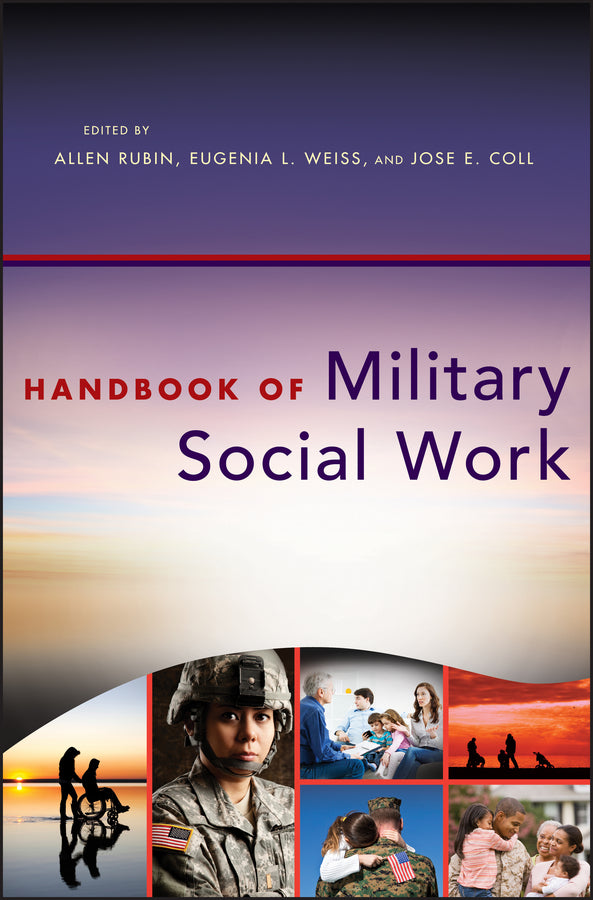
Handbook of Military Social Work
"This is an important book for anyone interested in providing care for our recent veterans and their loved ones. It provides a sophisticated, thoughtful orientation for non- military clinicians. The discussion of Military Cultural and Diversity is especially comprehensive and brings together concepts that clinicians need to understand if they are to provide the best possible treatment for our military and their families. I highly recommend it!" "This text is a vital work for social work students as well as practitioners who are or plan to be engaged with veterans and their families. The chapters' authors represent a "who's who" of leading researchers and practitioners as they delve into "the wide range of challenges, strengths, and interventions that social works need to learn about...." The text is also built around the CSWE's 2008 Educational Policy and Accreditation Standards while reflecting an evidence-based approach to practice. All social workers should become familiar with this important work. Rubin, Weiss, and Coll call us to stand firmly by our professional and civic responsibilities to these warriors and their families. To do otherwise would be the social work profession's shame." "Wow, this is an extremely comprehensive and easy to read handbook regarding all aspects of military social work. The authors and editors have done a fantastic job of covering military life from the perspective of the serving members, veterans and their families. This handbook will be of use to students through to experienced practitioners." "The editors of this handbook have literally written to meet EPAS Core Competencies of the field of social work. The twenty-six chapters provide a comprehensive guide to understanding and helping within the military culture. This book fills a void in military social work and will become one of the most referenced handbooks of its kind." "This text is a comprehensive and invaluable resource. It has relevance for all health professionals helping services members and families impacting by recent military operations." "An excellent text that offers a lot of valuable information to social work students or professionals (especially non-veterans), who want to serve this population. Service members are a unique population because of their experience in war and the dramatic impact that can have on them and their families. An understanding of this culture is essential in order to provide them the services they need to reintegrate successfully." "This book is a superb collection that will inform, educate, and inspire both social work students and practitioners in their commitment to provide the very best services to service members and their families. The challenges facing military personnel and their families are daunting. This volume meets a critical need in the preparation of practitioners who will meet those needs in the target population. I endorse it most highly."
—Judith Broder, M.D., Founder/Director The Soldiers Project
—Ira C. Colby, DSW, LCSW, Dean and Professor of Social Work, University of Houston
—Nicola T. Fear, Ph.D, Reader in Epidemiology, King’s Centre For Military Health Research, King's College, London
—Prof. Charles R. Figley, Ph.D., The Paul Henry Kurzweg, MD Distinguished Chair in Disaster Mental Health at Tulane University and School of Social Work Professor and Associate Dean for Research
—Col Rakesh Jetly, OMM, CO, MD, FRCPC, Psychiatrist and Mental Health Advisor to Surgeon General of Canada, Ottawa, Canada
—Stephen Peck, MSW, USMC, Vietnam Veteran, President/CEO, United States Veterans Initiative
—Julia M. Watkins, Ph.D., Executive Director Emerita, Council on Social Work Education, Alexandria, VA
Allen Rubin (Edited by), Eugenia L. Weiss (Edited by), Jose E. Coll (Edited by)
9781118067833, Wiley
Hardback, published 15 February 2013
608 pages
25.9 x 18.5 x 4.6 cm, 1.157 kg
"This is a desktop resource that students, educators, clinicians, clients, and those not in the field of social work can immediately use. This text scores high in readability, is easy to understand, and has applicability to almost any circumstance confronting social workers today…. The Handbook of Military Social Work is an awesome tool!" (The New Social Worker)
The need has never been more crucial for community health providers, programs, and organizations to have access to training in addressing the unique behavioral health challenges facing our veterans, active duty military, and their families. Handbook of Military Social Work is edited by renowned leaders in the field, with contributions from social work professionals drawing from their wealth of experience working with veterans, active duty military, and their families. Handbook of Military Social Work considers: Offering thoughtful advice covering the spectrum of issues encountered by mental health professionals working with individuals and families, Handbook of Military Social Work will contribute to the improvement of efforts to help our military personnel, veterans, and their families deal with the challenges they face.
Foreword xiii Preface xvii Acknowledgments xxi Introduction: Understanding and Intervening With Military Personnel and Their Families: An Overview xxiii About the Editors xxxiii About the Contributors xxxv Part I: Foundations of Social Work With Service Members and Veterans 1 A Brief History of Social Work With the Military and Veterans 3 2 Military Culture and Diversity 21 3 Women in the Military 37 4 Ethical Decision Making in Military Social Work 51 5 Secondary Trauma in Military Social Work 67 Part II: Interventions for the Behavioral Health Problems of Service Members and Veterans 7 The Neurobiology of PTSD and Cognitive Processing Therapy (CPT) 99 8 Treating Combat-Related PTSD With Virtual Reality Exposure Therapy 113 9 Psychopharmacology for PTSD and Co-Occurring Disorders 141 10 Traumatic Brain Injury (TBI) and the Military 163 11 TBI and Social Work Practice 179 12 Assessing, Preventing, and Treating Substance Use Disorders in Active Duty Military Settings 191 13 Preventing and Intervening With Substance Use Disorders in Veterans 209 14 Suicide in the Military 225 Part III: Veterans and Systems of Care 15 Homelessness Among Veterans 247 16 Navigating Systems of Care 271 17 Transitioning Veterans Into Civilian Life 281 Part IV: Families Impacted by Military Service 18 A Brief History of U.S. Military Families and the Role of Social Workers 301 19 Cycle of Deployment and Family Well-Being 313 20 Supporting National Guard and Reserve Members, and Their Families 335 21 The Exceptional Family Member Program: Helping Special Needs Children in Military Families 359 22 Grief, Loss, and Bereavement in Military Families 383 23 The Stress Process Model for Supporting Long-Term Family Caregiving 409 24 Family-Centered Programs and Interventions for Military Children and Youth 427 25 Couple Therapy for Redeployed Military and Veteran Couples 443 26 Theory and Practice With Military Couples and Families 467 Appendix: Veteran Organizations and Military Family Resources 493 Glossary of Military Terms 517 Author Index 531 Subject Index 551
Allen Rubin
Allen Rubin and Helena Harvie
Jose E. Coll, Eugenia L. Weiss, and Michael Metal
Eugenia L. Weiss and Tara DeBraber
James G. Daley
Allen Rubin and Eugenia L. Weiss
6 Posttraumatic Stress Disorder (PTSD) in Veterans 81
Jeffrey S. Yarvis
Jimmy Stehberg, David L. Albright, and Eugenia L. Weiss
Suzanne Leaman, Barbara Olasov Rothbaum, JoAnn Difede, Judith Cukor, Maryrose Gerardi, and Albert “Skip” Rizzo
Bruce Capehart and Matt Jeffreys
Cynthia Boyd and Sarah Asmussen
Margaret A. Struchen, Allison N. Clark, and Allen Rubin
Allen Rubin and Willie G. Barnes
Rachel Burda-Chmielewski and Aaron Nowlin
Colanda Cato
Edward V. Carrillo, Joseph J. Costello, and Caleb Yoon Ra
Jennifer Roberts
Jose E. Coll and Eugenia L. Weiss
Jesse Harris
Keita Franklin
Christina Harnett
Barbara Yoshioka Wheeler, Deborah McGough, and Fran Goldfarb
Jill Harrington-LaMorie
Monica M. Matthieu and Angela B. Swensen
Gregory A. Leskin, Ediza Garcia, Julie D’Amico, Catherine E. Mogil, and Patricia E. Lester
Kathryn Basham
Eugenia L. Weiss, Tara DeBraber, Allison Santoyo, and Todd Creager
Prepared by James A. Martin, Keita Franklin, Jeffrey S. Yarvis, Jose E. Coll, and Eugenia L. Weiss
Jose E. Coll
Subject Areas: Psychology [JM]