Freshly Printed - allow 7 days lead
Couldn't load pickup availability
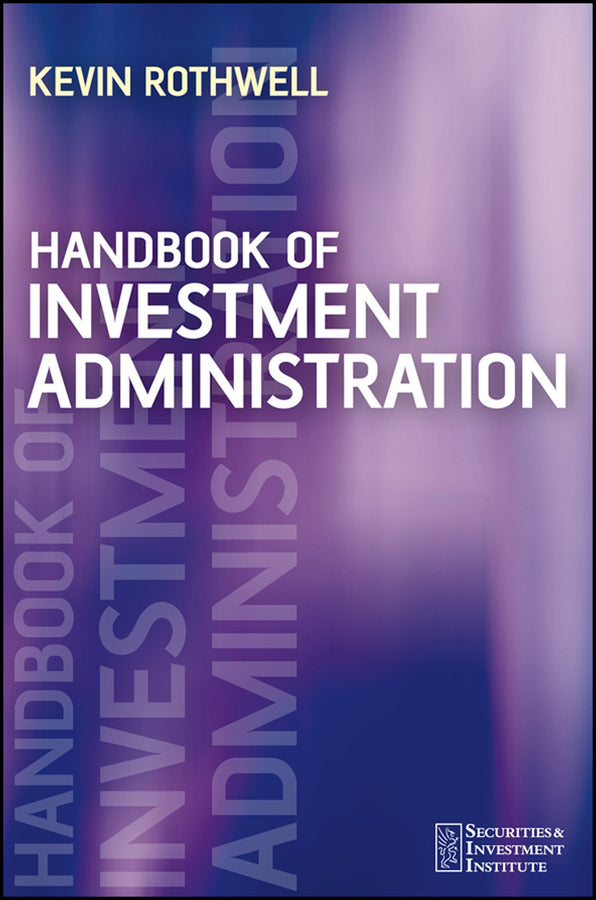
Handbook of Investment Administration
K Rothwell (Author)
9780470033623, Wiley
Paperback / softback, published 12 October 2007
520 pages
22.9 x 15.2 x 2.8 cm, 0.74 kg
Investment Administration has a key role to play in the many and varied investment products and services that are available in the retail investment marketplace. Kevin Rothwell’s Handbook of Investment Administration provides a comprehensive and readable source of both background and practical information for the practitioner. The Handbook takes the main aspects of investment administration and drills down into the detail of these from a retail perspective. It covers areas that are unique to the private client business such as trusts. It explains the background on why processes are undertaken providing as essential reference aid for the practitioner. Key features include:
About the Author xiii Introduction xv Part I: Introductory Elements 1 1 Wealth Management 3 1.1 Introduction 4 1.2 Wealth management market 5 1.3 Types of business 7 1.4 Investment services and products 11 1.5 Investment firms 19 1.6 Investment administration 27 Part II: Investment Administration 31 2 New and Closing Business 33 2.1 Introduction 34 2.2 New business 35 2.3 Client types 38 2.4 Know your customer 42 2.5 Agreements 46 2.6 Account opening 47 2.7 Money laundering 49 2.8 Validating the assets 52 2.9 Transferring assets 55 2.10 Raising assets 57 2.11 Closing business and transfers 59 2.12 Death of a client 67 3 Trading 77 3.1 Introduction 78 3.2 Stock market developments 79 3.3 Equity trading 81 3.4 Bond trading 94 3.5 Regulation 100 4 Settlement 107 4.1 Introduction 108 4.2 Fundamentals of settlement 108 4.3 Settlement process 123 4.4 UK settlement 129 4.5 International settlement 145 5 Corporate Actions 151 5.1 Introduction 152 5.2 Corporate actions industry 152 5.3 Types of event 154 5.4 Private client corporate action processing 160 5.5 Corporate events 172 5.6 Income events 190 Part III: other Considerations 207 6 Custody 209 6.1 Introduction 210 6.2 Protection of client assets 210 6.3 Segregation of safe custody assets 211 6.4 Use of a custodian 212 6.5 Nominee companies 213 6.6 Global custodians 215 6.7 Selecting a custodian 216 6.8 Custody agreements and SLAs 218 6.9 Reviewing the suitability of custodians 221 7 Tax 225 7.1 Introduction 226 7.2 Income tax 226 7.3 Tax treatment of dividends 231 7.4 Capital gains tax 238 7.5 Residence and domicile 247 7.6 Withholding tax 250 7.7 EU savings directive 256 8 Powers of Attorney 259 8.1 Introduction 260 8.2 Background 260 8.3 Parties and terminology 261 8.4 Enduring power of attorney 263 8.5 Receiverships 269 8.6 Mental capacity act 2005 273 8.7 Administration 275 9 Outsourcing 285 9.1 Introduction 286 9.2 Development of outsourcing 287 9.3 Risks associated with outsourcing 289 9.4 Regulatory principles 294 Part IV: Investment Accounts And Products 303 10 Individual Savings Accounts (isas) 305 10.1 Introduction 306 10.2 Development of ISAs and PEPs 306 10.3 Organisation and regulation 308 10.4 Individual savings accounts 314 10.5 Allowable investments 318 10.6 New and closing business 319 10.7 Voids and repairs 326 10.8 Residence 329 10.9 Investor reporting 332 10.10 Reform of the ISA regime 336 11 Collective Investment Schemes 339 11.1 Introduction 340 11.2 Regulation of UK funds 341 11.3 Types of UK funds 344 11.4 Fund administration 349 11.5 Pricing 350 11.6 Dealing and settlement 355 11.7 Share register 357 11.8 Dividend and interest distributions 358 11.9 Investor reporting 360 12 Trusts 363 12.1 Introduction 364 12.2 Development of trusts 364 12.3 Fundamentals of trusts 367 12.4 Investment administration 386 13 Charities 399 13.1 Introduction 400 13.2 What is a charity? 400 13.3 Legal background to investment by charities 402 13.4 Trustee investment powers and duties 406 13.5 Investment policy 411 13.6 Appointing an investment manager 413 13.7 Common investment funds 415 13.8 Use of nominees and custodians 416 14 Self-invested Personal Pensions 419 14.1 Introduction 420 14.2 Development of SIPPs 421 14.3 What is a SIPP? 423 14.4 Setting up a SIPP 425 14.5 Eligibility and contributions 426 14.6 Permitted investments 426 14.7 Benefits 428 15 Derivative Products 431 15.1 Introduction 432 15.2 Types of derivatives 433 15.3 Uses of derivates 438 15.4 Derivatives markets 440 15.5 Structured products 444 15.6 Covered warrants 451 15.7 Exchange traded commodities 457 15.8 Contracts for difference 459 Glossary 463 Bibliography 481 Reading Material 483 Index 487
Subject Areas: Finance & accounting [KF]