Freshly Printed - allow 7 days lead
Couldn't load pickup availability
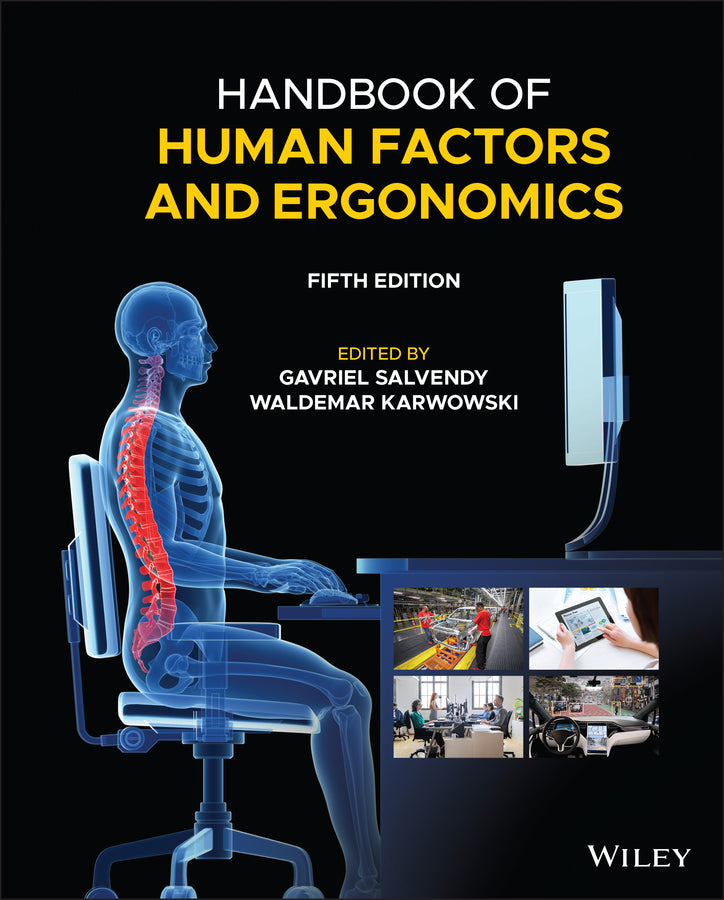
Handbook of Human Factors and Ergonomics
Gavriel Salvendy (Edited by), Waldemar Karwowski (Edited by)
9781119636083, Wiley
Hardback, published 4 October 2021
1600 pages
25.7 x 20.6 x 6.4 cm, 2.903 kg
Review of the fifth edition by Thomas B. Sheridan, Ford Professor Emeritus of Engineering and Applied Psychology, MassachusettsInstitute of Technology
The fifth edition of the Handbook of Human Factors and Ergonomics is the most authoritative and comprehensive reference work in the field.
Review of the fourth edition and comment on the fifth edition by Donald A. Norman, Director and Co-Founder, University of California, San Diego Design Lab.
I’m often asked for reading suggestions, especially for references to the literature on Human Factors and Ergonomics. In the past few months, I have been reading chapters of one book that has it all: Gavriel Salvendy’s massive tome, the Handbook of Human Factors and Ergonomics. The articles are all excellent. They all reflect up-to-date reviews of the areas they cover. They are wonderful self-study material, wonderful references, and would make excellent material in multiple courses. Consider it as essential piece of professional equipment.
If you don’t know human factors, this is a great way to find the parts relevant to your work. And even if you are an expert, this book will be valuable because it is unlikely that you are expert at all the topics covered here, yet very likely you will need some of the ones you are not (yet) expert at.
I follow my own advice. I consider myself an expert (I am a Fellow of the Human Factors Society), but I still learn each time I read from these pages.
The 5th edition has new – and very important – chapters written by the authorities in each topic. It has kept up with the times and become even more valuable as both a text and a reference.
From the Foreword to the second edition by John F. Smith, Jr., Chairman of the Board, Chief Executive Officer and
President, General Motors Corporation
The publication of this second Handbook of Human Factors and Ergonomics is very timely. It is a comprehensive guide that contains practical knowledge and technical background on virtually all aspects of physical, cognitive, and social ergonomics. As such, it can be a valuable source of information for any individual or organization committed to providing competitive, high-quality products and safe, productive work environments.
From the Foreword to the first edition by E. M. Estes, Retired President, General Motors Corporation
Regardless of what phase of the economy a person is involved in, this handbook is a very useful tool. Every area of human factors from environmental conditions and motivation to the use of new communications systems, robotics, and business systems is well covered in the handbook by experts in every field.
In der neu überarbeiteten fünften Auflage des Handbook of Human Factors and Ergonomics präsentieren Dr. Gavriel Salvendy und Waldemar Karwowski eine umfassende Untersuchung der Gestaltung von Arbeitsumgebungen, Mensch-Maschine-Schnittstellen und die neueste Forschung zur Verringerung von Gesundheits- und Sicherheitsrisiken. Die Herausgeber haben praxisorientierte Arbeiten von einem internationalen Team führender Experten auf dem Gebiet der Ergonomie und menschlichen Faktoren zusammengestellt, die sowohl für Fachleute auf diesem Gebiet als auch für Sicherheitsingenieure und Spezialisten für Mensch-Computer-Interaktion von Interesse sind.
Das Handbuch enthält Informationen aus über 7500 Quellen und bietet die neuesten Erkenntnisse zu Themen wie künstliche Intelligenz, soziale Medien, Informationstechnologie und Cybersicherheit sowie Datenanalyse. In zahlreichen Fallstudien wird die praktische Anwendung der darin besprochenen Konzepte und Methoden gezeigt, und es werden die außergewöhnlichen Entwicklungen auf diesem Gebiet seit Veröffentlichung der vierten Auflage im Jahr 2012 vorgestellt.
Dieses Werk bietet seinen Leserinnen und Lesern außerdem:
* Eine gründliche Einführung in die Wirkung der menschlichen Faktoren, insbesondere im Bereich menschliche Faktoren und Ergonomie sowie Gestaltung und Integration menschlicher Systeme
* Eine Untersuchung der Grundlagen menschlicher Faktoren, darunter Empfindung und Wahrnehmung, Auswahl und Handlungskontrolle, Informationsverarbeitung und mentale Belastung
* Erwägungen zur Gestaltung von Ausrüstung, Aufgaben, Tätigkeiten und Arbeitsumgebungen, insbesondere der Arbeitsplatzgestaltung, Analyse und Gestaltung von Aufgaben und der Nutzung von Schulungssystemen
* Eine eingehende Betrachtung der Gestaltung im Hinblick auf Gesundheit, Sicherheit und Komfort, vor allem hinsichtlich Muskel-Skelett-Erkrankungen im unteren Rückenbereich und in den oberen Extremitäten sowie bei der Verwendung von persönlicher Schutzausrüstung
Das Handbook of Human Factors and Ergonomics eignet sich perfekt für Ingenieure, die sich mit den Bereichen Ergonomie und menschliche Faktoren beschäftigen, und zwar auf jeder Ebene ihrer Laufbahn. Es hat auch einen Platz in den Bibliotheken von Fachleuten verdient, die in den Bereichen Designtechnik, angewandte Psychologie und Mensch-Computer-Interaktion tätig sind, sowie von Leitern von Konstruktions- und Technikabteilungen, Sicherheitsfachleuten und Industriehygienikern.
About the Editors ix Contributors xi Foreword xxi Preface xxiii 1. Human Factors Function 1 1. The Discipline of Human Factors and Ergonomics 3 2. Human Systems Integration and Design 38 2. Human Factors Fundamentals 55 3. Sensation and Perception 57 4. Selection and Control of Action 91 5. Information Processing 114 6. Decision-Making Models, Decision Support, and Problem Solving 159 7. Mental Workload 203 8. Social and Organizational Foundation of Ergonomics: Multi-Level Systems Approaches 227 9. Emotional Design 236 10. Cross-Cultural Design 252 3. Design of Equipment, Tasks, Jobs, and Environments 281 11. Three-Dimensional (3D) Anthropometry and Its Applications in Product Design 283 12. Basic Biomechanics and Workplace Design 303 13. The Changing Nature of Task Analysis 358 14. Workplace Design 368 15. Job and Team Design 383 16. Design, Delivery, Evaluation, and Transfer of Effective Training Systems 414 17. Situation Awareness 434 4. Design for Health, Safety, and Comfort 457 18. Sound and Noise: Measurement and Design Guidance 459 19. Vibration and Motion 494 20. Human Errors and Human Reliability 514 21. Occupational Safety and Health Management 573 22. Managing low-Back Disorder Risk in the Workplace 597 23. Manual Materials Handling: Evaluation and Practical Considerations 630 24. Warnings and Hazard Communications 644 25. Use of Personal Protective Equipment 668 5. Human Performance Modeling 685 26. Mathematical Modeling in Human–Machine System Design and Evaluation 687 27. Modeling and Simulation of Human Systems 704 28. Human Supervisory Control of Automation 736 29. Digital Human Modeling in Design 761 30. Extended Reality (XR) Environments 782 31. Neuroergonomics 816 6. System Evaluation 843 32. Accident and Incident Investigation 845 33. Human Factors and Ergonomics Audits 853 34. Cost/Benefit Analysis for Human Systems Investments 880 7. Human–Computer Interaction 893 35. Data Visualization 895 36. Representation Design 947 37. Collecting and Analyzing User Insights 960 38. Usability and User Experience: Design and Evaluation 972 39. Website Design and Evaluation 1016 40. Mobile Systems Design and Evaluation 1037 41. Human Factors in Ambient Intelligence Environments 1058 42. Human-Centered Design of Artificial Intelligence 1085 43. Cybersecurity, Privacy, and Trust 1107 44. Human–Robot Interaction 1121 45. Human Factors in Social Media 1143 8. Design for Individual Differences 1187 46. Design for All in Digital Technologies 1189 47. Design for People Experiencing Functional Limitations 1216 48. Design for Aging 1249 49. Design of Digital Technologies for Children 1287 9. Selected Applications 1305 50. Human Factors and Ergonomics Standards 1307 51. Data Analytics in Human Factors 1351 52. Human Factors and Ergonomics in Design of A3: Automation, Autonomy, and Artificial Intelligence 1385 53. Human Factors and Ergonomics in Health Care 1417 54. Human Factors and Ergonomics in Digital Manufacturing 1438 55. Human Factors and Ergonomics in Aviation 1460 56. Human Side of Space Exploration and Habitation 1480 57. Human Factors and Ergonomics for Sustainability 1512 Index 1529
Waldemar Karwowski and Wei Zhang
Guy A. Boy
Robert W. Proctor and Janet D. Proctor
Robert W. Proctor and Kim-Phuong L. Vu
Christopher D. Wickens and C. Melody Carswell
Mark R. Lehto and Gaurav Nanda
G.M. Hancock, L. Longo, M.S. Young, and P.A. Hancock
Pascale Carayon
Feng Zhou, Yangjian Ji, and Roger Jianxin Jiao
Tom Plocher, Pei-Luen Patrick Rau, Yee-Yin Choong, and Zhi Guo
Liang Ma and Jianwei Niu
William S. Marras and Waldemar Karwowski
Erik Hollnagel
Nicolas Marmaras and Dimitris Nathanael
Frederick P. Morgeson and Michael A. Campion
Tiffany M. Bisbey, Rebecca Grossman, Kareem Panton, Chris W. Coultas, and Eduardo Salas
Mica R. Endsley
John G. Casali
Neil J. Mansfield and Michael J. Griffin
Peng Liu, Renyou Zhang, Zijian Yin, and Zhizhong Li
Jeanne Mager Stellman, Sonalee Rau, and Pratik Thaker
William S. Marras and Waldemar Karwowski
Fadi A. Fathallah and Ira Janowitz
Michael S. Wogalter, Christopher B. Mayhorn, and Kenneth R. Laughery, Sr.
Grażyna Bartkowiak, Krzysztof Baszczyński, Anna Bogdan, Agnieszka Brochocka, Anna Dąbrowska, Rafał Hrynyk, Emilia Irzmańska, Danuta Koradecka, Emil Kozłowski, Katarzyna Majchrzycka, Krzysztof Makowski, Anna Marszałek, Magdalena Młynarczyk, Rafał Młyński, Grzegorz Owczarek, and Janżera
Changxu Wu and Yili Liu
Gunther E. Paul
Thomas B. Sheridan
Vincent G. Duffy
Kay M. Stanney, Hannah Nye, Sam Haddad, Kelly S. Hale, Christina K. Padron, and Joseph V. Cohn
Hasan Ayaz and Frédéric Dehais
Patrick G. Dempsey
Colin G. Drury and Patrick G. Dempsey
William B. Rouse and Dennis K. McBride
Sumanta N. Pattanaik and R. Paul Wiegand
John M. Flach, Kevin B. Bennett, Jonathan W. Butler, and Michael A. Heroux
Matthias Peissner, Kathrin Pollmann, and Nora Fronemann
James R. Lewis and Jeff Sauro
Kim-Phuong L. Vu, Robert W. Proctor, and Ya-Hsin Hung
June Wei and Siyi Dong
Constantine Stephanidis, Margherita Antona, and Stavroula Ntoa
George Margetis, Stavroula Ntoa, Margherita Antona, and Constantine Stephanidis
Abbas Moallem
Jessie Y.C. Chen and Michael J. Barnes
Qin Gao and Yue Chen
Constantine Stephanidis
Gregg C. Vanderheiden, J. Bern Jordan, and Jonathan Lazar
Jia Zhou and Qin Gao
Panos Markopoulos, Janet C. Read, and Michail Giannakos
Waldemar Karwowski, Redha Taiar, David Rodrick, Bohdana Sherehiy, and Robert R. Fox
Matt Holman, Guy Walker, Melissa Bedinger, Annie Visser-Quinn, Kerri McClymont, Lindsay Beevers, and Terry Lansdown
Ben D. Sawyer, Dave B. Miller, Matthew Canham, and Waldemar Karwowski
Pascale Carayon, Kathryn Wust, Bat-Zion Hose, and Megan E. Salwei
Dieter Spath and Martin Braun
Steven J. Landry
Kevin R. Duda, Dava J. Newman, Joanna Zhang, Nicolas Meirhaeghe, and H. Larissa Zhou
Klaus Fischer, Andrew Thatcher, and Klaus J. Zink
Subject Areas: Electronics & communications engineering [TJ]